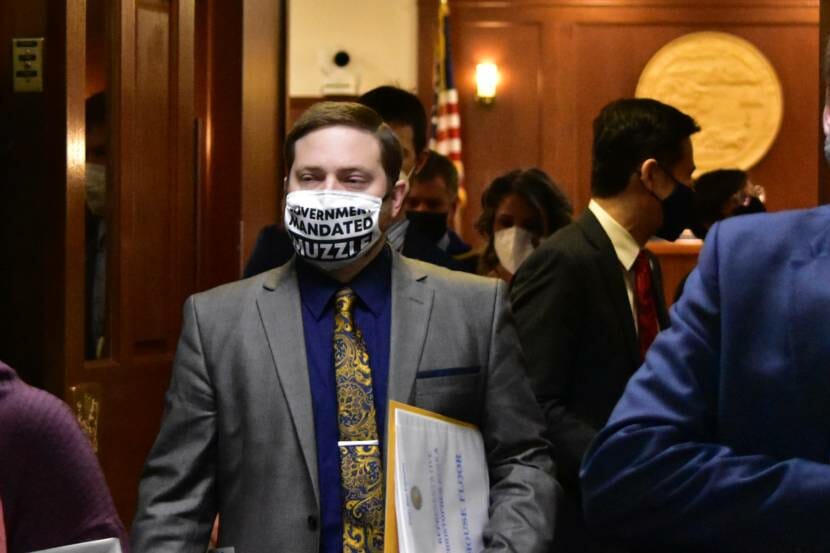
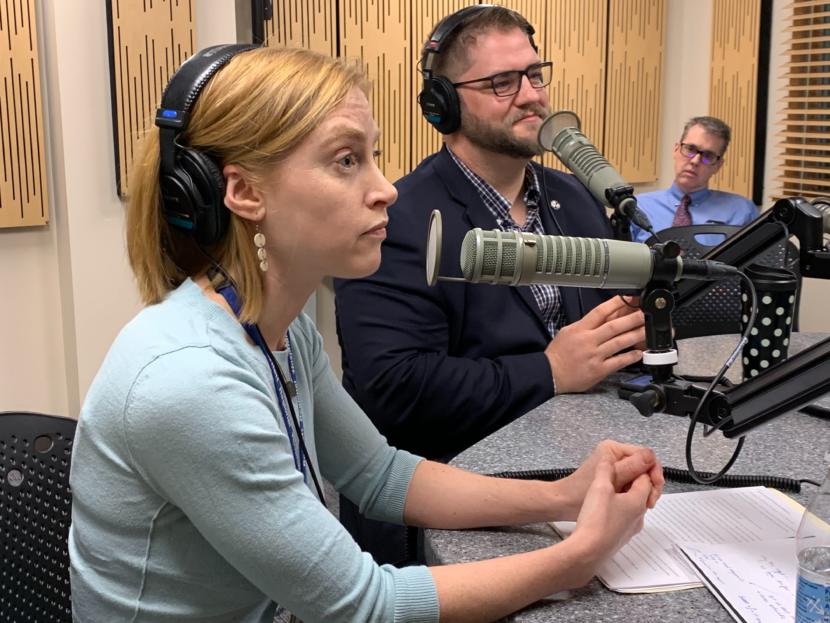
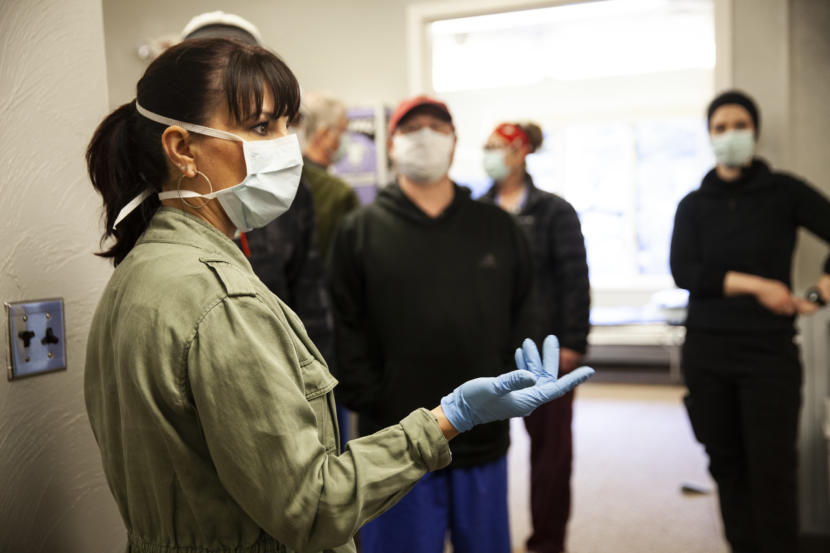
Rep. Chris Kurka, R-Wasilla, leaves the chambers of the Alaska House of Representatives on Friday, March 19, 2021. Kurka proposed a budget amendment intended to cut Medicaid funding for abortions on Wednesday, April 6, 2022 (Peter Segall/Juneau Empire via AP, pool)
Rep. Christopher Kurka, R-Wasilla, proposed the amendment. He is running for governor this year.
“The legislature has consistently said we don’t want to pay for abortions,” he said. “I think it’s high time to stop using intent language. We again, like last year, put this language in the budget to make it very clear that this body is not interested in paying for abortions.”
The amendment passed 21-18. Lawmakers who oppose the measure say it’s likely to be signed into law even though similar measures were found to be unconstitutional.
Rep. Kevin McCabe, R-Big Lake, supported the amendment. He said future court rulings could turn out differently.
“I don’t really care if we have to run it through courts 100 times,” he said. “Let’s run it through the courts. Maybe we’ll get a different outcome.”
Planned Parenthood has won two state Supreme Court cases against similar legislation in the last twenty-one years. Rep. Andy Josephson, D-Anchorage, was among the lawmakers opposed.
“The court said that reproductive choice is a private matter — protected — and will be treated like other women’s health issues. And if we can’t prohibit, for example, a mammogram, then we can’t prohibit an abortion,” he said.
Planned Parenthood is Alaska’s largest provider of reproductive health services through Medicaid. Rose O’Hara-Jolley, the state director of Planned Parenthood Alliance Advocates, calls the amendment a cruel and inequitable restriction on access to people with low incomes.
“It’s creating a system where people who don’t have wealth are being told that they aren’t allowed to have medical decisions anymore, that the state is making them for them. So there will still be access to abortion. But it will be for those who are wealthy,” they said.
O’Hara-Jolley said women would have to pay out of pocket for services related to abortions if the amendment becomes law.
“Medicaid covers nearly one in three American Indian and Alaska Native adults,” O’Hara-Jolley said, referring to people who are on Medicaid in Alaska. “So this inequity just further exacerbates links to racism, sexism and economic inequality — for people of color specifically.”
The House is still considering budget amendments. If the amendment remains in the House’s final budget proposal, it will move to the Senate for approval before going to the governor’s desk for a signature.
Editors note: This story has been edited to clarify that out of people who are on Medicaid in Alaska — not nationwide — one in three are American Indian or Alaska Native.
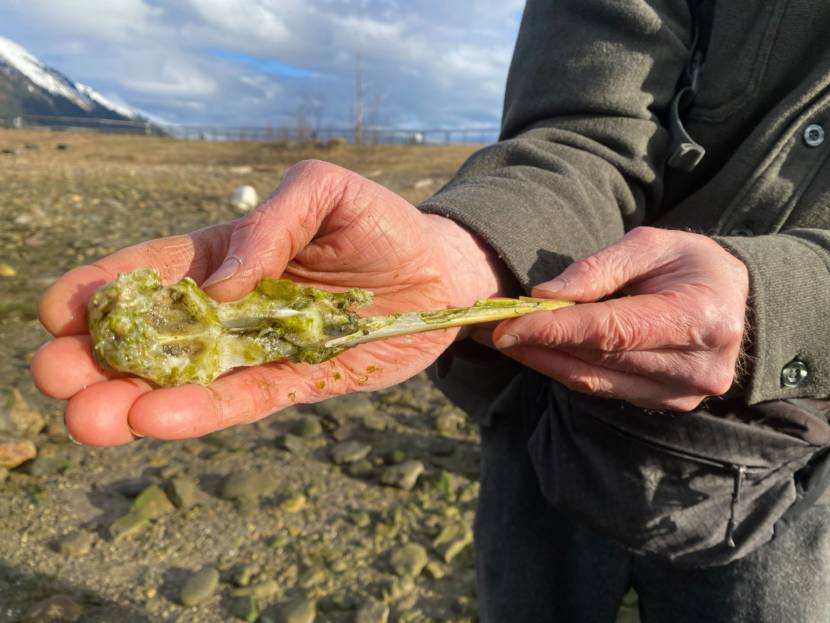
Richard Carstensen holds a heron skull near the Juneau Seawalk. April 4, 2022. (Stremple, KTOO)
“Oh-ho, look at this,” naturalist Richard Carstensen calls out to his friend and colleague Steve Merli.
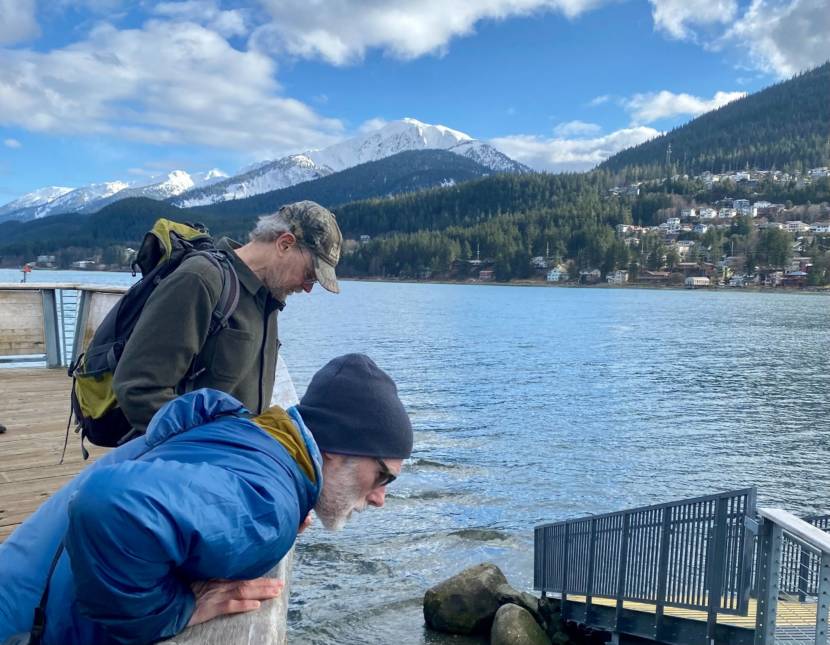
The men squat below the high tideline, just off the path at the downtown Juneau Seawalk. They’re studying part of a cream-colored skull with a long beak. Carstensen measures it with the length of his hand, then gently plucks it out of the damp earth.
“Could be a heron, could be a sandhill crane,” Carstensen says, “And I’m trying to rule out sandhill crane.”
The two men were among the founding members of Discovery Southeast, an outdoor education non-profit for youth and families. This summer the organization will partner with some veteran trackers to lead a certification course aimed at adults.
Wilderness trackers read signs in the natural world to find and identify animals. It’s useful for hunting, conservation and photography. But it’s more than just finding an animal, paw print or bone, they say. It’s understanding the context. For example, Carstensen can see signs that somewhere on the road from bird to skeleton, that heron was a meal.
Richard Carstensen and Steve Merli evaluate the tide at Juneau’s Seawalk. (Stremple/KTOO)
It doesn’t seem like this beach in downtown Juneau would be a tracking hotspot — while they’re examining the skull, a plane flies overhead and evening traffic whizzes by. Yet they spotted a dozen goats on a nearby mountainside, found the sternum of a gull and identified the skull they found as a heron’s.
Merli says it’s all about observing and letting curiosity be your guide.
“Everything is a track, and every track tells a story,” he said. “We can just look at all this stuff that’s around us. There’s all kinds of sign here.”
The track and sign course is likely to take place a bit more off the beaten path.
It’s an intensive 2-day workshop that will teach students to think like Merli and Carstensen — to identify prints and understand how wildlife interacts with landscape.
Former Juneauite Kevin O’Malley will host the workshop through his wilderness school near Seattle. He says the ecology of Southeast Alaska is exciting for trackers because of big animals like bears and mountain goats. Six people around the world have already signed up. A few are Juneau locals, and one plans to come from as far as Central Asia, he said.
Marcus Reynerson from Tracker Certification North America will teach the course. He is one of only ten evaluators who can certify new trackers for the program. He says it’s the first time his organization has offered a tracker certification in Alaska.
“Really, at the basis, wildlife tracking is just pattern recognition,” he said. “And humans have kind of evolved to read patterns.”
A tracker certification can be useful for certain jobs, like naturalist or resource management positions. It’s also a way to measure personal growth, like the belt system in karate. Reynerson is kind of like a black belt in field ecology.
He says tracking is just another lens through which to view the living world.
“There’s this very old kind of aspect to it, that’s in our bones, that’s in our DNA, that’s in our humanity, where we just do it. And so when you turn that lens on reading the signs and the tracks of animals around, you can really tap into a rich story.”
There will be a test with up to 60 questions that range from simple to complex. Reynerson says not to sweat it too much. At the end of the day, your interpretation of the natural world is still up to you.
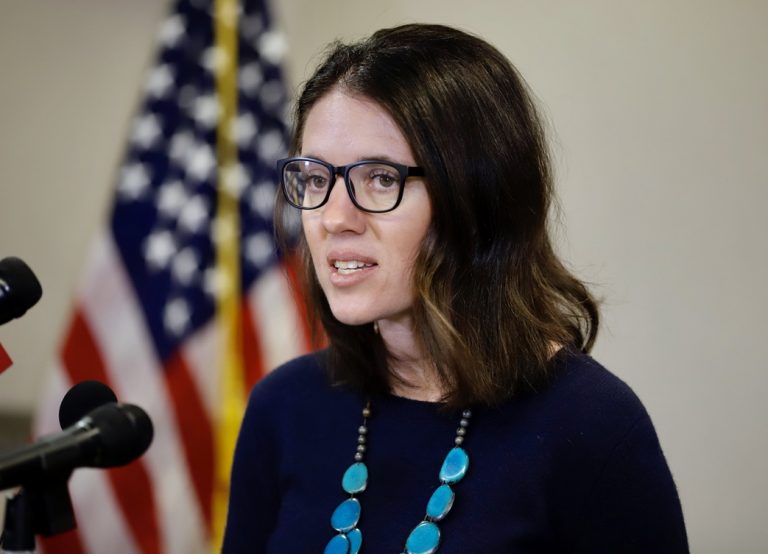
Alaska Chief Medical Officer Anne Zink talks to reporters at a press conference about the coronavirus on Monday, March 9, 2020. (Joey Mendolia/Alaska Public Media)
Municipalities across the state have dropped pandemic restrictions, but a lot of people are still getting COVID-19. KTOO’s Claire Stremple checked in with Alaska Chief Medical Officer Dr. Anne Zink to talk about this moment of living with COVID while many are ready to move on.
Listen here:
The transcript below has been lightly edited for clarity.
Claire Stremple: So, I myself got COVID last week — maybe you can hear some lingering congestion in my voice. It was a strange moment, after spending two years working to avoid getting sick, to get COVID while I’m hearing about a “post-pandemic” world. And I wasn’t alone. A lot of people I know here in Juneau are also getting sick lately.
How is public health thinking about this moment? And how about your colleagues who work in clinical settings?
Dr. Zink: Yeah, I think it’s continued to change throughout the pandemic. You know, we really have very different tools in 2022 than we did in 2020. It’s never fun to be sick, and so I’m sorry that you got sick. And it can be, I think, particularly — it’s sometimes, for many, frightening after, as you mentioned, avoiding it for many years. Because we don’t know the long term implications of the disease.
We’re learning a lot. And we know a lot more now than we did beforehand. There’s also no shame in getting COVID. And so we know it’s a highly, highly contagious virus that just moves quickly from person to person, so I think we need to make sure that we just recognize that as well. It’s just a virus, and it’s just contagious, and people are going to get it overall.
[I’m] not surprised that many vaccinated people are getting COVID-19 right now, as it is so transmissible. But what’s great is to see some of our lowest hospitalization rates during the whole pandemic, is what we’re seeing right now. And we’re just not seeing the same rate of people getting really sick, needing to go to the emergency department, being hospitalized and dying from this disease.
It’s still happening — still admit people all the time in the emergency department. But nothing like we saw, particularly during the delta wave. We got hit so hard in this state by the delta wave, and then what we saw, particularly in other states and other countries early on.
Claire Stremple: Speaking of the metrics that we’re looking at, we relied on case counts for a long time to understand what was happening with the pandemic in our communities. Some people checked them every day, like the weather. Hospital numbers are a really important indicator. Now, as you mentioned, what’s the state plan for tracking cases and tracking the virus going forward?
Dr. Zink: We’ve always known from the beginning that we have not identified every case. We identified a lot of cases, particularly at the beginning, but we have never identified all the cases. There was asymptomatic spread, there were people who did not want to get tested.
And now we probably have an even higher likelihood that we’re not seeing all the case numbers because people are doing home testing [and] home testing isn’t reported. They may be testing in different avenues, and we see a real change in that landscape. So we just recognize we’re not able to see all of the cases.
The same is true with influenza and with other diseases where they have really gone to a surveillance reporting, so, looking at the overall state and getting a sampling to have a good sense of what’s happening with that disease progression. And then we use those numbers in combination with other things, like you mentioned hospitalization data, what we call syndromic surveillance data, [which is] how many people are showing up to the emergency department and being diagnosed with COVID, being diagnosed with influenza, or showing up with symptoms that looks similar to that. So we want to make sure that we’re taking all of those things into consideration.
Claire Stremple: In Juneau, some people are calling this moment a “wave” of cases. A noticeable number of people are getting sick. And I’m wondering if you’re seeing that in other parts of the state or if the Juneau wave is showing up in data at all.
Dr. Zink: I think that, you know, a wave is definitely showing up in the media, and it is showing up a little bit in the data. But we’ve had other waves like this in other parts of the state. But you know, this is a time when a lot of people’s eyes are on Juneau, given the legislative session. So I think there’s a little bit of extra attention and focus in that region right now.
But we’ve seen this since the beginning of the pandemic, where, particularly with delta and then omicron, it just moves so fast that it will kind of sweep through a town or a region very, very quickly, just because it’s so transmissible. And then it moves to another region and moves to there.
I’ve often described it kind of like popcorn in our state. And so one region explodes with cases and then another one explodes with cases. But what we’re looking at in the state is kind of that sound overall. And then when it settles down, you can hear the individual pops a little bit easier. And so we kind of settle down, and so you’re hearing that Juneau pop I think a little bit more than you’re hearing the pops across other places.
Claire Stremple: Is there anything else you’d like to add? Maybe anything I didn’t ask you that you’d like to share or think is important.
Dr. Zink: Thanks for asking that. I think a lot of people ask like, “What should I do at this point in the pandemic?” And I think that the basics still apply. The biggest thing you can do is take care of your physical and mental health. It will make you more prepared to take on this virus or other things. So get outside, enjoy the sun, play, eat well. You know, the best source of vitamin D that we get is actually salmon in the state. That’s where the majority of us get it. So eating a balanced diet is incredibly important.
Two, making sure that you have a degree of protection. And the best way you can do that is getting vaccinated and staying up to date. And then you know, knowing that we’ve got treatments available, knowing that we have different resources.
Your masks work. Treatments make a huge difference. Make sure that if you are going to be going someplace high risk and you’re at risk, [that you’re] wearing a mask, using testing, and if you test positive, consider treatment. So just, the same tools apply, we just need to continue to use them and continue to build our overall health and wellbeing.
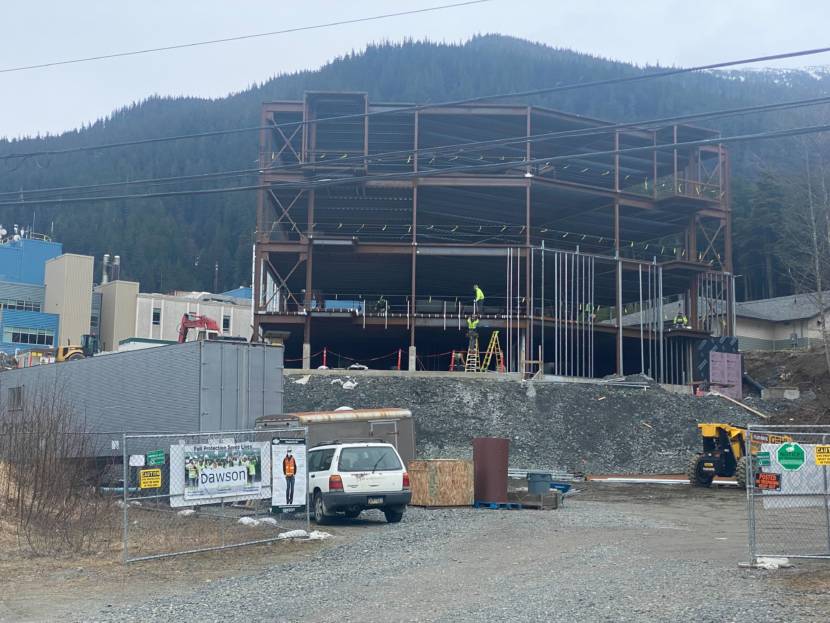
Construction workers at the site of Bartlett Regional Hospital’s new building for its behavioral health department. (Photo by Claire Stremple/KTOO)
The steel framing that’s now visible along Egan Drive south of Twin Lakes is the future home of Bartlett Regional Hospital’s behavioral health department. It’s been under construction since last June. It’s now expected to be finished later than originally planned and will cost more money.
The four-story building will house an outpatient care and crisis stabilization center. Hospital officials say it will be the first residential behavioral health care for youth and adults in the region. Bartlett currently sends youth patients to Anchorage for such care. Officials say there is no equivalent care for adults in the state.
The cost estimate for the project jumped from nearly $14 million to $18 million due to inflation and an increase in the cost of materials.
The building was originally scheduled to be completed late this year. Now the hospital estimates construction will last until Spring of 2023.
The upgrade comes as demand for behavioral health care continues to rise. Officials say there are about 50 people waiting for care after an initial assessment. The estimated wait time for a therapist is 8 weeks.
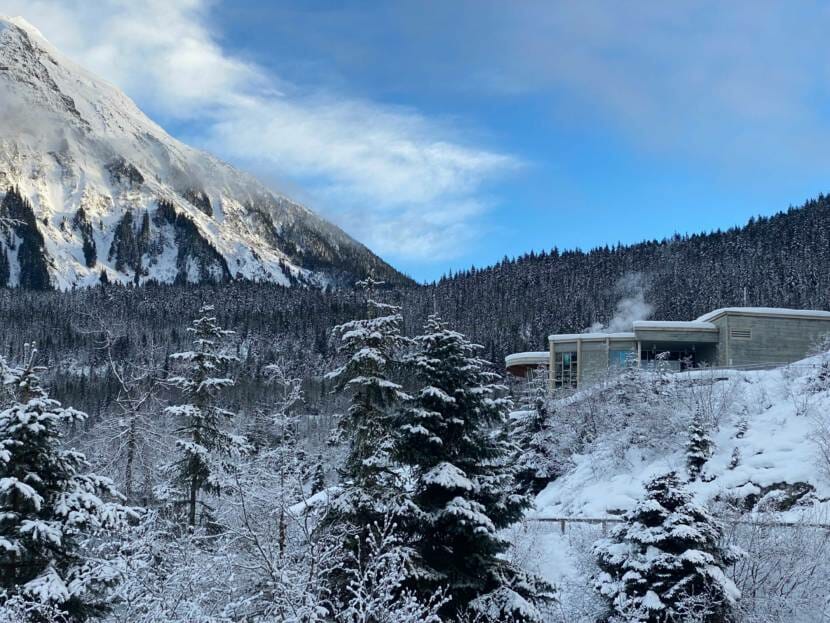
The Mendenhall Glacier Visitor Center in Juneau. December 2021. (Photo by Claire Stremple/KTOO)
The forest service is in the middle of a lengthy process that may lead to significant changes at the Mendenhall Glacier Recreation Area in Juneau. This month it released a document detailing the possible environmental impacts of different expansion options. The public has a chance to weigh in on those right now.
The original visitor center was built in the 1960s, but the glacier won’t be visible from there at all in a few decades. There’s also been a significant uptick in visitors since then. So the Forest Service has proposed expanded trails, a new welcome center and remote glacier facilities — plus motorized boat tours on the lake to get people closer to the receding ice.
A lengthy draft of the project’s environmental impact statement is available online, at Juneau public libraries and at the Mendenhall Visitor Center. A video summarizing the potential changes is available online.
The Forest Service will accept public comment until April 18. There’s also a chance to learn more and ask questions about the proposed work at an evening webinar on March 31.
Comments can be submitted online, via fax at 907-586-8808, or hand-delivered to 8510 Mendenhall Loop Road, Juneau, Alaska, 99801.
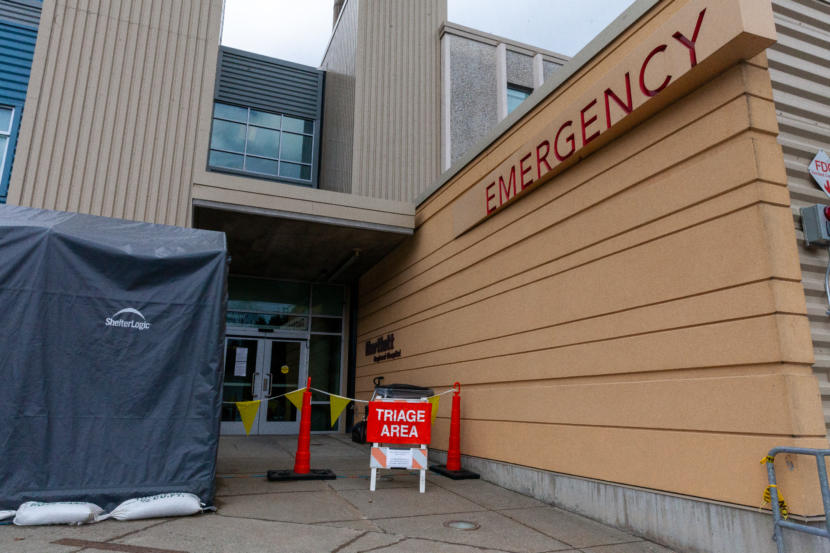
A triage tent is set up to screen patients for symptoms of COVID-19 outside on Monday, April 7, 2020 at Bartlett Hospital in Juneau, Alaska. (Photo by Rashah McChesney/KTOO)
Juneau’s Bartlett Regional Hospital is the first, and so far the only, hospital in the state to be cited by state workplace safety regulators for COVID-19 violations.
Hospital staff tipped off the state, leading investigators to find the city-owned hospital’s health and safety program inadequate. They issued more than a dozen citations.
Staff speaks out
The whistleblower was Laurie Bell. After years of pushing for a safer work environment at the hospital, she finally reached her breaking point over masks.
Bell used to work at the registration desk in Bartlett Regional Hospital’s Emergency Department. She and her coworkers were often the department’s first line of defense.
“We basically did all the grunt work before the patient would be seen by a nurse or doctor,” she said.
She said when the COVID-19 pandemic first spread into Alaska, they had a lot of exposure to the virus.
“There wasn’t enough [personal protective equipment] for everybody,” Bell said. “We were told that we were low risk and did not deserve personal protection.”
She said the hospital gave them one blue paper surgical mask per shift. She said that each time, she cited federal guidelines and asked for more protection.
“I was told that, in not-so-polite terms, that I didn’t know what I was talking about,” she said. “[That] I didn’t understand the science, even though everybody could go on the [Centers for Disease Control and Prevention] website and see what was recommended. And that I should just stick to what I know.”
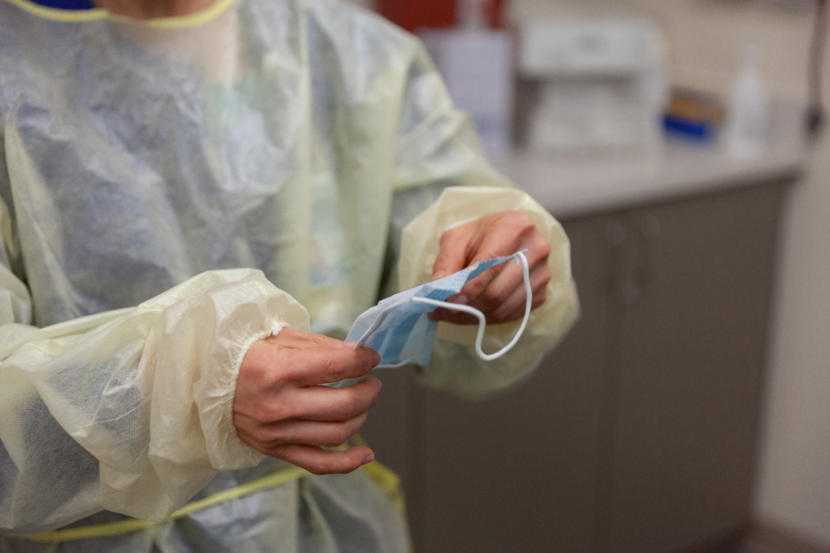
A nurse at Bartlett Regional Hospital demonstrates putting on personal protective equipment to handle a patient infected with COVID-19 on Monday, April 7, 2020 in Juneau. Bartlett is the first, and so far the only, hospital in the state to be cited by workplace safety regulators for COVID-19 violations. (Photo by Rashah McChesney/KTOO)
But one day a COVID patient came in whose partner wasn’t consistently wearing a mask. Bell said he was unruly near her desk.
“He was aggressive and yelling,” she said. “He camped out in the hallway just outside of the ER. But he would come in and pace in front of my desk, yelling at me that he needed to be back there with her.”
Bell says a manager gave the man a rapid test and allowed him to stay. She says she found out later that he tested positive for COVID-19 — and that was only after another nurse called her to warn her that she had been exposed.
Bell complained to her supervisors. Then she filed a complaint internally. She told a union representative. But she says nothing changed.
“If you speak to anybody in the hospital, they will tell you the reporting system is a joke and most people don’t even bother using it,” she said. “But I did, because I felt like, at least I can say I went through the appropriate channels as I was instructed to do. And it did nothing for me.”
So Bell reported Bartlett to state health and labor department regulators in late 2020. She left the hospital that December.
Regulators cite the hospital
After Bell blew the whistle, inspectors from the state’s health department and the department of labor showed up to figure out what was going on at the hospital.
Then the violations and citations started rolling in.
First, they came from the health department. Those inspectors make sure the hospital is safe for patients.
They documented at least one incident where a staff member reported having COVID-19 symptoms but was told to keep working after they tested. That person reported having contact with a lot of patients before their test came back positive six days later.
Those COVID-19 violations had to be addressed pretty quickly because Bartlett’s Medicare and Medicaid funding was at risk.
The second team of inspectors who went through the hospital were from the state’s department of labor. They make sure the hospital is a safe place to work.
Employees were supposed to be self-screening for COVID-19 symptoms and logging them when they got to work, but inspectors said the hospital’s own records showed that less than 57% of them were actually doing it in December of 2020.
When they released their final report in June of 2021, along with more than a dozen violations and fines, it wasn’t just the hospital’s COVID-19 protocols that were called into question. They also fined the hospital for how it handled workplace violence. Inspectors said the hospital wasn’t recording injuries and illnesses among staff properly and also raised concerns that the hospital was under-recording its injuries.
They also wrote that employees were never properly trained on responding to hazardous spills. They documented more than 130 employees who never learned how to deal with blood-borne pathogens, despite being regularly exposed to them on the job. Others had not gotten medical clearance or been properly fitted for N95 masks and respirators.
Charlee Gribbon, infectious disease preventionist from Bartlett Regional Hospital, left, answers questions about the coronavirus for a KTOO News special program on March 5, 2020. Gribbon says the learning curve for COVID safety was really high in the early days of the pandemic. (Photo by Rashah McChesney/KTOO)
Fit tests make sure hospital employees are wearing tight-fitting respirators that will seal properly and keep them from being exposed to airborne virus and bacteria.
“They got behind on their due dates,” said Bartlett Infection Preventionist Charlee Gribbon.
Employees are supposed to be checked yearly. State inspectors say more than two dozen people were overdue. The hospital instituted a new scheduling system to keep employee fit tests up to date.
Who is accountable for worker safety after top-level leadership shakeup?
Juneau didn’t get hit with COVID as hard as a lot of other communities.
The hospital took a lot of steps to improve and even hired a quality director to keep an eye on things. That safety team says the inspections helped the hospital.
“The importance of it and the safety aspect of it was reinforced for everybody,” Gribbon said. “So, you know, I was, like, grateful for the inspection because it makes us all better. You know, and if anybody is feeling unsafe, you know, we really need to dive into that.”
Gribbon says there’s more oversight now — that the learning curve was really high in the early days of the pandemic.
KTOO reached out to a number of current and former employees of Bartlett for this story. Gribbon was one of the few to take responsibility for failures in workplace safety.
The other person to take personal responsibility was former CEO Rose Lawhorne.
Lawhorne took over leadership of the hospital after the complaints had been filed, in April of 2021. She inherited this problem.
She told KTOO in 2021, “the buck stops with me.”
Former Bartlett Regional Hospital Chief Nursing Officer Rose Lawhorne walks through a newly converted spillover facility designed to house COVID-19 patients on Monday, April 7, 2020 in Juneau, Alaska. Whistleblower Laurie Bell says Lawhorne was one of the few leaders who checked in to make sure she felt safe. (Photo by Rashah McChesney/KTOO)
Lawhorne had worked at the hospital for decades, and she said she wasn’t surprised by the citations. Instead, she said she was ready to make changes.
“I have this gift of authority that I can empower them and say, ‘Yes, I approve. Yes, go ahead and provide additional training to the people who you feel need it,’” she said at the time.
Bell, the whistleblower, speaks highly of Lawhorne too. She says Lawhorne was one of the few leaders who checked in to make sure she felt safe.
That first sign of instability turned into a landslide of resignations at the highest levels of the hospital. Since the beginning of the pandemic, all but one member of the senior leadership team left.
The hospital is managed like a business, so it answers to a board of directors. But there was no public board meeting to discuss the state’s final inspection report when it came out.
In the end, Bartlett was fined almost $150,000 by workplace safety inspectors, but the state reduced that by nearly 70%.
The hospital won’t pay that reduced fine either. It will take advantage of a state law that lets them use that money to improve workplace safety and submit those receipts to the state.
One of the things the hospital bought with the funds is respiratory protection — that is, the kind of PPE Laurie Bell wanted back in 2020.
Contact KTOO reporter Claire Stremple
Correction: The state’s department of labor reduced fines for Bartlett Regional Hospital, not the Commissioner specifically.
Close
Update notification options
Subscribe to notifications
Subscribe
Get notifications about news related to the topics you care about. You can unsubscribe anytime.