An artist’s rendering of the coronavirus. (Illustration courtesy of the Centers for Disease Control and Prevention)
Alaska has begun testing for coronavirus within the state. And there have been no reported cases so far.
Gov. Mike Dunleavy announced on Monday in Anchorage that he will ask the Legislature for at least $4 million for public health nurses focused on coronavirus, as well as for expenses related to testing for the virus. The administration also is seeking legislative approval to accept $9 million in federal money.
“We want to make sure that we have protocols in place that once this virus arrives — and we think it probably will, just because of the way it’s spreading — that we’re prepared for it,” Dunleavy said.
He added that, “from a 30,000-foot level, we’re feeling pretty good about where we’re at and how things are going.”
Alaska’s Chief Medical Officer Dr. Anne Zink speaking at a press conference in Anchorage about the flight carrying 201 passengers from Wuhan, China, the epicenter of the coronavirus, that landed in Anchorage on Jan. 29. On Monday, she spoke at a press conference in Anchorage about the virus. (Photo by Zachariah Hughes/Alaska Public Media)
The state began testing on Feb. 27. That’s also the day the federal Centers for Disease Control and Prevention broadened its definition of who should be tested.
There have been three people tested in Alaska as of Monday morning, according to Dr. Anne Zink, the state’s chief medical officer. Two tested negative and one person’s case was still under investigation on Monday, since the state was waiting for the person’s sample to reach a testing facility. It takes approximately four hours to get the results from a test.
Zink said Alaskans should be prepared to stay at home for two weeks — with enough food and medicine — if public health authorities determine they’re at risk of having been exposed to the virus. She emphasizes the importance of healthy practices, like washing your hands and staying home with any sickness.
“What do you do if you get the sniffles?” she said. “You do the normal stuff that you should be doing, which is taking care of yourself. And that’s eating fresh fruits and vegetables, that’s getting outside and getting fresh air; that’s getting plenty of rest; that’s drinking plenty of water. That’s staying home if you’re sick; that’s not getting other people sick.”
Zink also said it’s not too late to get a flu shot. She said preventing flu cases could reduce the strain on the health care system from coronavirus.
The state has operated an emergency response center for coronavirus for five weeks. Dunleavy said the administration will begin giving legislators frequent coronavirus updates.
Zink says the state Department of Health and Social Services and CDC websites are good sources for coronavirus updates. And state public health nurses will be visiting communities to help them prepare for the virus.
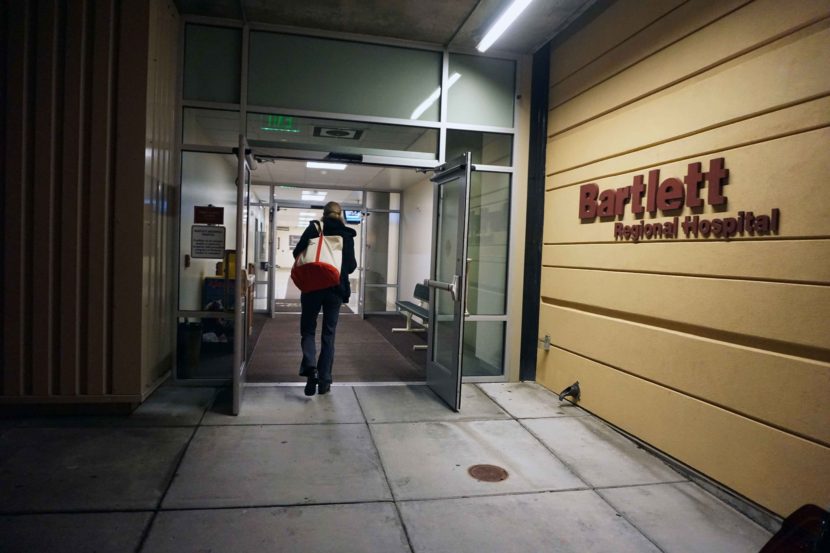
Emergency room entrance at Bartlett Regional Hospital. (Photo by Jennifer Canfield/KTOO)
There have been no reported cases in Juneau so far, but that doesn’t mean that the staff at Bartlett Regional Hospital isn’t preparing for the increasing possibility of that happening.
Charlee Gribbon, an infection prevention specialist, recently disputed rumors of there being a patient in isolation at Bartlett because of coronavirus.
“No. Nobody at the hospital that is under suspicion or is tested or even considered a case is here right now,” she said
In late February, Gribbon said they would test for coronavirus if someone with symptoms of a severe lower respiratory illness returned from China or had contact with someone who had. Now that recommendations from Centers for Disease Control and Prevention have changed, Gribbon says they would also test anyone who had any respiratory symptoms that were unexplained.
“(If it’s) a severe case of respiratory illness with no close contacts and no exposure risk to an area that’s got a high concentration of this virus, then that’s where we would talk to the state about doing this test,” she said.
They’d send a sample to the state for that test and if it came back positive, Louisa Castrodale, epidemiologist with Alaska Department of Health and Social Services, says they would investigate beyond that one patient.
“We would be working in concert with the health care providers and the family to figure out where they had been, who they might have been around, and figure out the next sequence of events for potentially those people who are exposed to this person and what would happen next,” Castrodale said.
That could be isolation either at home or at the hospital.
Gribbon says at Bartlett that would depend on the stage of the virus and whether the patient is suffering from any heart or lung complications.
Gribbon says she’s more concerned now with the virus so close, but it’s still not as widespread as the regular flu.
“So, your exposure risk traveling through Seattle and traveling through Washington, you may come into contact with it,” she said, “but still 80% of people aren’t getting that sick.”
Two people were admitted to Bartlett Regional Hospital in February because of complications from the flu and three hospital staff members were sent home for at least a week because they developed symptoms.
Whether it’s coronavirus or regular flu going around, Gribbon recommends good hand hygiene and respiratory etiquette, like keeping the mouth and nose covered when coughing or sneezing.
Anyone showing up at Bartlett with any symptoms of a respiratory illness will be asked to put on a mask if they didn’t bring their own.
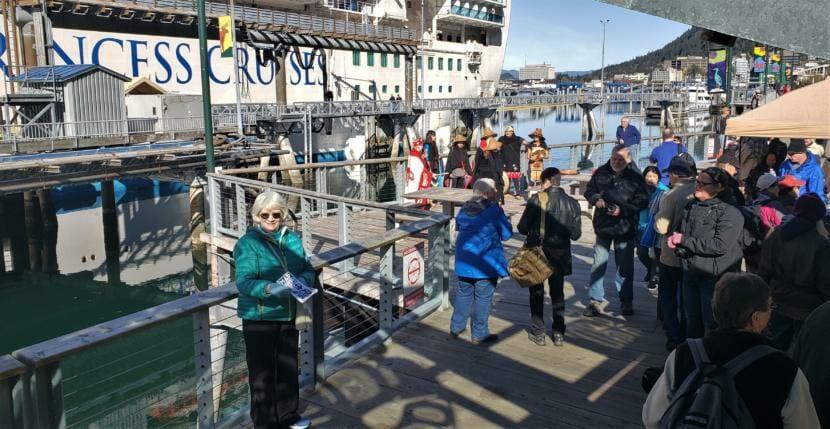
Vicki Logan of Travel Juneau greets and hands out walking maps to passengers of the Ruby Princess at the Franklin Dock on Sunday, April 28, 2019. It’s still unknown what impact the coronavirus outbreak that started in China will have on Alaska’s tourism economy in 2020. (Photo by Jeremy Hsieh/KTOO)
Alaska has no known cases of the coronavirus, but the outbreak that began in China has set off economic shockwaves that are already jolting Alaskans. For one, the virus crushed the stock market in the last week of February. Looking ahead, economists foresee several grim possibilities, but they’re not universally terrible.
One of the biggest unknowns is what the epidemic will mean for Alaska’s summer tourism. The vast majority of Alaska’s visitors come from other U.S. states, not China. But with a viral infection in the news, will they still want to crowd onto airplanes and cruise ships to get here?
Meilani Schijvens of Juneau said the coronavirus could actually boost Alaska tourism.
“Obviously, sometimes when there are world events, people have more comfort traveling domestically rather than abroad,” said Schijvens, who runs an economic analysis and research firm, Rain Coast Data. Her specialty is Southeast Alaska, so she keeps an eye on the cruise industry.
Images of the Diamond Princess stuck in Yokohama with thousands of passengers in quarantine wasn’t great advertising for booking a cruise, at least not in Asia.
Schijvens said cruise lines might reposition ships from Asia to Alaska.
“It actually might be the case where we could see increased ships, especially earlier in the season when there’s more openings in our ports,” she said.
That does appear to be happening: Cruise Lines International Association Alaska said at least two ships are leaving Asia earlier than scheduled, adding six voyages to their Alaska season. But don’t bank on it. In an email, a representative from the trade association warned things can change quickly.
Tourism jobs were expected to become the largest source of wages for Southeast this year for the first time ever, Schijvens said, because so many state government jobs have been cut from the budget. She said the seasonal nature of tourism magnifies variability.
“Because so much of our economic commerce happens in the summer, even micro-impacts to our industries could have significant effects on our economy,” she said.
Schijvens knows of one smaller ship that has cancelled a few sailings in Southeast.
Beyond tourism, Schijvens sees a slew of potential losses. Consider global shipping.
“If there’s some type of disruption in shipping, that could impact our mining sector. That could impact our seafood – getting our seafood to market. But it could also affect our access to food and freight,” she said.
It’s not that supermarket shelves would be empty. But Schijvens said a hitch in international cargo traffic might mean some regularly stocked items aren’t available.
Among the effects Alaska is already feeling, the biggest is probably what the virus has done to the world demand for oil.
“Oil prices have probably fallen by more than $5 a barrel,” said Neal Fried, an economist at the Alaska Department of Labor.
Lower oil prices mean the state has less revenue to spend. And low prices discourage the oil industry. Fried said the virus-induced price drop isn’t likely to derail projects already planned for this year.
“But, you know, it could take a little bit of the edge off the willingness of some investment to go forward,” Fried said. “Oil prices obviously are important when it comes to the oil industry and what decisions they make.”
Alaskans with money in the stock market are feeling the economic pain of the virus. When the markets drop, Fried said, Alaska’s Permanent Fund feels the pinch, too.
“And now that a fair amount of our (state) revenues are now flowing from the Permanent Fund earnings, you know, in the long run — I mean it’s too early to tell, but that also could have an impact,” he said.
It’s also too early to know if the market drop will result in lower dividends.
The worst-case scenario is, of course, widespread disease and some deaths. In addition to the human tragedy, it would also be expensive and ruinous to the economy. But, short of total catastrophe, one of the biggest economic costs would be if public facilities and workplaces have to close to prevent the virus from spreading.
“The CDC did recently suggest that people make preparations for their lives to be interrupted by an outbreak in the United States,” said Kevin Berry, an economist at the University of Alaska Anchorage who has studied the impact of epidemics. “So the potential costs of things like foregone childcare, closed schools and other interruptions to just business could be large.”
The Centers for Disease Control is recommending that Americans stock their pantries, refill important prescriptions and take steps to work from home, in case we have to hole up for a while.
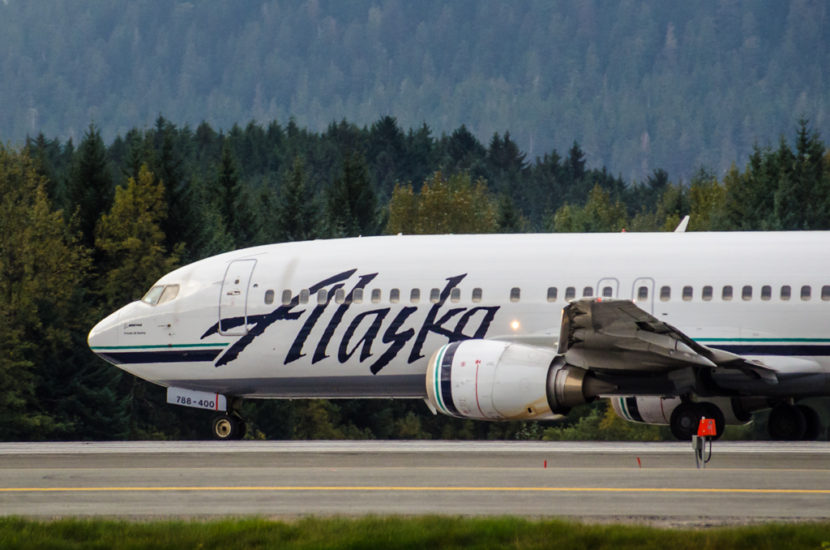
An Alaska Airlines plane at Juneau International Airport. (Photo by Heather Bryant/KTOO)
Alaska Airlines will allow passengers to change or cancel bookings made in the next two weeks without penalty in response to travel concerns from coronavirus.
The company announced Thursday, Feb. 27, that between now and March 12, any passenger can change or cancel a flight reservation and receive a full travel credit good for up to one year.
According to the press release, passengers will still have to pay any difference between fares for rebooked trips.
The temporary policy applies to all fare levels and to travel bookings through June 1.
Asked whether Alaska Airlines will consider expanding the policy beyond March 12, spokesman Tim Thompson said the company is continually monitoring the situation.
This story has been updated.
Correction: A previous version of this story implied that customers could cancel or change any Alaska Airlines reservations up until March 12 without paying a penalty. The policy only applies to reservations made between Feb. 27 and March 12.
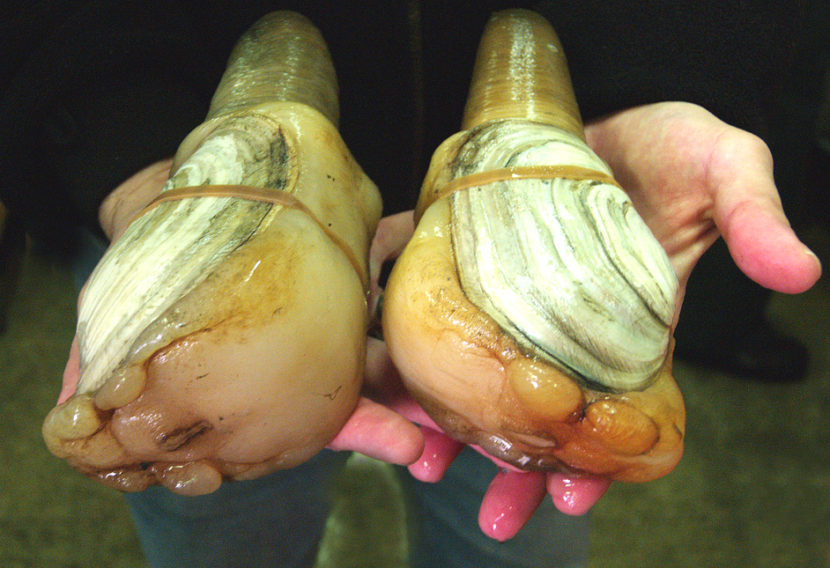
Geoducks are the largest burrowing clam in the world and can also live more than 100 years. The geoduck fishery is closed until at least March 5, 2020, due to a drop in demand from Chinese customers during the coronavirus outbreak. (Photo courtesy USDA)
Alaska geoduck clam divers are stuck sitting on the beach until at least March 5.
A group of fishermen who determine whether to open the fishery made the call on Thursday, Feb. 20, to keep it closed.
Geoduck clams are two- to three-pound clams that live in the waters of the Pacific Northwest. They’re harvested live and sold largely to customers in China. But the ongoing coronavirus outbreak has shuttered restaurants and seafood markets on the other side of the Pacific.
Geoducks are the largest burrowing clam in the world and can also live more than 100 years. (Photo courtesy USDA)
The geoduck clam is a weird looking animal. It looks a little like a regular, everyday steamer clam — but much bigger.
“It’s two and a half to three pounds in weight and then the neck on it — it can be up to a three foot long neck,” Phil Doherty said. He helps lead the Southeast Alaska Dive Fisheries Association, an organization of fishermen who scour the seabed looking for the giant bivalves along the coast of the Pacific Northwest.
Though geoducks are native to the Western Hemisphere, Doherty said, 95% of the catch gets sent across the Pacific to China.
Geoducks are considered a delicacy there, and their phallic shape has given them a reputation as an aphrodisiac. But Doherty said that with the recent coronavirus outbreak, demand has plummeted.
The coronavirus that emerged in late 2019 has infected more than 60,000 people, mostly in China. Though there haven’t been any confirmed cases in Alaska, geoduck clam fishermen are feeling ripple effects.
“All of the restaurants, or the vast, vast majority of restaurants are closed,” Doherty said. “The vast majority of seafood markets are closed.”
And there’s another wrinkle.
“It’s all a live market,” Doherty said. “And that’s where, kind of, the rub comes in.”
So that means that geoducks can’t exactly be frozen or canned and saved for later.
“You’re only looking at about a four-day window between harvesting the geoduck and wanting them sold,” said dive fisherman Jeremy Leighton.
Leighton spends most Wednesdays and Thursdays during the winter racing to fill his boat with up to a thousand pounds of geoduck clams. He sells his catch to buyers on the docks here in Ketchikan.
But lately, he hasn’t been fishing.
“Well, most of the divers are just uncertain about what’s going to happen,” he said. “We’re all sitting on the beach, hoping to go to work.”
Leighton said he can usually sell his haul for $5 to $10 per pound, sometimes more. But with the Chinese market essentially shut down, they’re going for about $1 a pound.
So, in January, divers held an emergency meeting of the geoduck committee — that’s a group of 20 undersea fishermen — to talk about what to do next.
Leighton chairs the committee, and he said it was a tough call.
“Some guys are broke now, and they want to go to work,” he said.
But he said a majority of divers decided that with prices so low, it just didn’t make sense.
Leighton said he’s seen the geoduck fishery shut down before — like during the severe acute respiratory syndrome, or SARS, outbreak in the early 2000s. But he said the scale and open-endedness of this outbreak have divers worried.
“To all of a sudden just shut down, everybody’s kind of in shock, you know, not expecting it,” he said, “and they’re just like, ‘okay, well, now what do we do?’”
Leighton said he’s got enough savings to scrape by until next winter if he has to. He said some divers will likely take their boats south to dive for sea urchins.
But for now, all Leighton can do is sit on the beach and hope he can get back to work on the seafloor soon.
The geoduck committee meets again Thursday, Feb. 20.
Close
Update notification options
Subscribe to notifications
Subscribe
Get notifications about news related to the topics you care about. You can unsubscribe anytime.