
Alaska coronavirus news

Live updates and information on COVID-19 in Juneau and Alaska

Is your Alaska doctor as worried about coronavirus as you are? Maybe not.

Inlet View Elementary sixth grader Ilsa Robinson, second from left, at the Anchorage airport for a trip to Washington, D.C., Feb. 28. Her mother, Julie Robinson, an Anchorage doctor, said she didn’t have anxiety about sending her daughter on the trip despite coronavirus concerns. (Photo courtesy of Dr. Julie Robinson)

When Dr. Julie Robinson of Anchorage dropped her 11-year-old daughter at the airport for a class trip to Washington, D.C., last week, she made sure the group boarded the plane with a few extra items.

“I met the group at the airport with a bag of wet wipes and bottles of hand sanitizer,” Robinson said.

Robinson felt good about letting her daughter travel across the country. For her, it wasn’t a tough call. But at Arete Family Medicine in Anchorage, where she’s a family practice physician, many of her patients are anxiously grappling with similar decisions.

“Especially with spring break next week, we’re just getting a lot of questions about travel,” Robinson said.

There are no confirmed cases of coronavirus in Alaska. The state is testing more patients every day and medical experts say the virus is likely to be discovered in the state soon. At local clinics and hospitals, doctors are fielding lots of questions. Many say they’re counseling patients to take COVID-19 seriously, but not to panic.

When addressing travel questions, Robinson tells each patient to think about their own health. Do they have chronic respiratory issues or another underlying health problem that could make them more susceptible to coronavirus, and more likely to contract severe symptoms if they do get the disease?

“And then also, do they have anxiety? A lot of patients who have underlying anxiety are really struggling with this decision about travel. And so if they’re otherwise a low-risk traveler, but they feel really anxious about it, that’s maybe a reason to stay home,” Robinson said.

For younger and healthy individuals, Robinson isn’t much more worried about coronavirus than she is about influenza, a more familiar virus that can be deadly for people in fragile health. She acknowledges there are a lot of unknowns. And she suspects Alaska cases will be confirmed soon, but tells her patients to be pragmatic.

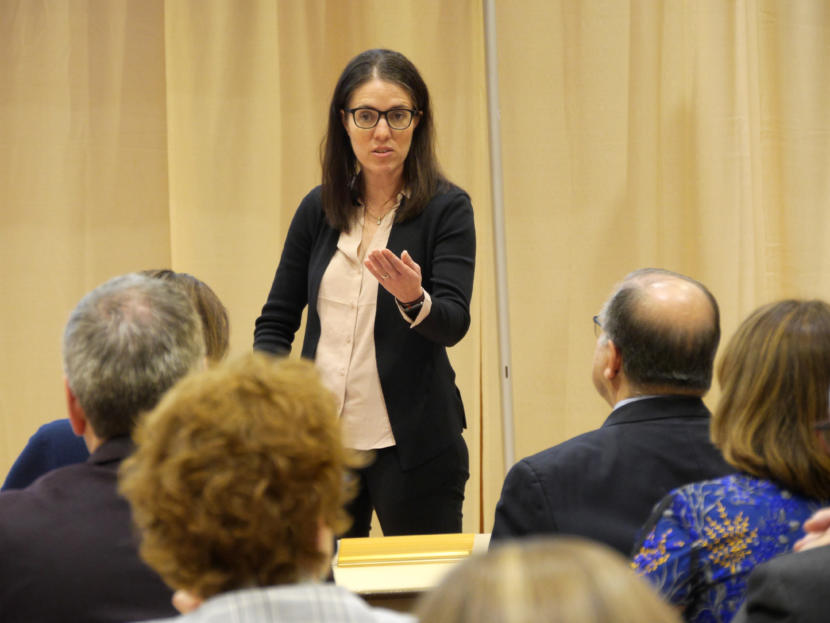
Michelle Laufer, a pediatrician at Medical Park Pediatrics in Anchorage, gives similar advice.

“I don’t think we should walk around necessarily being worried,” she said. “For the most part we just need to be conscious about preventing illness and then caring for ourselves if we become ill.”

Laufer said the hardest part for most patients is that there’s still a lot of uncertainty surrounding the coronavirus. She said reliable data is limited.

“We know that it’s a virus, we know that it’s relatively transmissible and that it can cause severe illness and even death. But the numbers around that and risk of that — it’s just unclear at this point,” she said.

Laufer said she expects the virus is already in Alaska, but hasn’t yet been detected. Her biggest frustration is that the state doesn’t have more capacity to test. The state has capacity to conduct fewer than 200 tests and doesn’t know when the Centers for Disease Control and Prevention will ship more. Laufer expects private labs will be able to test for coronavirus soon, but said it’s unclear if insurance will cover the cost.

At Providence Hospital this week, the state approved testing for two intensive care patients who didn’t have a travel history, according to regional chief medical officer Michael Bernstein. He said both tests came back negative. Bernstein describes the level of worry in Anchorage over coronavirus as moderate, which he said is appropriate.

“My sense within our community, honestly, is that the sense of concern is probably about where it needs to be,” he said. “It’s enough to get us to do a lot of preparation.”

Bernstein said the Providence Health System has canceled all travel meetings for at least the next month to ensure there are enough workers to address coronavirus.

Bernstein asks people wash their hands, refrain from touching their face and to get a flu vaccine if they haven’t already.

Julie Robinson, the family practice doctor, adds that Alaskans should eat healthy and exercise. She said people also tend to underestimate the importance of getting a good night of sleep for warding off any illness.

Other than that, she said, it’s a waiting game.

“I think people need to take a big breath and try to relax and we’ll see what happens,” she said.

See all of KTOO’s Alaska coronavirus coverage

Dunleavy’s town hall meetings suspended so he can monitor coronavirus

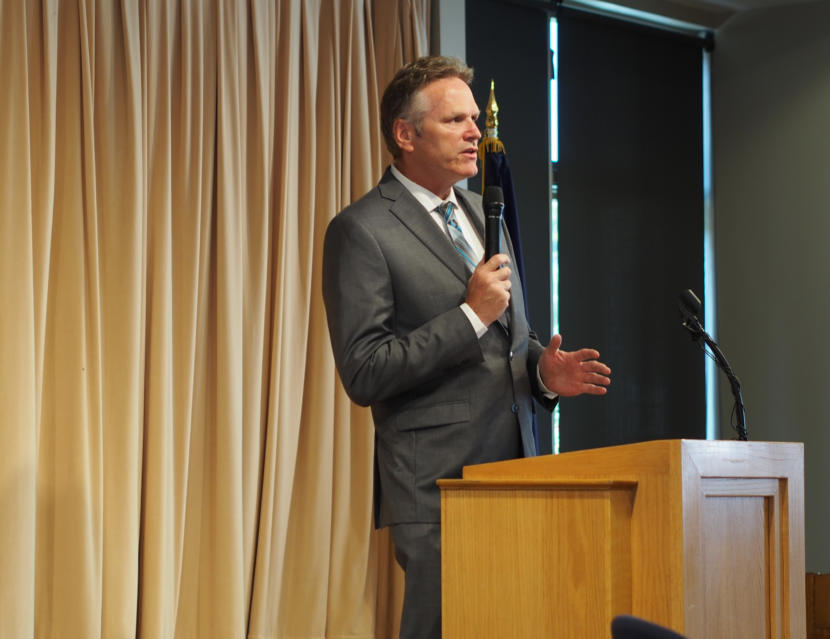
Gov. Mike Dunleavy announces to a lunchtime audience at the Chugiak-Eagle River Senior Center in Chugiak that he will restore funds for the Senior Benefits Payment Program.
Gov. Mike Dunleavy speaks at the Chugiak-Eagle River Senior Center, Aug. 12, 2019. On Monday, the governor’s office suspended three public town hall meetings planned for this week. (Photo by Zachariah Hughes/Alaska Public Media)

Gov. Mike Dunleavy has suspended three public town hall meetings he was planning to hold this week.

According to the governor’s office, the reason is to allow Dunleavy to “remain closely connected to federal and local partners” while the coronavirus situation continues to evolve.

The governor said in December that he planned to visit communities to talk with Alaskans about the future of the state’s budget. He held one meeting, in Chugiak, last week. His office canceled meetings in Petersburg and Wrangell in February, citing poor weather.

The newly canceled events were scheduled for Kenai on March 9, Seward on March 10 and Homer on March 11.

Dunleavy says his administration will communicate with local governments, school districts, businesses, tribes and nonprofits by telephone and Facebook town halls, until he can resume travel to communities.

See all of KTOO’s Alaska coronavirus coverage.

Amid coronavirus fears, who decides if a cruise ship can come or not?

Top left: Gov. Mike Dunleavy delivers the State of the State Address to the Alaska Legislature in Juneau on Jan. 27. (Photo by Rashah McChesney/KTOO)
Bottom right: Capt. Stephen White gives his remarks after assuming command of Coast Guard Sector Juneau during a change of command ceremony at the Alaska State Museum in Juneau on May 4, 2018. (Photo by Petty Officer 1st Class Jon-Paul Rios/U.S. Coast Guard)

Alaska’s cruise ship season begins in April, and that’s making a lot of people anxious in port towns that have, so far, been untouched by the COVID-19 virus.

For now, the response from state and federal public health authorities is based around prevention, quick detection and small-scale containment. But if certain officials decide an Alaska-bound ship threatens public health, they could take extraordinary measures.

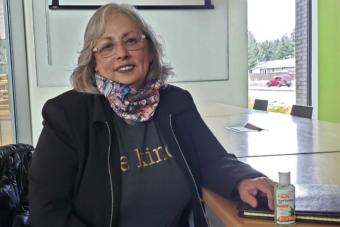
Deb Rodriguez is a Juneau resident and retiree. She found out that Holland America Line had canceled sailings in Asia for their ship, the Westerdam, over coronavirus concerns. And now, the Westerdam’s coming to Juneau early.

Deb Rodriguez
Juneau resident Deb Rodriguez poses for a portrait with her bottle of hand sanitizer at the Mendenhall Valley Library in Juneau on March 3. (Photo by Jeremy Hsieh/KTOO)

“I mean, my first reaction is, why, when other countries have turned it away? … Who made this decision?” Rodriguez said. “And was this decision thought through? Do we have what we need?”

Rodriguez said those aren’t rhetorical questions; she earnestly wants officials to address them. She said more transparency about the safeguards and precautions around the Westerdam and the cruise ship season in general would go a long way to quiet her fears.

But reactions around the coronavirus and coming cruise season run the gamut. Some seasonal tourism workers are at peace with the risk, because they already take precautions for norovirus and other infectious diseases that spread similarly. Some said they’re more worried about the impact on their wages and tips.

Others think officials should be discussing a total shutdown of cruise ship traffic in Alaska ports.

In Juneau, Mayor Beth Weldon said she’s keeping an eye on the coronavirus situation, but she doesn’t see it as a local political issue at this point.

“We’re letting the experts make the plans at this time, and then we’ll review the plans as we need to at the Assembly level,” she said.

Weldon said the city’s public health and public safety experts are getting together regularly to prepare.

But back to Rodriguez’s question: Who decides if a cruise ship can come in or not? Normally, for the entirety of Southeast Alaska, there’s one Coast Guard officer with the authority to make that call. His name is Stephen White, and he’s the “captain of the port.”

The Coast Guard’s public information office for Alaska said White would not be available for an interview. The Coast Guard didn’t answer written questions about what goes into the captain of the port’s decision making. Coast Guard spokesperson Melissa McKenzie said my questions had been forwarded to a subject matter expert, but that she had not heard back.

However, White did meet with a visitor industry task force in January to explain his role with cruise ships. This was before coronavirus had spread around the globe.

“We do have some regulatory authorities and responsibilities that are laid down in law. And they’re vast and they’re complex,” he said.

Broadly, he said he has the authority to stop vessel traffic and target specific ships from coming or going.

“But it’s supposed to be used judiciously. Not for day-to-day management,” White said. “This is like, ‘Hey, we’re closing the port because of the hurricane. Or there’s a security threat coming. Or this particular vessel is a threat if it gets underway.'”

White said he can also penalize people who don’t follow the captain of the port’s authority.

Ships generally have the right under the U.S. Constitution to come and go. The state and municipal governments have some room to regulate them, too. But they’re not supposed to create undue burdens. Juneau’s municipal attorney, Robert Palmer, outlined the limits of these rights and powers in a legal memo for local officials in January.

Coronavirus aside, cruise ship crews and state health officials already have regular practices for identifying and containing illnesses. The Centers for Disease Control and Prevention has a lot of detailed guidance for cruise ship travelers and workers. It gets down into stuff like how to handle dirty laundry and how much alcohol should be in hand sanitizers.

But if someone’s visibly sick with COVID-19 symptoms or other illnesses, a ship’s crew is required to report it to the CDC.

So that’s what’s going on under normal circumstances. What about abnormal circumstances?

“If there is a large disease outbreak of a contagious disease, that could trigger an emergency,” Palmer said. “And when that happens, there are super-broad powers that can be authorized or assumed depending on whatever’s reasonable and necessary to protect the people. … What some of those powers can include: restricting access to areas that are believed to be highly infected — whether it’s a building, or an area of town, or a structure or a ship — that part doesn’t probably matter as much.”

Municipal, state or federal officials could — separately or in coordination with each other — invoke various emergency powers that could affect a ship’s access to Alaska’s port towns. Palmer’s department is on Monday’s agenda of a Juneau Assembly committee meeting to discuss the scope and authority of disaster declarations.

If the governor declares a public health disaster, state law says the commissioner of the Department of Health and Social Services gets a lot of extra powers, too. Then, the commissioner could compel evacuations and closures, destroy public health hazards, restrict people’s movement, even take over funeral homes to dispose of bodies.

We’re not there. And Deb Rodriguez said she’s not freaking out.

“For myself, I’m fine,” she said. “I feel like I have everything I need if I needed to be in my house for two weeks because I had the flu or if I had some kind of symptoms. I would be able to take care of myself.

She is concerned about the overall situation, but doesn’t want to live in fear.


KTOO News hosted a live, one-hour special on Thursday, March 5, with guests who helped answer the collective questions we have about the virus, the disease it causes and the social impacts it could have on us here in Juneau.


Special program: Coronavirus questions and concerns for Juneau

It’s starting to seem inevitable that COVID-19, the coronavirus disease, will turn up in Juneau. What does that mean for us? What will our lives be like when that first case is confirmed?

KTOO News hosted a live, one-hour special on Thursday, March 5, with guests who helped answer the collective questions we have about the virus, the disease it causes and the social impacts it could have on us here in Juneau.

Panelists

  • Adam Crum, Alaska Department of Health and Social Services commissioner
  • Charlee Gribbon, Bartlett Regional Hospital infectious disease preventionist
  • Bridget Weiss, Juneau School District superintendent
  • Rorie Watt, Juneau city manager
  • Adelyn Baxter, KTOO reporter
  • Jeremy Hsieh, KTOO reporter
  • Jennifer Pemberton, KTOO managing editor

More information and resources


Radio broadcast of this program:

Alaska’s top health officials tell lawmakers to keep calm, stay informed on coronavirus

Alaska’s Chief Medical Officer Dr. Anne Zink gives a status report on the novel coronavirus to legislators at the Terry Miller Building in Juneau on Wednesday. Zink was accompanied by Health and Social Services Commissioner Adam Crum. (Photo by Skip Gray/KTOO)

The state officials leading preparations for the arrival of the novel coronavirus in Alaska told lawmakers on Wednesday in Juneau to keep calm and stay informed about developments related to the virus.

Alaska Chief Medical Officer Dr. Anne Zink said it’s important to take simple steps, like washing your hands and staying at home if you’re sick. This will reduce the risk of other diseases, too, like the flu. And that will help the health care system handle COVID-19, the disease caused by the coronavirus, when it arrives in the state as anticipated.

“So when I’m thinking about the health care system as a whole, I don’t want to fight a battle on two or three fronts,” she said.

House Speaker Bryce Edgmon; House Majority Leader Rep. Steve Thompson; and House Minority Leader Lance Pruitt, left to right, listen to a briefing about the state’s preparedness for the novel coronavirus at the Terry Miller Building in Juneau on Wednesday. (Photo by Skip Gray/KTOO)

Zink walked through basic facts that are known about the virus. It appears to be 10 to 20 times more fatal than the typical flu. Children are not showing symptoms of the disease, but seniors seem particularly susceptible. Symptoms start two to five days after people contract the virus; peak between five and seven days; and linger for up to 14 days.

Zink said people with flu-like symptoms should first seek help from a health care provider. That could mean a visit to a doctor, but it also could mean using a phone service like Teledoc. But she cautioned against people going to a hospital emergency department.

She said a fever might require a call to a doctor. But it can be difficult to know whether to take a cough seriously.

“It is hard,” she said. “Is that a little dry air? Is that a little allergy? I got a little cough — I think everyone’s watching each other’s coughs and sneezes a little more intensely right now because we’re all a little — I’m not picking on anyone here.”

The state has tested four people for COVID-19. None tested positive. Testing for two others is in progress.

The state can currently test up to 100 people. Zink expects the federal government to provide more test kits. But the state hasn’t been given a time frame for receiving them.

People will first be tested for the flu and other viruses before being checked for COVID-19.

“This is a phased and layered approach, and using the test for the right people is going to make sure that the most people are protected,” Zink said. “We’re not trying to limit the number of tests. We’re trying to get them out as quickly as possible.”

Zink said the state is preparing for the virus, anticipating how it would impact both urban and rural communities. For port communities, that means trying to connect officials with cruise lines’ medical professionals. And she said the state has transportation plans for rural communities — for individuals and larger groups of patients.


Watch the latest legislative coverage from Gavel Alaska.

Cruise ship will arrive early in Juneau after canceled Asia sailings

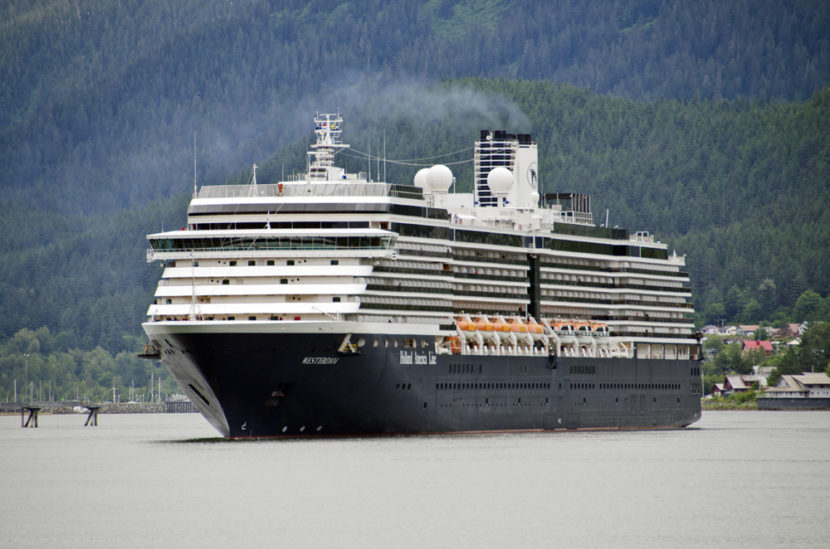
The Holland America Cruise Ship Westerdam prepares to dock in Juneau July 16, 2012. (Photo by Heather Bryant/KTOO)
The Holland America Line cruise ship Westerdam prepares to dock in Juneau on July 16, 2012. (Photo by Heather Bryant/KTOO)

A cruise ship that was turned away from multiple ports in Asia due to fear of spreading coronavirus will arrive in Juneau later this month.

Juneau City Manager Rorie Watt said he received confirmation Monday from Holland America Group that the Westerdam will depart the Philippines shortly and arrive in Juneau on or around March 22.

Holland America Line canceled the remainder of its sailings in Asia last month, citing concern over ports turning away cruise ships due to the spread of novel coronavirus.

One passenger from the Westerdam tested positive for the virus but has since been cleared. All passengers have now left the ship, and the crew has tested negative.

Juneau does not have any reported cases of coronavirus. Watt said he is not concerned about the ship’s arrival in Juneau.

“By the time it arrives in Juneau, the crew essentially will have been quarantined on the ship, with no entry or exit of other people for the better part of a month,” Watt said.

Watt said the city does not test visitors for infectious disease, but the crew will likely undergo additional testing when they arrive in Hawaii on their way to Juneau.

The crew will be allowed to get off the ship in Juneau once they arrive. The Westerdam will be moored at the AJ Dock near the Alaska Marine Lines shipyard.

“They probably are going to be doing maintenance projects and giving crew some shore leave,” Watt said. “I would imagine the crew’s probably pretty tired and stressed out from the whole situation.”

Holland America Line did not immediately respond to a request for comment.

With multiple cruise lines canceling sailings in Asia, other companies may also be considering earlier-than-normal visits to Southeast Alaska.

That would most likely mean ships that typically arrive later in the season would come earlier. But Watt said there is no truth to rumors that the Diamond Princess — the ship that was quarantined off the coast of Japan — will come to Juneau.

He said the more immediate concern for coronavirus in Juneau is airline travel.

“It’s more likely that Juneau will experience a coronavirus case by virtue of our frequent airplane traffic in and out of the Pacific Northwest,” he said.

The governor of Washington state declared an emergency there on Saturday. The state saw the first confirmed death in the country from COVID-19 over the weekend.

According to Alaska Airlines representative Tim Thompson, there are no immediate impacts for passengers traveling between Alaska and Washington state.

The airline says it’s taking extra precautions by enhancing the disinfecting of planes and suspending onboard recycling and hot towel service in first class.


Site notifications
Update notification options
Subscribe to notifications