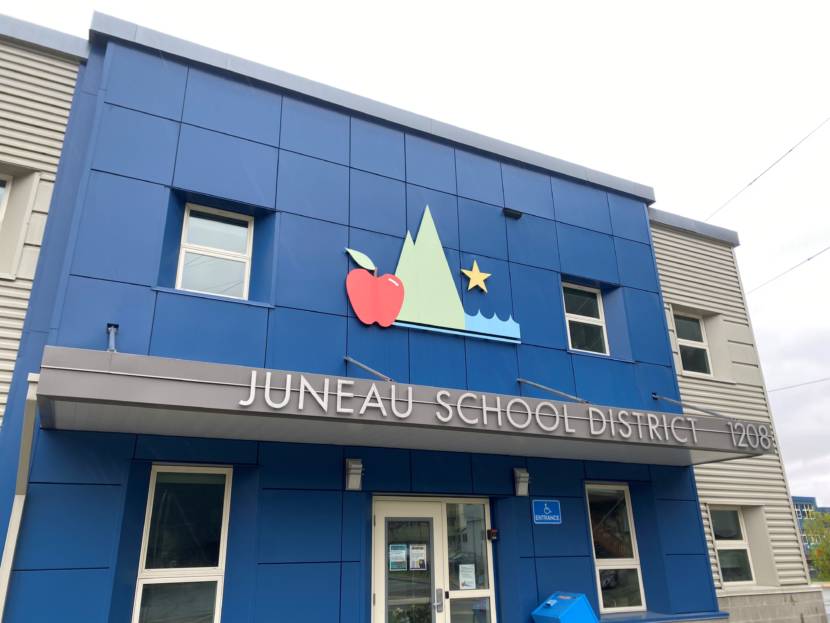
The Juneau School District’s budget for next school year may take a $2 million hit.
The City and Bureau of Juneau and the Juneau School District got a letter from the state that says it can’t use outside-the-cap funding to supplement the district’s budget.
Alaska’s school funding formula allows local governments to add to the school budget with their own money, but only up to a certain amount. Juneau contributes the maximum each year.
‘Outside the cap’ funding is money the city gives to a district beyond that amount. Last year, that money was used for non-instructional things, like transportation and sports.
The district has been using outside the cap funding for years, as do other districts in the state. Last year, the Juneau Assembly gave the school district $2.3 million to fill a budget deficit. For the 2024 fiscal year, which just started, the district received about $2.3 million in outside-the-cap funding from the city again.
The city received the letter on June 29, one day before the end of the 2023 fiscal year. This left little time to resolve the gaps that could be created by not using outside the cap funding.The Juneau Empire reported on the letter Wednesday. Reporter Clarise Larson sat down with KTOO’s Yvonne Krumrey to talk about what this might mean for Juneau’s schools.
This interview has been edited for length and clarity.
Yvonne Krumrey: Did the district request that money from the city originally?
Clarise Larson: Yeah.
Yvonne Krumrey: So why did they request that money?
Clarise Larson: Because they needed to get to zero. When the school district goes into a fiscal year, they have to pass a balanced budget, right? In order to balance this budget they needed — they would have to do a lot of digging, or they could, you know, utilize the outside of the cap funding mechanism. In this case, that was for $2.3 million. That paid for — $1.3 million of that was towards transportation deficits, which is happening all across the state, a lot of districts are struggling with transportation funding because it’s been flatlined for years — $750,000 goes towards RALLY, the after-school childcare program, $60,000 toward new wrestling mats. So none of those are instructional.
Yvonne Krumrey: So this money has already been spent. It’s not like they can like take it back. It’s been spent for the 2023 year.
Clarise Larson: Yes, that $2.3 million has been used. Now, the letter says, the letter points to that $2.3 million and is like, Hey, that’s not okay. We’re not going to make you pay that back. But what we are going to do is, say, going into fiscal year 2024. So starting on July 1, you can’t do it anymore. But when the school district or when the Assembly passed their budget, in June, it included $2.28 million for fiscal year 2024 outside of the cap funding. That leaves a $2.2 million hole in the fiscal year 2024 budget for the school district. So they’re gonna have to build they’re gonna have to make those funds up.
Yvonne Krumrey: Ok. And can I ask, though, you explained what the non-instructional funds have been used for in this instance? Why are they an issue with the state? Like, why do they care that the outside the cap funding is being used on non-instructional things?
Clarise Larson: And that’s kind of the golden question that we tried to dig into with the state, right? We found out about this letter later in the day. And a lot of the reporting we did yesterday was within hours. And so we really didn’t have much time to talk with the state about this. In recent years, the state has failed federal disparity tests due to the districts allocating “special revenue funds.” In this case, outside of the cap funding — or you know, another word for it — for the purpose of, you know, like pupil transportation, stuff like that. But this is the disparity test. The disparity test is a little-known rule involving areas affected by federal impact aid, which for Alaska means, proving there’s less than a 25% funding difference between the highest and lowest funded districts in the state.
Yvonne Krumrey: So essentially what the state is saying is that this extra outside-the-cap funding, even if it’s going towards non-instructional purposes, is creating further inequity between Juneau school districts and the ones that have less money to work with.
Clarise Larson: I don’t really know. That’s the whole thing. It’s like, this is so messy. It’s a difficult thing to understand — why now, right? Why now are they are doing this? We don’t, we don’t have an answer for that yet. We’re trying to figure that out. Likewise, our school district and city officials right now are trying to figure (it) out.
Yvonne Krumrey: And that comes back to what I’ve been most curious about — what does this mean for Juneau schools right now?
Clarise Larson: It means a lot of unknowns. It means a lot of uncertainty. Because if you look at the letter, it’s a one page letter — doesn’t really get into detail about questions that I have, the questions that the school district have, that the attorney has, you know, city attorney, a lot of questions remain unanswered. A lot of people are arguing ‘this isn’t applied to the cap at all.’ This is completely separate, you know? The cap doesn’t apply. A lot of people are having that argument. That’s why so many school districts have done this because they have, you know, for whatever reason, thought that the cap doesn’t apply, but the state the state is arguing otherwise, why they’re arguing that there’s a lot of reasons that we don’t know yet.
Yvonne Krumrey: Well, thank you for taking the time to speak with us.
Clarise Larson: Thank you for having me.