
Listen to this story:
Since Juneau broke its official winter snowfall record on Monday, some residents have asked whether the melting snowpack will influence the next glacial outburst flood expected in the Mendenhall Valley this summer.
The short answer is no. Local scientists who study the flood say this winter’s snowfall won’t have much, if any, influence on Juneau’s next glacial outburst flood.
First, there’s an important distinction between snowfall, which is added up on a daily basis, and snowpack, which is made of layers that stack up and compress over the whole winter. The capital city broke its snowfall record at the Juneau International Airport with 201.2 inches on March 23.
But Aaron Jacobs, the senior service hydrologist at the National Weather Service in Juneau, said the snowpack and the water that it will melt down to are pretty close to average this year.
“The amount of water that’s in the snowpack is about near normal, nothing very extraordinary, not very high,” Jacobs said.
That’s according to snowpack data tracked by the U.S. Natural Resources Conservation Service at two SNOTEL stations near Juneau. One station is located at Long Lake near the Snettisham Hydroelectric Project, about 840 feet above sea level, and shows the quantity of water in the snowpack was at 106% of its average on March 25.
Eran Hood, a glacial outburst flood expert at the University of Alaska Southeast, said the snowpack isn’t deeper because there was a long warm-up in the middle of winter when a lot of it melted.
“There’s the first sort of snowpocalypse, and then this melt-out period, and then the second snowpocalypse,” Hood said, referring to the record-breaking snowfall Juneau received at the end of last year and again in March.
But more importantly, Hood said snowpack is completely unrelated to the conditions that control the size of glacial outburst floods, unlike spring floods in parts of the western U.S.
Suicide Basin is the glacial lake beside Mendenhall Glacier that produces Juneau’s annual glacial outburst flood when it fills up and then bursts through the ice, releasing around 16 billion gallons of water all at once into the suburban Mendenhall Valley below.
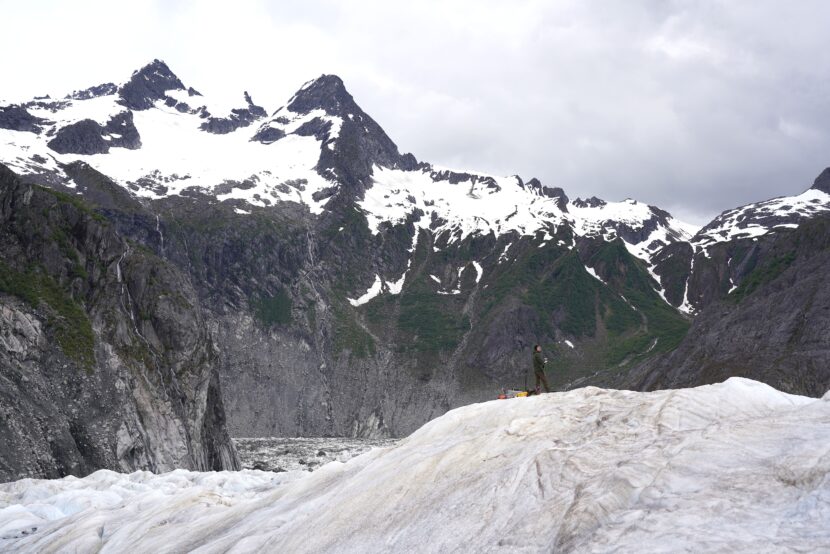
Heavy summer rainfall contributes the most to how quickly Suicide Basin fills up, Hood said, since it both adds water directly and rapidly melts ice. But he said in a year with a particularly large snowpack, potentially the basin would fill a little bit sooner.
“Maybe instead of early August, we could fill it by, say, the third week of July,” Hood said. “Would that influence how big the flood was? No. What influences how big the flood is is the volume of the basin when it’s full and how fast the water is released.”
He said those two variables that control the size of the flood have nothing to do with how quickly the basin fills.
Hood said the researchers won’t know how the basin volume has changed until the summer. In the winter, he said glacial ice flow rates are slow and massive icebergs aren’t calving into Suicide Basin.
“I don’t think there’s a lot of activity over winter in terms of the basin volume changing substantially — I wouldn’t expect that,” he said.
He said his team plans to do drone surveys of Suicide Basin in May and June that will allow them to update the estimated volume of water it can hold.
The other factor that controls the size of the flood is how fast the water bursts from Suicide Basin and rushes through Mendenhall River. Scientists can’t measure that until the flood is underway.
The size of the flood has consistently grown over the last three years. If the next flood is the biggest one yet, this winter’s snow wouldn’t be the cause.
