Listen to this story:
Mendenhall Glacier is melting in ways that affect the size of glacial outburst floods in Juneau’s Mendenhall Valley. In a crowded lecture hall at Egan Library on Friday, scientists presented new preliminary data on how the ice contributed to this summer’s record-breaking flood, and shared their ideas about how that could change in the future.
Juneau’s glacial outburst flood in August broke more than one record. Eran Hood is an environmental scientist at the University of Alaska Southeast. He said the Mendenhall River rose quicker than ever this year.
“It was a fast release — the fastest release we’ve seen in terms of just the rate at which the amount of water in the river was increasing hour over hour,” Hood said.
There was also more water than in years past, both from heavy rain in the days leading up to the flood and because the capacity of Suicide Basin — the source of Juneau’s outburst flood — has grown. The basin is an immense pool that formed when Suicide Glacier receded. Steep rock faces make up all but one of its walls. Billions of gallons of water are held back by one wall that’s an ever-changing ice dam formed by Mendenhall Glacier.
The outburst flood happens when rain and meltwater rise to the top of the ice dam and pressure builds up enough for the water to tunnel through the glacier and drain out of the basin all at once, sending a torrent through Mendenhall Valley.
The flood has been growing, but the researchers say it will reach a peak one day and then start getting smaller. Hood said they aren’t sure when exactly the basin will deliver its largest flood.
“Hopefully we’re up near the top of the curve,” he said. “We don’t know yet.”
Jason Amundson, a glaciologist at UAS, said calculating the shifting volume of Suicide Basin is key to understanding how the melting glacier influences the size of the flood.
“I would say at this point, we have a really good grasp of the basin volume and how it’s changing over time,” he said.
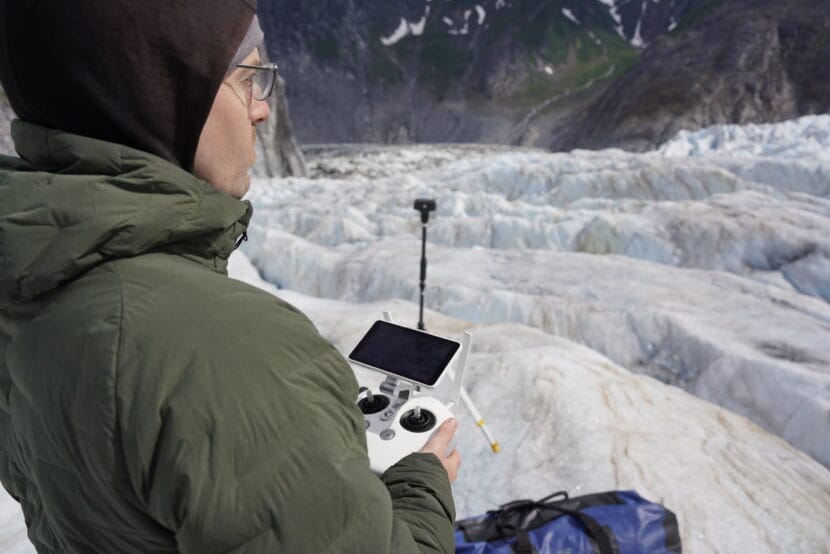
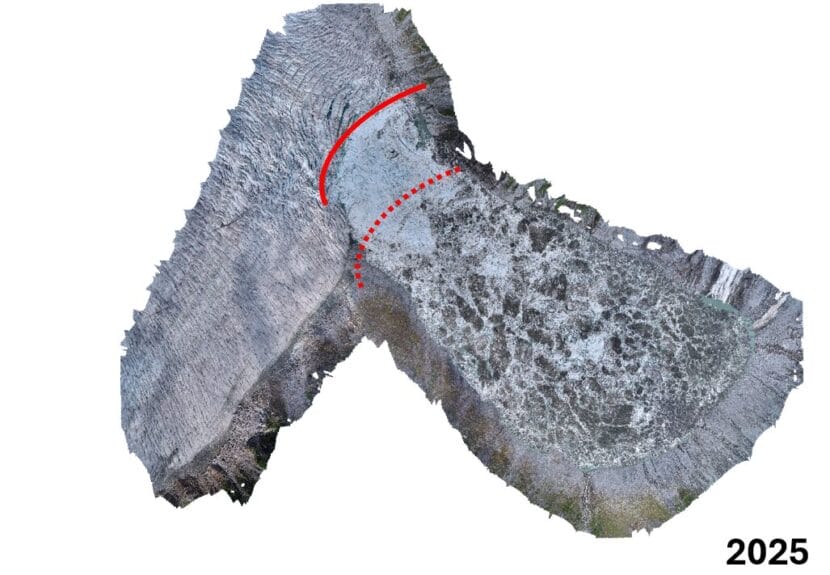
The researchers flew drones over the basin that captured thousands of high-resolution photos. Stitched together, the images help the team measure how much water it can hold.
In the presentation on Friday, Amundson broke down the math he did to calculate the change in water capacity over the past five years. He presented the volume in acre-feet — for reference, one acre-foot is equal to a football field covered in a foot of water.
First, Suicide Basin is expanding into the side of the glacier. That means it’s getting wider. Amundson said the basin cut into the glacier by roughly 100 meters, adding about 6,400 acre-feet of storage capacity. But he said this is the hardest variable to follow because the ice is constantly moving. It calves and stretches, repeatedly pressing into the basin and retreating.
Second, the researchers reported that Mendenhall Glacier has thinned somewhere between 15 and 20 meters due to climate change. That means the basin’s ice dam is getting shorter. Amundson said this has reduced water capacity by roughly 8,500 acre-feet.
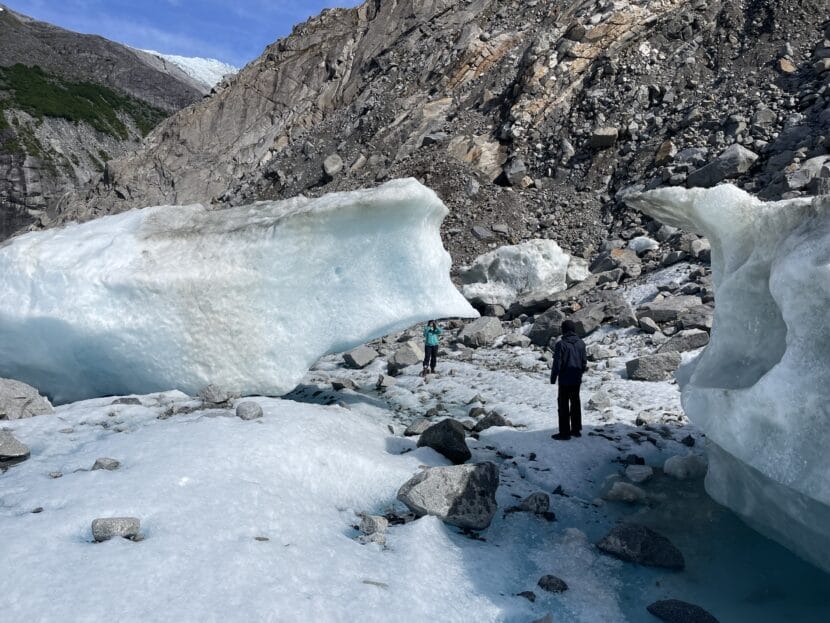
Third, icebergs in Suicide Basin are melting rapidly. That adds water capacity, because floating ice displaces water. Amundson said iceberg loss has added about 12,000 acre-feet of storage to the basin.
Altogether, Suicide Basin can now hold about 9,900 acre-feet or 3.2 billion gallons more water than it could in 2020. The numbers presented are still rough estimates based on preliminary data that hasn’t been finalized yet.
“In the last five years, the storage capacity has increased by something like 20% — little bit scary to think about it continuing to increase … 10,000 acre feet every five years,” Amundson said. “But I think the thing that should give you at least a little bit of comfort is that there’s not a lot of floating ice left in the basin.”
He said melting icebergs added the most water capacity, but now there’s only about 6,000 acre-feet left to melt.
The theory is that the largest outburst flood should happen when there are no icebergs left in the basin. So Hood said this could be good news.
“Theoretically, that’s kind of a good sign that we could be nearing the peak,” Hood said.
But he said reality is never as clean as theory. The changing ice dam, high tide or an atmospheric river could make the Valley’s largest flood come sometime before or after all of the icebergs melt.
The research team is also using ice-penetrating radar that hangs from a helicopter, pings down to the bedrock and produces maps of the glacier’s underside. Those maps will help them measure how thick the ice is, predict the lifespan of the floods from Suicide Basin and investigate other potential basins that might release floods down the line.
Amundson said that at first glance, the next potential basin further up the glacier, which is still covered in ice, doesn’t seem deep enough to create a big outburst flood.
“I’m a little bit skeptical that it could be a big basin,” he said. “We’re not sure yet, because we haven’t fully processed the data.”
He said more potential basins will be analyzed over the next few months.
Learn more about Juneau’s glacial outburst flood by visiting our ktoo.org/flood and listening to the Outburst podcast.