(Shelby Herbert/KFSK)
Alaska’s Little Norway celebrated Norwegian Constitution Day in mid-May with a week-long festival. For some families in the community, that meant many hours spent cooking heaps of treats from the Old Country, often using recipes that have been passed down for generations.
The air inside Petersburg’s Sons of Norway Hall was thick with the smell of cardamom, vanilla, and melted butter. Volunteers labored over portable stoves and bowls of batter. Sally Dwyer is the director of Petersburg’s Sons of Norway chapter, and she’s the mastermind behind the cooking operation.
After directing the volunteers to their stations, Dwyer fired up her griddle and, a few moments later, handed this reporter a delicate, cone-shaped waffle cookie — something called a krumkake. It melts in your mouth just as fast as it disintegrates in your hands.
As the crumbs fell away, Dwyer demonstrated her krumkake system.
“I am pouring approximately a tablespoon of krumkake batter into the krumkake iron, which has beautiful imprints of flowers and scroll-ey thingies,” she said. “I want it to spread out and be crispy, then I’ll put them on my roller and roll them into the cone shape, and then set them here to rest while making the next one.”
She would repeat that process hundreds of times that day. All the volunteers were making heaps of traditional treats to raise money for Petersburg’s Sons of Norway chapter at an annual buffet-style bake sale, called “Kaffehus.”
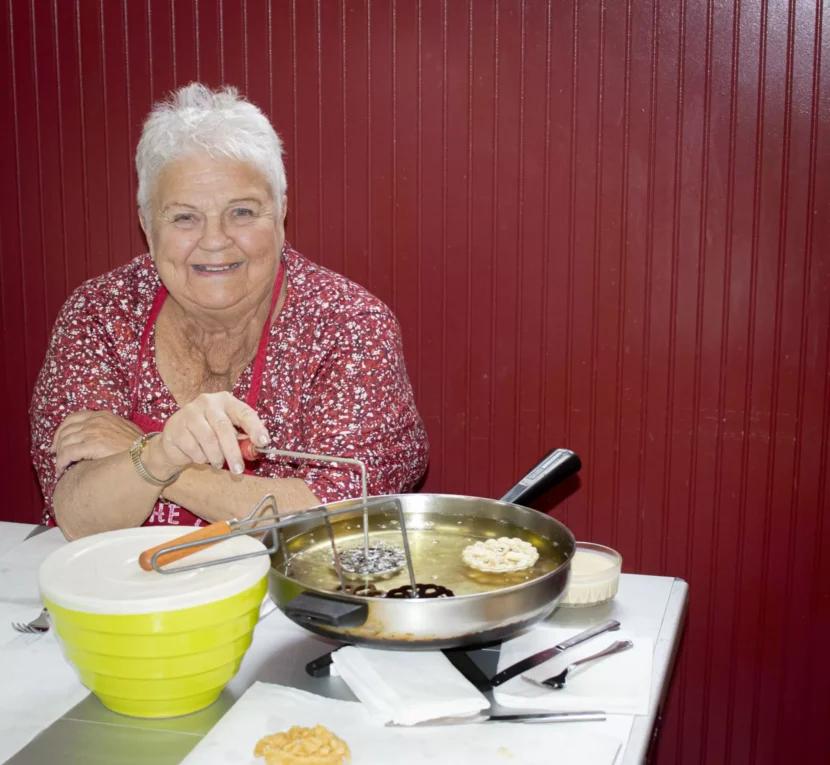
In another corner of the room, Margaret Newlun was making rosettes. That’s a little more involved — and dangerous. Newlun wielded a long, thin metal rod with a flower-shaped cookie cutter at the end. She dipped the cookie cutter into a bowl of batter, and then turned around to face a ripping hot pan of oil.
“It just takes a while to make ‘em,” Newlun said. “You gotta fry ‘em in oil and you can’t set [the rod] down in the oil, because it’ll ruin the cookie!”
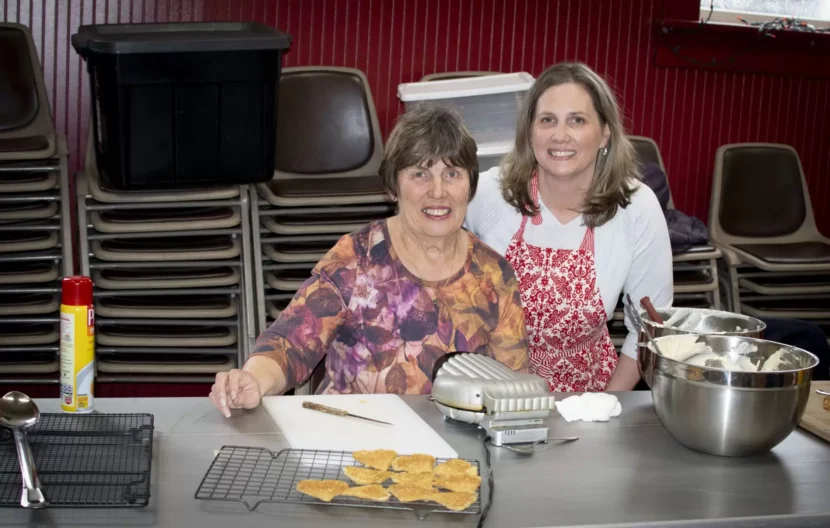
At another table, Katrina Miller was making waffler with her mom — that’s basically a tiny waffle sandwich. Miller’s grandmother taught her how to make it. Miller said waffler is an all-occasion thing that the next generation of her family has bonded over.
“It’s just kind of always been our thing and it brings us all together,” Miller said. “And it’s fun! We do it for Christmas, we do weddings, funerals… And then, sometimes, just because we want waffler.”
Miller’s mom, Sharon Wikan, offered a piece of waffler smeared with a type of caramelized goat cheese, called gjetost. She thinks that’s the best way to eat waffler, but not everybody in her family agrees.
“These are my grandkids’ favorite,” Wikan said. “But they don’t like the goat cheese. My kids don’t like the goat cheese. Just grandma — nobody else does.”
(Shelby Herbert/KFSK)
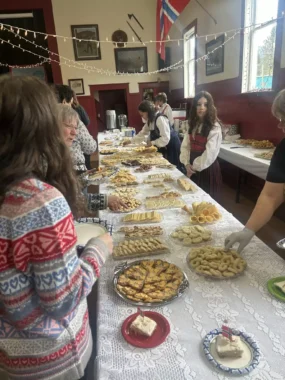
After hours of work, the volunteers’ tables were piled high with dozens upon dozens of pastries, which they started squirreling away for Kaffehus.
Days later, the dainty desserts reappeared in the Sons of Norway Hall, arranged on long buffet tables. A line of hungry festival-goers stretched around the outside the building, in the rain. But Bob Martin, who had been standing there for around 45 minutes, said it was all worth it.
“Lefse! It’s hard to find these days,” Martin said. “The ladies wearing bunads — they know the secrets!”
Lefse was one of the big draws — it’s a soft flatbread often filled with butter, sugar, and spices. It’s classic Scandinavian fare, but there’s been some drift over the years. Here, it’s taken on some American flavor.
(Shelby Herbert/KFSK)
Dwyer said her family’s lefse is a great example of how the town’s Norwegian forebears came up with new ideas after they started their lives in Petersburg.
“According to [our] family legend, Grandma Tora put sugar in her lefse after she buttered it, she used powdered sugar for the first time in Petersburg,” Dwyer said. “The granulated sugar — most of us think it’s like sand! So, most of us here use powdered sugar. Women were innovators back then!”
But the day’s visitors weren’t there to quibble over authenticity. They were there for the sugar rush. Plates of lefse — filled with both granulated and powdered sugar — got wolfed down, along with all the other fruits of the volunteers’ labor — another successful Kaffehus in the books.
This story has been updated to correct Vav Wikan’s identity in a photo caption.