This is Tongass Voices, a series from KTOO sharing weekly perspectives from the homelands of the Áak’w Kwáan and beyond.
Tessa Hulls has worked a lot of jobs, biked a lot of miles, and lived a few different lives in and outside of Alaska. A part of her was running from something.
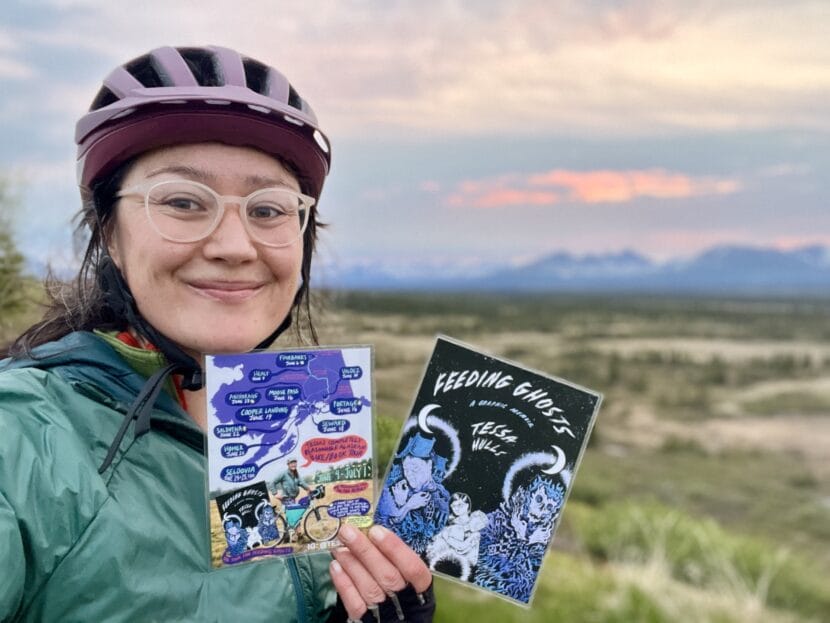
But she spent the last decade turning to face it by writing a graphic memoir about her family’s history. The memoir is called Feeding Ghosts, and it’s won three national awards.
The following transcript has been lightly edited for clarity.
Tessa Hulls: I have always been somebody who wrote. You know, I was one of those kids where, from the age I could shove a crayon up my nose, it was clear I was going to be a writer and an artist. And there’s not any route I could have taken that would have allowed me to escape that.
My name is Tessa Hulls. I am an artist, writer and adventurer who drew and wrote the graphic memoir Feeding Ghosts.
And yeah, my grandmother, Sun Yi, she was a journalist in Shanghai during the communist takeover, and she ended up on the wrong side of political history, so she was labeled a dissident and was arrested and put through Maoist era thought reform. And for her, writing was the way in which she tried to assert her own reality, even as she watched the government take over and deny everything that was happening.
And it was something that was both her liberation, but also ultimately what broke her mind, because after she and my mom fled China as political refugees, they went to Hong Kong, and my grandma wrote a memoir about eight years of living under the communist regime, and then, unfortunately, had a mental breakdown, and she never really regained her sanity, and she spent the rest of her life trying to rewrite the story that had been taken from her.
Yeah, well, I think when I first started the book, I was really determined to not talk about any feelings. It was just going to be about history. I was not going to be a character in it. And once I was able to commission a translation of my grandmother’s memoir, because it was written in Chinese and never translated into English. So when I opened it and finally read her book, it was kind of the first time that I ever heard her voice, because even though I grew up with her and my nuclear family, we had a language barrier, and she was also heavily medicated on antipsychotics.
So when I started reading this book that she had written as a political refugee in her 20s, I just immediately went “Oh no,” because I knew suddenly the scope of what I was trying to do had become infinitely more complicated, and the book was going to have to contend with the question of, ‘what is truth?’ when you’re working with both an unreliable mind and a government that is dismantling reality all around you.
I didn’t feel like I had a choice. My family ghosts literally told me I had to do this.
So I would spend full summers working in Alaska, and then would freelance as an artist and writer in Seattle in fall and winter, and then spend two months alone on a solo bikepacking trip.
And I was doing it in a way that felt really authentic to what I needed, but I also was well aware that I was running from something.
And so I was on one of these bike trips kind of realizing that this chapter of my life where I was just hoarding my own wonder had come to an end and that I needed to step into a different kind of responsibility.
And so I was biking alone up a mountain and so I said, “Okay, if this chapter is done, what comes next?” And the landscape opened up and spoke to me and said, “Someone has to feed the ghosts.” And my book is called Feeding Ghosts, because that was the beginning of this nine year process of really stepping into something that was my family duty.
And as I got towards the end of the story, you kind of get contemplative about,” Well, what did I learn, really, along the way?” And I think the process of drawing and writing this book was really me learning how to render both my mother and my grandmother in two complex, three dimensional characters. And in order to do that, I had to draw them from every angle.
And I wrote about my grandmother saying that it’s much easier to call someone crazy than it is to contend with how deeply they’ve been injured by the past.
And I think a lot of the things that we put the umbrella category of trauma on are really just instead coming from a refusal to look at the depth of rupture, and therefore the amount of work it would require for there to be genuine repair.
So the places where there weren’t clear answers, I forced that uncertainty on my reader and said, look, it’s kind of a choose your own adventure here, because there’s no way to actually discern what actually happened, and here are the competing narratives. And I leave it up to you to decide what path to take through it.
You can find Feeding Ghosts at Alaska Robotics, where Hulls will launch the paperback version with a party on May 6 at 5:30 p.m.