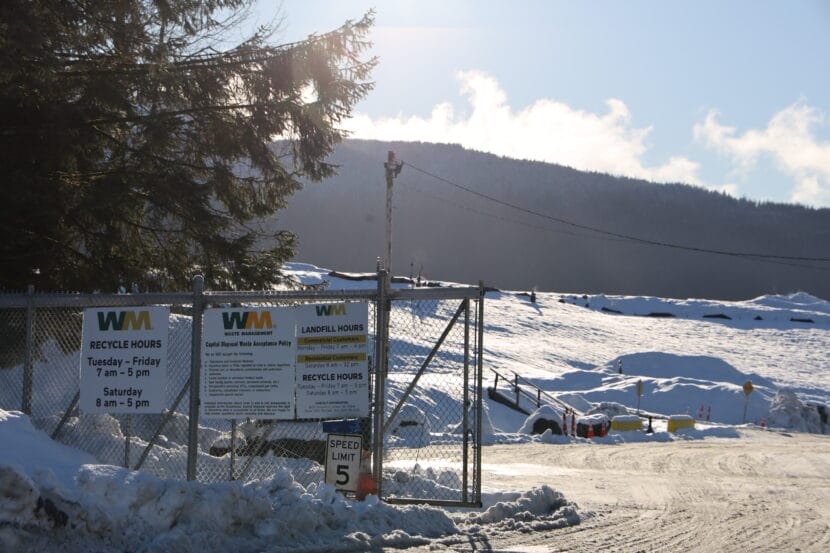
The clock is ticking for Juneau to come up with a new place to put its trash.
City officials and Waste Management, the private company that runs the landfill, say it likely has about 10 years left before it fills up – maybe 15 if they can stretch it.
At a meeting earlier this week, Denise Koch, the city’s director of Engineering and Public Works, told Assembly members the city needs to act now.
“I think that we’re coming to a point where we have to make a decision just because any landfill doesn’t last forever, it will fill up,” she said. “We can’t wait until we find out that the landfill is closing to have these sorts of conversations.”
A newly released study commissioned by the city offers three different routes the city could take to address its trash issue. Option one: Build a new landfill. Option two: Ship the trash south. And option three: Burn it.
At the meeting, Janet Goodrich with Jacobs Engineering Group – which conducted the study – explained what solutions would best fit Juneau, and what barriers each one faces.
“It is pretty important that CBJ look at a way to establish control over your future one way or another, whether you stay privately owned or publicly owned in all of the parameters or some of them,” she said.
All of the options would be multimillion-dollar projects and all come with their own logistical hurdles. Take the idea to build a waste-to-energy facility to essentially burn the trash for example: It sounds simple enough, but Terra Miller-Cassman with the engineering group said that’s the study’s least preferred option.
“The waste stream in Juneau is substantially smaller than other regions where waste-to-energy plants have been constructed,” she said. “It likely would not be within Juneau’s best interest to have diversion programs to divert waste for recycling or composting, because essentially all of that waste would need to be processed at the waste-to-energy facility in order to optimize the efficiency of the operations.”
A more preferred option laid out by the engineering group is to build a new landfill. That has some barriers too. For one, the price tag is pretty high. To build a landfill with just a 50-year lifespan, it would cost $50 to $162 million. For a 100-year landfill, it would cost between $99 to $323 million. Juneau’s current landfill was built in the 60s.
Goodrich said timing is also a factor.
“My experience personally is that a landfill is going to take at least 10 years from inception to garbage coming in there,” she said.
Goodrich said building a landfill can take up to 30 years because of all the regulations and permitting. That’s much longer than the current landfill will likely last. But that’s where the third option, shipping the waste south, could come into play.
Juneau produces roughly 30,000 tons of waste a year. The city has taken steps in recent years to at least slow down the flow of waste in town using its recycling program and working with a privately owned compost facility to divert materials. Cruise lines have also agreed to stop offloading bulky and oversized items into the landfill. But these steps are only Band-Aids.
The group that did the study says shipping the waste could be a permanent solution, or be used as a sort of crutch in the meantime while a long-term solution like building a new landfill is being figured out.
Assembly members at the meeting wanted to explore that idea further. They plan to discuss it more at an upcoming committee of the whole meeting and consider commissioning another study to dive deeper into the options.