
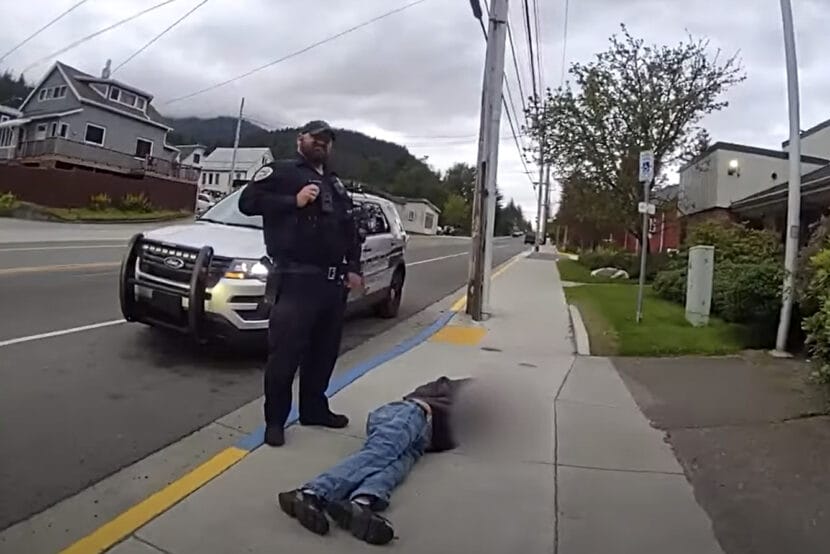
The former Juneau Police officer who slammed a man to the ground during an arrest last summer is asking a court judge to dismiss a lawsuit brought against him by the man he arrested.
Christopher Williams, Jr. originally filed the civil lawsuit last November against the City and Borough of Juneau and former Juneau Police Officer Brandon LeBlanc. Williams alleges LeBlanc violated his civil rights during a violent arrest, which left him unconscious. Williams was later medevaced out of town.
Video of the July incident recorded by a witness circulated widely online and prompted a public outcry from residents and the Central Council of the Tlingit and Haida Indian Tribes of Alaska.
However, the state’s Office of Special Prosecutions cleared LeBlanc of criminal charges stemming from the arrest.
LeBlanc’s attorney, Chris Peloso, filed a motion earlier this week seeking a superior court judge to dismiss the case against LeBlanc. Peloso argues his client’s actions are protected under qualified immunity.
“Under state and federal law, police officers have certain immunities to things, they call that qualified immunity, so this is just Mr. LeBlanc asserting that particular protection,” he said in an interview.
Qualified immunity is a legal doctrine meant to protect government officials — including police officers — from being held personally liable in civil lawsuits when performing duties within the scope of their jobs. The majority of use-of-force-related civil lawsuits against law enforcement in Alaska fail because of it.
In his motion, Peloso argued the doctrine is designed to “shield reasonable officials from frivolous lawsuits while carrying out their discretionary duties.” Peloso argued that his client was acting in good faith, without malice or improper motive, and within the scope of his authority as a police officer during the arrest.
But Jeff Barber, an attorney representing Williams, disputes that. In an interview, he said the argument laid out in the motion is baseless and “borderline frivolous.”
“It’s an excessive force case — there’s no grounds for the officer to challenge it,” he said. “It’s clear that what he did, did not comport with what he was supposed to do.”
Barber argued LeBlanc’s actions demonstrated both malice and reckless indifference toward his client during the arrest and after. Barber argues the motion to dismiss was also filed prematurely.
The city is another defendant in the civil lawsuit. Juneau’s City Attorney Emily Wright said Peloso’s motion is a standard filing for cases involving police officers and their actions. She said qualified immunity is an issue a judge must decide early on in a case and the city will await a ruling by the judge. Wright said that whether or not a judge approves the motion will not directly impact the city’s side of the lawsuit.
This isn’t the first time former Juneau police officer LeBlanc has been sued. In 2016, a man sued LeBlanc for excessive force and battery while he served as an officer in Louisiana. A jury found LeBlanc not guilty.
