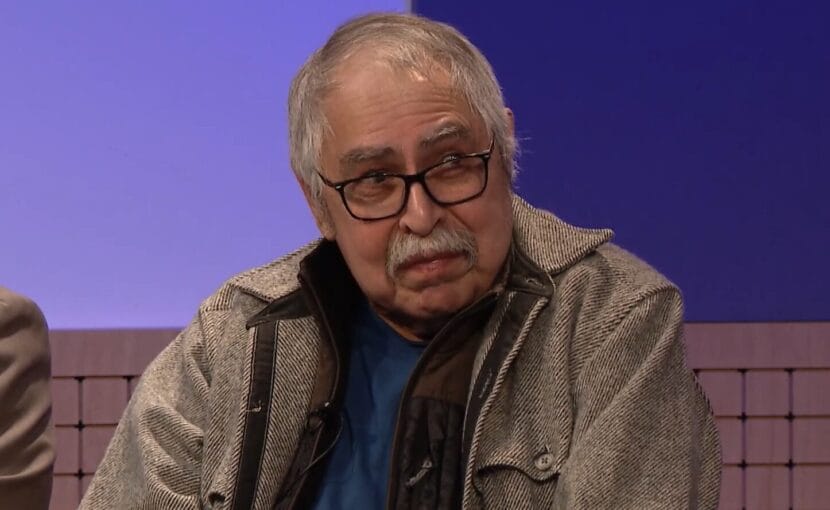
Clarence “Butch” Laiti was Yanyeidí and T’aaḵu Ḵwáan, born and raised in Juneau. He was a Vietnam War veteran, grandfather and great grandfather.
Laiti died at the age of 77 on April 10.
Until his death, he served as president of the Douglas Indian Association, a tribal government based on Douglas Island.
For much of his life, Laiti was a tireless advocate for Alaska Native fishing rights and sovereignty. He devoted his life to the preservation of the Taku River, where his family fished for generations.
In 2021, he participated in a City and Borough of Juneau project called “Juneau Voices.” Interviews with locals who lived through Juneau’s history were edited and placed along the seawalk for anyone to listen to.
“The history of fisheries in Alaska, like so much of our history, is a history of theft,” he said.
In Laiti’s installment, he talks about growing up fishing, and a moment when that tradition was threatened by the 1973 Limited Entry Act.
“It restricts the number of fishermen who can fish,” he said. “We’re trying to stop some of the outside fishermen from the Lower 48 but it doesn’t work out like that, and it makes it harder for locals to keep our livelihood.”
Laiti inherited his father’s fishing boat and business, but he wasn’t allowed to use it.
“I decide to fight,” he said. “I’m not going to let anyone tell me I can’t commercial fish. I come in with a stack of papers this high. I use their weapons against them.”
It worked. Laiti got his permit.
“Generations of Yanyeidí fishermen, my grandfather Willie Peters, my uncle James Peters, my father and me, now my grandson Philip Andrews Cadiente, who’s fished with me since he was five,” he said.
Last year, during a KTOO and Northern Journal panel discussion about the future of Alaska fisheries, Laiti continued to push for change.
“We need to have a big say-so on what’s going on,” he said. “This is our country first. This is our fishery first. I want to leave it to my grandkids. I don’t like to see where it’s going now.”
He fought against pollution in the Taku River that he worried stems from mining in British Columbia.
“We’re not gonna back down or give way, because there’s too much at stake here,” Laiti said in a meeting with Canadian mining company leadership in 2025. “If we lose the Taku, and then that’s it, it won’t come back. And that’s the bottom line, right there.”
At a memorial on Wednesday at the Elizabeth Peratrovich Hall, Laiti’s sister-in-law Barbara Cadiente-Nelson said he was a force in his community.
“Butch was the captain of his own ship, captain of his own soul,” she said. “He was sovereign in his belief of who he is as a native man, and he was sovereign in who he knew, in his community.”
She said Laiti was always fighting for a better future for Lingít people in Juneau.
“To this day, and right to the very end, he was still talking about the vision for Douglas Indian Association, the land-based tribe of this area,” she said. “He was still pushing us as a council to define a path for our young people to be rooted in place, just as he was.”
As family and loved ones lined up to get food, Cadiente-Nelson said even that was a gift from Laiti.
“Tonight, you will be receiving some of the sockeye that Butch caught down in the Taku, so even now he’s feeding us,” she told those gathered.
And in his own words in “Juneau Voices,” Laiti said he hopes his family will always be able to fish and eat Taku sockeye.
“I hope the salmon always return to the Taku River,” he says in the recording. “I hope that people protect the watershed from more pollution. I hope, as Lingíts, we will once again have our fishing fleet back.”