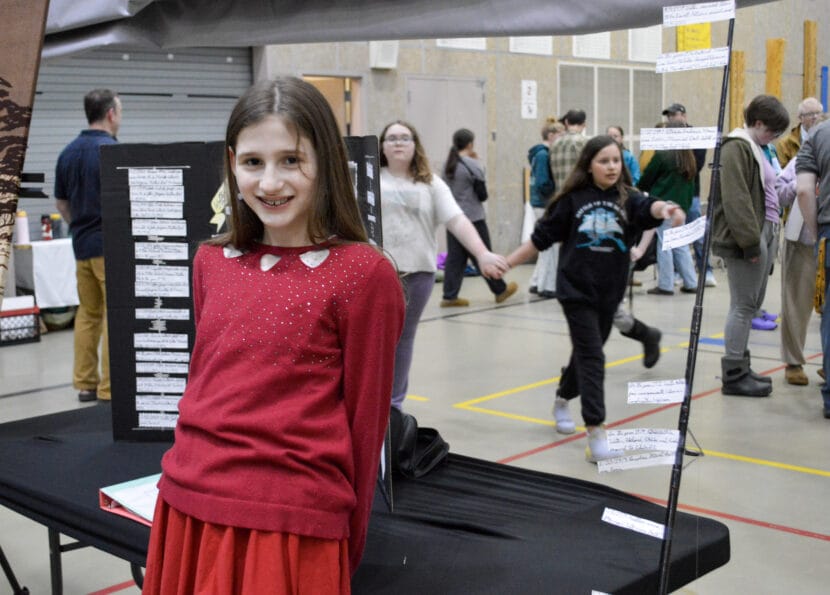
Sixth graders in Juneau’s Montessori Borealis program recently showcased their family histories with presentations they spent months working on.
It’s the capstone project for their grade level — and the presentations parallel southeast Alaska’s history, too.
Parents and siblings lined up in the hallway outside the Dzantik’i Heeni campus gym on May 14, waiting to see the culmination of their sixth graders’ hard work.
Teacher Cory Crossett held the door open. He helps lead the project and said it was already a tradition when he started 20 years ago.
“I think one of the things that Montessori emphasizes is that people came before us, and we need to remember that we stand on their shoulders and their accomplishments,” he said. “And I think that ultimately we want children to wonder what their own contribution might be.”
Each student outlined the life story of a person in three different generations of their family. They made a migration map, a family tree, and brought in artifacts from their families’ stories. They had 10 minutes to present everything they learned, and read a memoir — a story from their own lives that taught them something.
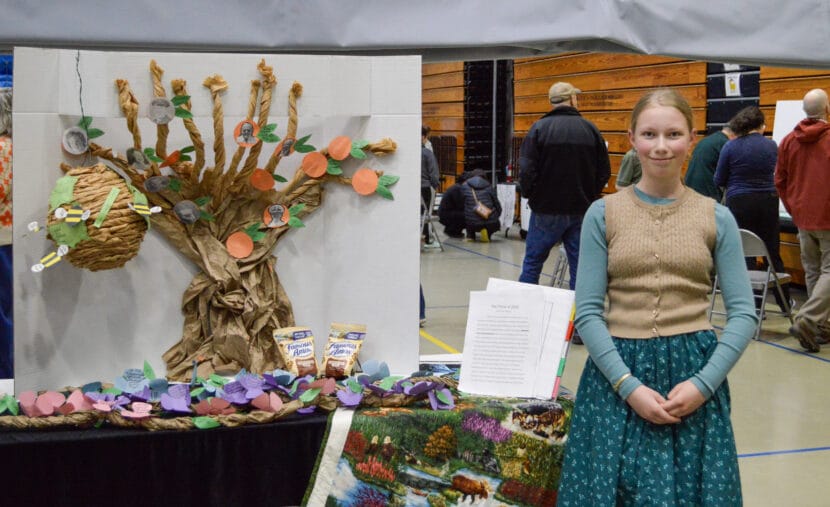
As soon as Crossett started the timer, the students began racing back through time.
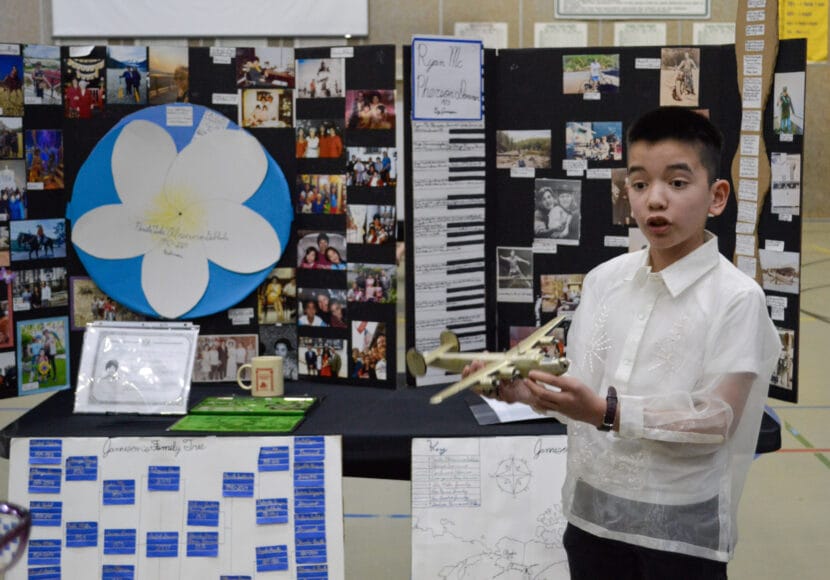
Jameson Danner stood in front of his posterboard, which featured three timelines printed on cardboard versions of piano keys, a Sampaguita flower, and a plane propeller. The last one represented his great-grandpa.
“Another thing that I learned about him was that during World War Two he was an aeronautical engineer and worked with the Consolidated Aircraft Corporation,” he said
Danner held up a small model plane.
“And this is a B-24 Liberator, which is the type of thing that he worked on,” he said.
His great-grandpa grew up in Juneau. At age 14, he and his family raised an orphaned black bear cub on their homestead.
Danner’s family migration map was bright, colorful and far flung, with lines from the Philippines and all over Europe to Juneau, and then shooting back out down the West Coast.
“After moving to Juneau, my family sort of like spread out,” he said. “Kind of like a firework going off.”
His grandmother’s life story was printed on a rotating wheel hidden behind the big white flower. Turning the wheel allowed one moment in the timeline to peak between the petals at a time.
“The flower is the national flower of the Philippines,” he said. “And also she really loved gardening.”
Danner’s grandma died in 2024. Below the Sampaguita flower was a government document with her name and face on it — another family artifact.
“This right here is her naturalization certificate from when she moved from the Philippines to the U.S.,” Danner said.
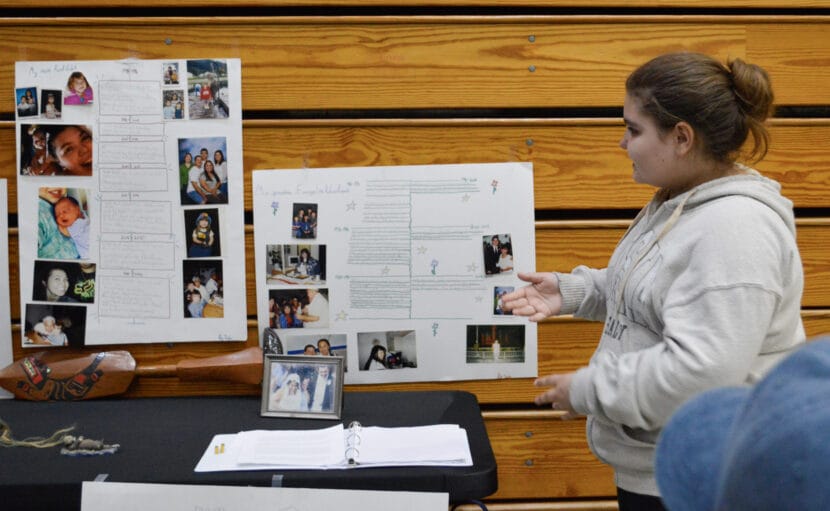
Across the gym floor, sixth grader Taylor Kubik started with her mom’s life story. It’s full of ups and downs.
“One thing that I didn’t know was that in 1993 her grandfather actually got in a logging accident and was sadly killed, and in 2003 she was the first middle school girl to join hockey in Juneau and she made the newspaper, and in 2006 she was hungry and was in Walmart and stole popcorn chicken,” she said. “In 2014, the biggest life-changing event: I was born.”
Next, she went back about 70 years in time to her great-grandmother’s story, which intersects with Southeast Alaska’s history.
“In 1944, when she was only five months old, the town that she lived in burnt down — Hoonah, Alaska — and they had to rebuild the whole town,” she said.
Kubik showed some of her artifacts.
“Over here we have regalia,” she said. “I didn’t bring like the real one with all the stuff on it, because I didn’t want it to break or anything. And here is a rattle with Raven. I danced with this at Celebration.”
She ended with her memoir, which was about her switching schools and being nervous about the change.
“I looked around and was taking all this in. It felt very peaceful, not too loud and not too quiet,” she read, describing her first day at Montessori Borealis. “For some reason, it smelled like maple leaves with a hint of chemicals. The sun was shining, and there was no clouds in sight. The air was cold on my skin. There was a slight breeze. I didn’t know I was looking at my future best friends.”
And the rest is history.