
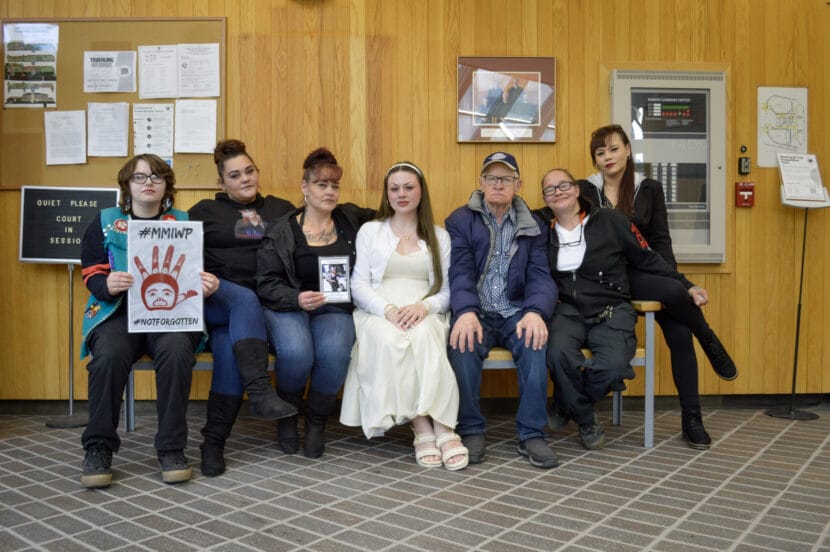
This is part one in a three-part series about Tracy Day and her family’s ongoing search for answers.
May 5 is a day of awareness for Missing and Murdered Indigenous People. For many families, it’s a reminder of cases that are still open and may never close.
Like Tracy’s Day’s case. Day is a Lingít woman from Juneau, who went missing in 2019.
Last year, Day’s family requested a death declaration hearing as a way to ask police officers questions about their investigation. But the judge said their questioning wasn’t allowed – even though it was allowed for the family of another Alaska Native woman who went missing elsewhere in the state.
Listen:
For the last seven years, Day’s daughter, Kaelyn Schneider has been using TikTok and other avenues to draw attention to her mother’s case. Day’s disappearance fits a broader pattern of Indigenous women who go missing or are killed at rates far higher than non-Indigenous women.
Last year, Schneider petitioned the state to have her mother declared dead. For her, this was a chance to prod Juneau police officials publicly about the investigation into Day’s disappearance – to finally get some answers.
But the presumptive death hearing didn’t go that way.
“I was hoping to ask JPD a few questions,” she said during the hearing. “I didn’t realize that I wasn’t going to get that chance. So I guess it doesn’t really matter, because I had some questions that I was that I felt were important to the case, but–“
Judge Peggy McCoy did not allow her to ask them.
“Well, this is not about the investigation, it’s about whether they believe she’s still alive,” McCoy said.
After the hearing that legally declared her mother dead, Schneider told KTOO she had spent weeks preparing for the chance to ask officers questions.
“We don’t care about a death certificate. We just wanted to tell her story in a legal setting and make JPD answer our questions. That’s what this was about.”
Schneider was not off-base to think she’d be allowed to question police officers. She had reason to think this.
One year earlier, at another presumptive death declaration hearing in Anchorage for a different missing Alaska Native woman, the woman’s family was able to ask police questions about their investigation.
The woman’s name was Cassandra Boskofsky. She went missing in Anchorage in 2019, just months after Tracy Day disappeared.
Five years later, with prompting by MMIP advocates, Anchorage police connected a photo of a woman found on the phone of serial killer Brian Steven Smith with Boskofsky’s missing person case.
Boskofsky’s death declaration was a result of this information: that she was likely killed by Smith.
The judge at the Boskofsky hearing allowed the family to ask questions about the investigation.
“Ms. Boskofsky-Grounds, are there any other questions that you think this witness should talk about before we ask the jurors?” Judge Brian Clark asked Boskofsky’s cousin Marcella Boskofsky-Grounds in a recording of the 2024 hearing.
Clark also allowed family members to read testimony they prepared, and said information the family and advocates brought to the hearing was admissible.
“Like I said, this is not an adversarial proceeding,” he said at the time. “Nobody is going to object to that.”
MMIP advocate and former Alaska law enforcement officer Michael Livingston said later he thought Marcella Boskofsky-Grounds being able to ask questions of the officials allowed the family to regain a lot of agency.
“She interviewed the witnesses when they were under oath on the stand in front of a jury and a judge,” Livingston said. “And so I think it was empowering for her to go from feeling completely powerless, having a relative missing and not hearing anything for five years, to having the opportunity to ask a tough question for the police officers.”
Now, more than a year after the hearing, Boskofsky-Grounds said the experience was intense. Though Judge Clark told her before the hearing she would be able to ask questions, the family didn’t have much time to prepare.
She says it was an emotional rollercoaster.
“Because what Brian Steven Smith did to us was really take our heart, man, and Cassandra, she was a big part of my life. And I don’t know it was kind of, it was relieving, in a sense, heart wrenching,” Boskofsky-Grounds said. “I had all kinds of mixed emotions going on at that time.”
She suspects that nationwide media coverage and attention on Brian Steven Smith was part of the reason the courts gave them so much power during the hearing.
Tracy Day’s family, however, wasn’t given this same opportunity.
Now, nearly a year later, Kaelyn Schneider said the hearing is still a painful memory for her.
“I actually stopped talking about it for a while, because I was so just deeply traumatized by the situation,” she said.”
For Schneider, the presumptive death declaration was a Hail Mary — a chance after so many years to get JPD to re-investigate the case.
“For a while I was feeling pretty hopeless about it,” she said. “It was really hard, because I felt like that was our last ditch effort. You know, we had nothing. We had no body, no proof that a crime occurred.”
She said it was important to her to ask JPD questions about their investigation into her mother’s disappearance in front of a public audience. She saw posts on social media by other MMIP advocates who said these hearings were a way to question investigators.
“When we came up with the idea it was like, ‘Oh my god, this is genius.’ Because it’s a legal loophole where we can force them to be in a courtroom answering these questions, and they can’t just say no,” Schneider said.
And Schneider still wants the answers to the questions she prepared to ask JPD at the hearing.
“I really just want to know, like who they looked into, what evidence they have, and if they plan on doing anything,” she said. “Or if they’re just going to leave it open and unattended by an investigator.”
Juneau police say they will investigate new leads as they come in, and they are reevaluating their procedures for communicating with families of missing people.
Rebecca Koford, a spokesperson for the Alaska Court System, said that aside from brief guidelines in the District Court Rules of Civil Procedure, it’s up to the judge how witness testimony will be presented in death declaration hearings.
In part two of this series, we’ll examine the questions Schneider wanted to ask Juneau police at Tracy Day’s hearing.
Correction: This story has been updated to correct where Rebecca Koford works. Koford works for the Alaska Court System.
