
This is Tongass Voices, a series from KTOO sharing perspectives from the homelands of the Áak’w Kwáan and beyond.
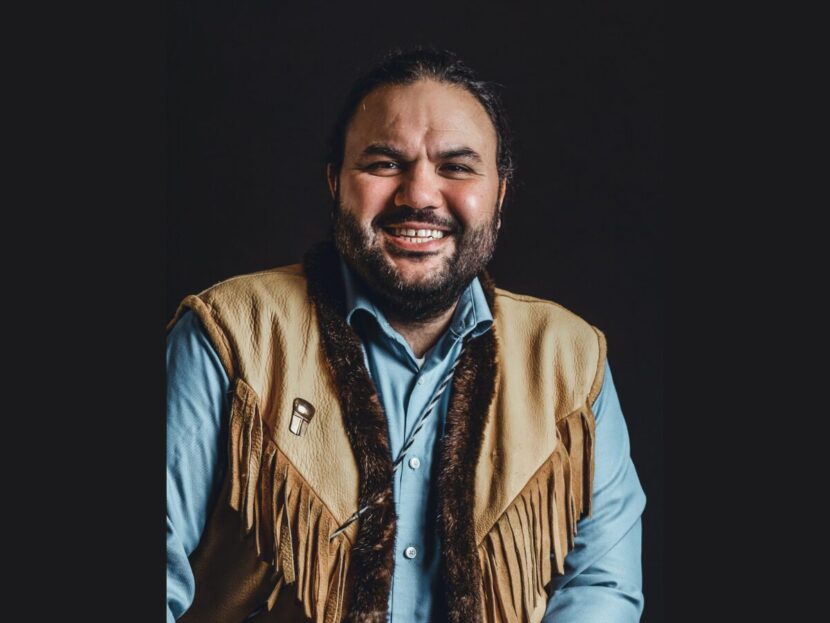
Shaakindustoow Ed Littlefield is a Lingít composer and musician from Sitka. For the past three years, he’s been a part of a team composing what will be the first full opera in the Lingit language. It’s about the Battle of Sitka in the early 1800s.
Littlefield composed the music and Juneau-born musician Rory Stitt arranged it, assigning pieces to different instruments.
The Juneau Symphony will perform the opera’s overture, titled “Kutulagaaw,” for the first time this weekend. The opera itself premieres in September.
In this story you’ll hear samples of Littlefield’s compositions.
Listen:
This transcript has been lightly edited for clarity.
Ed Littlefield: Creating experiential music all in Lingít is a pretty amazing thing for us to do together. So the entire piece is being told by the Lingít perspective. So it’s all in Lingít.
We’re trying to do it in Lingít for Lingít’s sake, not for anyone else’s sake, even though we want people to understand the story, so we’re still working on that. You know, how can people have the best experience while listening to another language?
Shaakindustoow yóo x̱at duwasáakw. Kaagwaantaan áyá x̱at. L’uknax.ádi yádi x̱at sitee. Kaagwaantaan dachx̱án. Ḵook Hít áyá x̱at. Sheet’ká Ḵwáan daak naax̱ x̱at sitee.
My name is Ed Littlefield, and Shaakindustoow and I am from Sitka, and we’re going to talk about the Juneau Symphony’s world premiere of the Lingít opera overture.
The first step since an opera is sung: it has to have lyrics. And so Vera Starbard wrote the libretto, which is essentially all the text that goes into the story. And it is the story of the battles of Sitka, between the Russian and Lingít people. And it is all historically based and oral tradition. And there’s a book called Russians in Tlingit America [WEB: by Nora Marks Daunhauer and Richard Daunhauer], where a lot of this information was taken from.
And so Vera created a story based on historical context. Then it was translated by X̱’unei Lance Twitchell. So act one gets sent to me with all the text and all the story for that one part.
And then I start writing, you know, and trying to think about themes of different things, of different moments. What’s the feeling?
And the really cool part for me was that I tried to keep all the melodies—if you were to take out the violin, the viola, the piano and the percussion, if you were to take all of that out, you could add a hand drum to the voice and have it be almost like a traditional song. So even though it’s got all very complex rhythms going on beneath there, it’s still at its core Lingít.
An overture in a musical or larger work is usually a way for audiences to become familiar with the themes that are happening. What I did is I took four main themes that happened and fleshed those out.
Rory got a lot of really cool ideas about like adding different sounds, like one—I just loved what he did—he took one of the lines, which is a really low rumbly line, like a bass line. He goes, “We’re putting that in contrabassoon.”
So we got a contrabassoon in there playing like eight bars of really low rumbly sound. But that really does set a vibe, or a feeling of what’s going to happen in the opera and so, yeah, it sets the tone of, you know what you’re going to hear.
For the main opera, I think of resilience as a key word. There’s strength in Lingít people that I wanted to show.
If we’re going to uplift the language, we should use the language, and that’s the way people learn. And if we get a ton of it, more people might learn some more Lingít out of that.

