
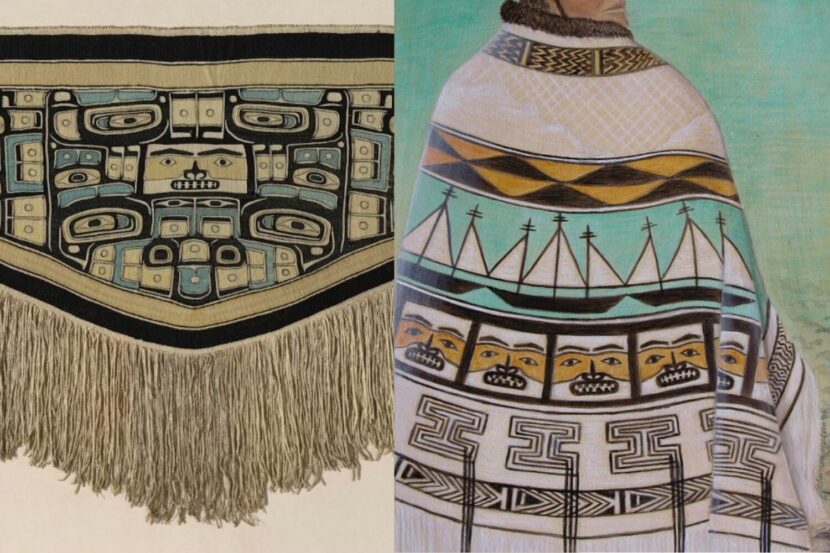
Two Chilkat robes — one very old, one not yet on the loom — will soon belong to a Lingít clan as they work to rebuild their clan house in Sitka.
In the last year, California sculptor Bruce Beasley started to think about how he can repatriate his collection of Indigenous art to the people who made it.
“I’m going to be 87 in a month,” Beasley said. “And I was afraid that if I didn’t get this done myself, that when my family took over the house, they would just give it to the local museum, and I didn’t think that was the best thing to do.”
Nick Cline is a partner at Alaska Premier Auctions & Appraisals. Beasely first reached out to him about a narwhal tusk in his possession, but — as Cline describes it — their conversations turned to other items he owned.
“And it really got the gears turning in my head. What else might Bruce have in his collection?” he said. “So we started poking and prodding a little bit. And a week or two later, he sent over a picture of this, this gorgeous robe.”
The robe is dated to the 1890s. Beasley got it in 1967, when he traded one of his sculptures for it to the owner of a gallery in Seattle. It’s been in his home since. He told Cline he wanted to donate the robe, and Cline thought of Kiks.ádi clan member Jerrick Hope-Lang, who has been working to rebuild his clan house.
“I think that would be a perfect fit, on account of his clan as somebody who’s actually going to use the robe and ceremonies and see it brought back to life for the people,” Cline said. “As opposed to having it go and where they’re in a collection that may or may not ever be seen again.”
Hope-Lang has been fundraising to rebuild the Point House clan house in Sitka. He said the robe’s design — a diving whale — is common and not associated with specific clans. In Kiks.ádi possession, the robe will be danced, and brought out for ceremonies, he said.
“Things were created for purpose,” he said. “And what this does is it places purpose on it, the purpose it was designed for and used for. So we’re excited about the opportunity to display it and have it back and be stewards of it and take care of it.”
This robe’s return to Southeast Alaska coincides with the creation of another robe.
The book “Anóoshi Lingít Aaní Ká: Russians in Tlingit America” outlines a significant period in Kiks.ádi history. On its cover is an illustration of a robe that doesn’t exist. The weaver who designed the robe for the cover is Clarissa Rizal, who died in 2016. Hope-Lang has been working with that weaver’s daughter, Kadusné Ursala Hudson, to bring it to life.
“We need the past and we need the present,” he said. “And how do you merge those two together? And they’re questions that we’re going to find in community, and we’re going to continue to create.”
He envisions the two robes, old and new, standing together in Kiks.ádi ceremonies.
Hudson said robes are more than just material objects.
“We know that these belongings are our relatives,” she said. “They’re our ancestors”
While the process of bringing the diving whale robe back to Southeast is repatriation, the practice of creating new robes is rematriation, she says.
“So rematriation is the return of ways of being, and not just the return of belongings,” Hudson said. “And it’s the return of ways of relating to one another and with the land and with each other, with other clans, with other nations and with ourselves. And so it goes beyond just getting our material culture back. and yeah, both are absolutely necessary.”
The diving whale robe arrived in Sitka earlier this week and will be brought out and danced at the Pink Martini Point House fundraiser in Sitka and Juneau this week. Hope-Lang hopes to bring it to Celebration in June as well.
