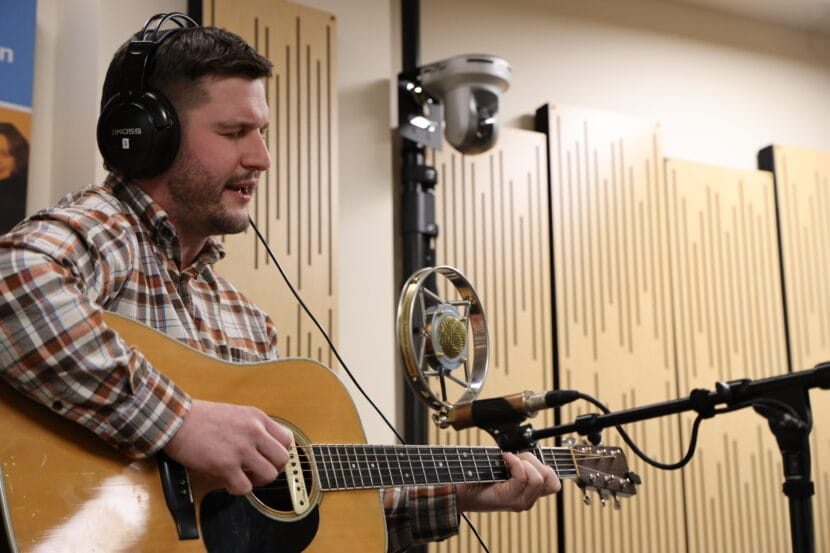
The 51st Alaska Folk Festival will feature about 125 acts on the main stage – and that’s just one piece of a much larger production. Beyond Centennial Hall, performances fill the dance hall at the JACC and a full schedule of workshops adds to the mix.
So how does it all come together? KTOO’s Mike Lane spoke with Folk Fest Board President Josh Fortenbery about the logistics behind the festival and what it takes to make it run smoothly.
Listen:
This interview has been edited for length and clarity.
Mike Lane: The Alaska Folk Festival is coming up April 6 through the 12th, and the Alaska Folk Festival Board President Josh Fortenbery joins us in the studio.
Josh, the 51st annual Alaska Folk Festival, it’s coming up quick. There’s going to be performers from all around Alaska and from all over the Lower 48. How many performers are going to participate this year in total?
Josh Fortenbery: So, you know, I don’t know if I know the exact number of total performers. We have about 125 acts on the main stage, and then about 12 acts in the dance hall at the JACC, and then somewhere around 32 different workshops going on.
Mike Lane: How do you get so many performers to come to Juneau and perform? I mean, what’s the board’s process on that?
Josh Fortenbery: Well, you know, a part of it is just this festival has become kind of legendary among musicians, because it’s all about the music. It’s not about anything sort of commercial or trying to make money or trying to get sponsorships. It’s just here for the joy of music. So a lot of people return year after year. This year, we had over 200 applications for 125 slots in the main stage.
Mike Lane: So how do you select performers for this?
Josh Fortenbery: It’s a little bit science, a little bit art. You know, we really try, when we have this many applications, to get as many people on stage as possible. So, you know, it’s a lot harder sometimes for us to find slots for all the solo performers. A lot of times we try to get bands up there first, you know? We have a few solo performers, probably five to seven every concert. There’s nine concerts. But then, you know, we’re trying to get bands up there so we get as many people on stage as possible. And then for the solo acts, you know, we try not to waitlist people too many years in a row, and we do our best to get people up there who’ve been waitlisted in the past. There’s certainly no audition. We don’t listen to anyone’s music ahead of time. We read their application, we see what days they’re available. And that’s the other thing. You have people traveling, often they’re only available Thursday through Sunday. So, you know, there’s a lot of competition for those slots. And we do our best to get as many people on stage as we can.
Mike Lane: Okay, so earlier, you said it’s not about the money. However, how does Alaska Folk Festival, Inc. pay for and organize such a huge event?
Josh Fortenbery: Yeah. So really, we have three kind of key revenue streams. The most — the biggest one — is member donations. So we have a little over 800 members now, and they all, you know, have varying levels of contributions, but they are our primary funder. We sell ads for the program every year. That’s another way we pay for some of the festival. And then we sell merchandise. So we have an artist every year who designs our poster. We use that poster art to make merchandise. We sell merchandise at the festival.
Mike Lane: I’m glad you brought up the artist, because I wanted to ask you about the guest poster artist, Savannah LeCornu.
Josh Fortenbery: Savannah is a self-taught artist from Ketchikan, Alaska. She was recipient of the Native American fellowship from UCROSS, where she did a residency in 2022. She created sort of an incredible poster for us this year, which sort of features some northern lights and the downtown cityscape pf Juneau and some musicians. And we’re super excited about the art we got.
Mike Lane: In addition to all the performers, there’s a lot of people who travel to Juneau for Folk Fest. So do you know how many people typically attend?
Josh Fortenbery: We usually estimate that our program gets 5,000 6,000 views every year. So that’s that’s a, you know, that’s a pretty good estimate of the number of attendees of the main hall. Now, there are a lot of people who come to town to participate in the shows at the bars around town, or just to jam who don’t maybe come to the main hall, so probably somewhere north of there right now. We are working on getting a grant to do an economic impact study, sort of figure out exactly how people come to town, how much money we bring into Juneau every year, to sort of help the city understand what a big impact the festival has on Juneau.
Mike Lane: With that in mind, how many venues are we talking about?
Josh Fortenbery: So I mean, the things that we run really, are just Centennial Hall in the JACC. So the board itself puts on the, you know, the festival that happens here. But there are — you know, luckily, a lot of local businesses participate. So this year, I know that there’s going to be shows at the Crystal Saloon, at Devil’s Club Brewing, at the Alaskan Hotel, at the Red Dog Saloon. In the past, we’ve had shows the Imperial. There’s gonna be pop up stuff all around town. I know that. You know, Amalga Distillery always welcomes jammers in there, and you’ll see musicians sort of everywhere, in every business all around town.
Mike Lane: And there’s workshops too, correct?
Josh Fortenbery: There are workshops. So there’s workshops all day, Saturday and Sunday. Those take place in Centennial Hall or the JACC, and they feature workshops put on by our guest artist, Willi Carlisle, our guest dance band, the Red Hots, our guest dance caller Connor. So there’s going to be a really great series of workshops, and a lot of these are put on by people who are professional musicians, who are coming to donate their time, who are just attending the festival for fun.
Mike Lane: How can the public help keep the Alaska Folk Festival going in the future?
Josh Fortenbery: The best way is to become a member of the festival. So the lowest member level is $25 you can now have a recurring donation that really helps us make sure this remains free, open to the public. All of our workshops are completely free to everyone. But the other way is volunteering. So you know, no one on the board is paid other than the people who run sound for us, no one who’s putting on the festival is paid at all. So we have hundreds of volunteers every year who help us set up the stage, who help us sell merch, who help us sort of put on the workshops. So signing up to be a volunteer for the festival is also a great way to help. If you if you can’t make a financial contribution.
Find the full schedule for this year’s mainstage performances and JACC dances here. Tune in to KRNN on the radio to listen and ktoo.org/folkfest to watch live during the festival.