
Winter maintenance of streets, supporting schools and public safety are the top budget priorities of more than 4,000 Juneau residents who took a city budget survey earlier this year.
The data will help inform the Juneau Assembly as it decides what city services to fund — or potentially cut — to mend a multimillion-dollar budget hole.
Juneau residents had a lot to say about how they’d like to see the City and Borough of Juneau prioritize its funding ahead of this year’s difficult budgeting season, according to a presentation given at the Juneau Assembly committee of the whole meeting Monday night.
Meilani Schijvens is the owner of Rain Coast Data, which conducted the survey. She said 4,400 residents responded to the survey that was sent out in January and wrote more than 6,000 comments to the city.
“That’s equivalent to the community of Juneau collaboratively writing Moby Dick,” she said.
The survey comes after last fall’s municipal election, in which Juneau voters approved municipal tax cuts. That created an estimated $10 to $12 million recurring hole in the city’s budget. The Juneau Assembly has to figure out how to mend that gap before the next fiscal year begins on July 1.
The survey asked residents to pick which city programs and services are most important to fund and which services are least important to fund. The city released the 474-page results to the public on Monday.
According to the results, the city service most respondents selected to prioritize is winter maintenance of streets, roads and bridges, with 58% of people putting it in their top priorities. After winter maintenance, more than half of the respondents agreed on prioritizing schools and K-12 education, and public safety — including police, fire and emergency medical services.
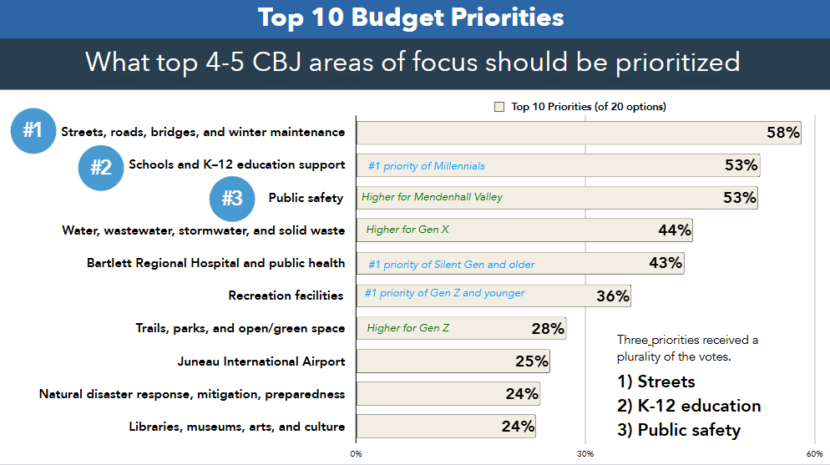
“So really, just the core elements that the municipality provides, the community said, ‘these are the things that we do not want to cut’,” Schijvens said.
Schijvens said that the survey was intentionally designed so that respondents could only choose a handful of priorities out of a large list of city services.
“Someone said, ‘I had to leave off choices I strongly support to keep my list short,’ and I think that encapsulates this very well,” she said. “It was a forced prioritization exercise.”
On the flip side, surveyors were also asked to rank what services from that same list they’d support budget cuts to. The data shows 62% of respondents chose tourism management, and visitor infrastructure, followed by 44% who chose climate action and energy efficiency. About a third chose economic development and workforce support as their lowest priorities for funding.
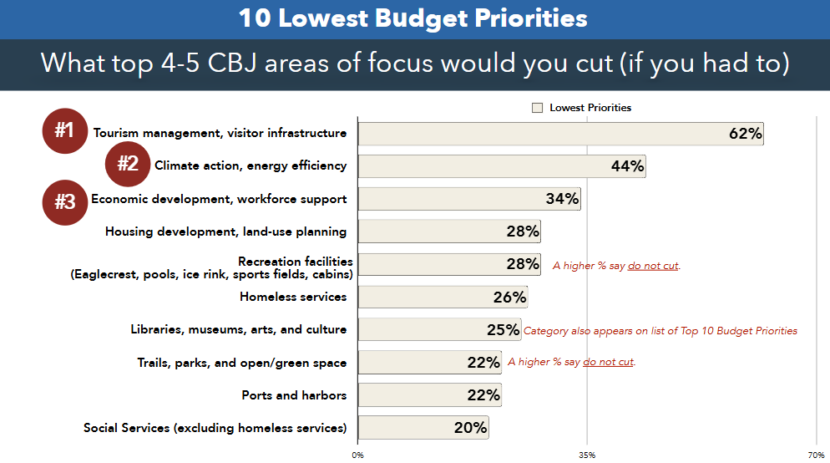
City programs and services like recreation facilities, libraries, museums, arts and culture, and trails and parks landed somewhere in the middle between most people’s top and lowest priorities.
“Choosing to make cuts there or choosing not to make cuts there will be controversial because there’s a similar level of support or some level of support on each of those top 10 lists,” she said.
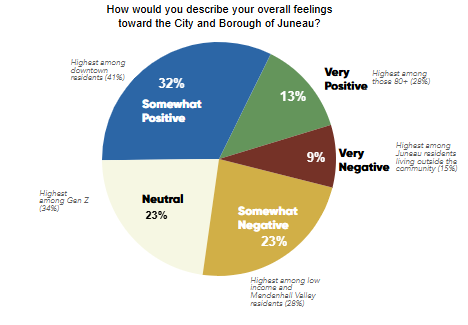
Residents were also asked how they felt about the City and Borough of Juneau overall. Forty-five percent of respondents said they felt somewhat or very positive, while 23% felt neutral and 32% said they felt somewhat or very negative.
The city asked respondents to rank community values, and the one most chosen was “making Juneau a place where working-age residents and young families can live, work, and stay long-term.” The two strategies for increasing city revenue that received the most support were property tax changes and increasing fees for vacant buildings or land.
The Juneau Assembly will begin making budget decisions — including any cuts to services — once the city manager releases the draft city budget in March.
