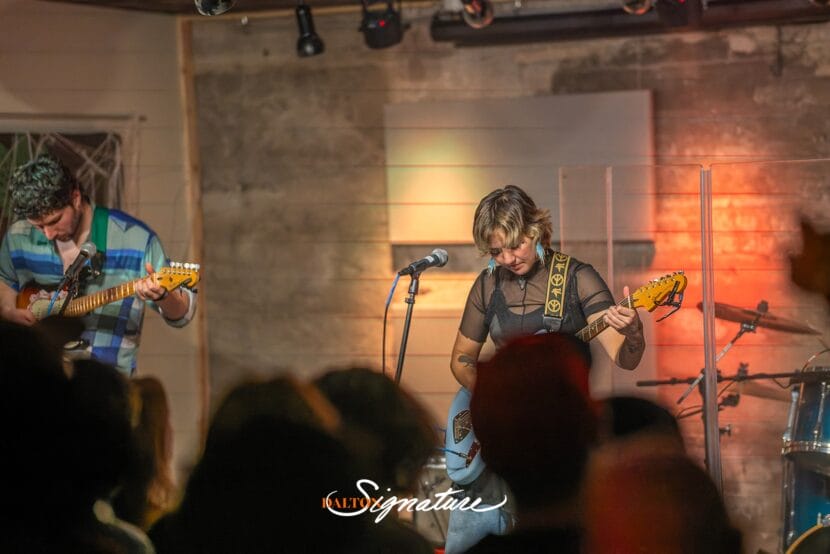
As breweries in Alaska adjust to a legal ruling that could allow them to have unlimited live shows, a different sort of industry is also celebrating: musicians.
Until last month, breweries were limited to hosting four live shows a year. Before 2024, they were banned from having them completely. Now, breweries can host unlimited live music performances.
The ruling comes right on time for musicians and businesses to start planning for the Alaska Folk Festival in April.
Marian Call is a Juneau musician and, as executive director of MusicAlaska, she’s also spent the last few years organizing other musicians across the state to advocate for the industry. She said the recent Alaska Superior Court ruling opens doors for musicians and performers.
“This regulation was ultimately a regulation about when and where musicians can work,” Call said. “It was essentially putting a limit on how often and in what locations we can do our job.”
The ruling argued that the regulations that limited live shows at breweries suppressed free speech. The lawsuit didn’t specifically include distilleries, but at a recent Alaska Alcoholic Beverage Control Board meeting, board members said they believe those businesses will fall under the same ruling, and be able to have unlimited live music as well.
“It makes sense for the government to regulate various industries. But the thing that was so difficult about this particular regulation was that they were not intending to regulate the music industry,” Call said. “They were intending to regulate the alcohol industry.”
She said musicians are a force in Juneau. More performances in town don’t create a zero-sum game, economically. Call said MusicAlaska researches the economic impacts of music in communities.
“Generally, what we see is that more music breeds more economic growth without necessarily undermining other sectors,” she said. “We come into a space where there was no economic activity and create it kind of out of thin air.”
If the ruling holds, this could open doors – financially and creatively – for musicians during the city’s biggest music event of the year, Call said.
“I think Folk Fest excites me the most because it’s really an invitation, not just for everyone to come out and listen and enjoy, but also for everyone to play,” she said. “And I can’t wait to see people feeling free to play anywhere without worrying about it.”
Avery Stewart is a guitarist, vocalist, and writer with local band the Rain Dogs. He said he thinks former limitations have dampened Juneau’s creative spirit during Folk Fest.
“I was just recalling past Folk Fest, seeing signs on the walls of distilleries because they had to put up these signs, like, ‘do not play music here,’ which I thought was so silly,” Stewart said.
He said that impromptu jam sessions are an inherent part of the festival, and now, there’s no risk of businesses or musicians facing fines for them.
“It’s like a communal experience, rather than a performance,” he said. “Just a sharing of music, in its purest forms.”
The Rain Dogs Frontwoman Anna Mahanor said she’s excited to have more places to play in Juneau, and different venues to suit different kinds of shows. She said she wants to be able to play for broader audiences.
“I think that our sound is evolving in a lot of different ways, and we’re experimenting with playing in different places,” Mahanor said “There’s a certain energy that you bring to when you’re playing at, like a bar or a dive bar.”
And a lot of the Rain Dogs shows meet that energy — loud and rowdy. But Mahanor wants to play in quieter venues, too.
“With the idea of there being kind of more listening-room-style, it’s like a little bit more intimate,” she said. “And you can be a little bit more personable with the crowd, you know, and interact and have just a more intimate, vulnerable experience”
The Alaska Alcohol and Marijuana Control Office has until Feb. 14th to appeal the decision.