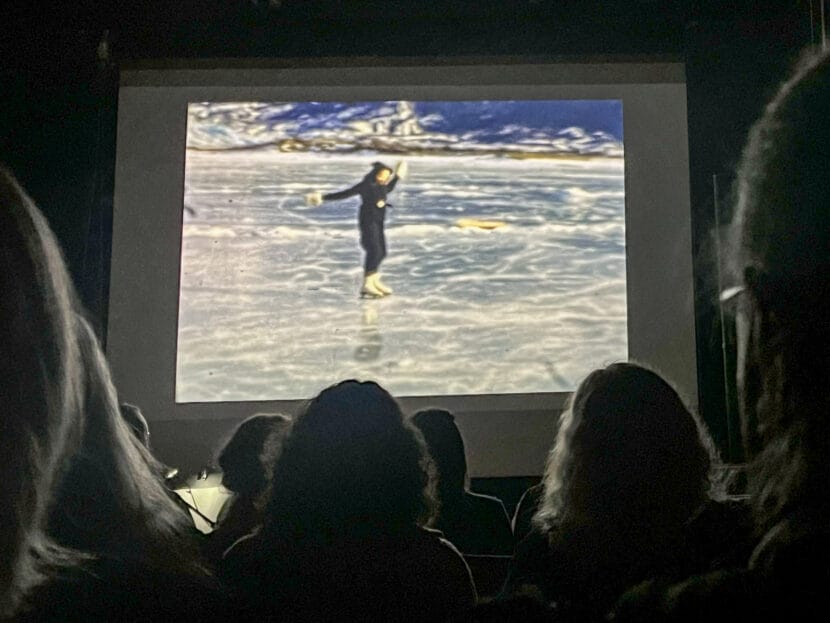
In the packed and dark Gold Town Theater, Karen Miceli watched home movies flick across the screen, while a two-man band played along. They were her own family’s videos, filmed in Juneau between the 1930s and 50s.
Miceli’s grandparents, Harry and Lucille Stonehouse, lived in Juneau in the mid-20th century. Harry worked for the railroad and made enough money to buy a piece of advanced technology — a Kodachrome film camera.
But until now, Miceli had never seen the footage from her mother’s childhood.
“We heard stories about fishing and ice skating and when the lake was frozen, or when Mendenhall Glacier lake was frozen, and my mom would talk about ice skating on it,” she said.
Two years ago, Miceli’s sister donated the family’s 36 color film reels to the Juneau-Douglas City Museum, and with a grant from the Alaska State Museum, the curators sent the reels to Anchorage to be digitized.
Miceli came to town from Washington state to see the films. They show a part of her family history that had only lived in stories before now, and it brought her to tears.
“So that’s why I think I’m so emotional, is just, you know, seeing my mom when she was little,” she said.
Museum staff organized clips into a presentation according to the season, and many of the shots feature landscapes around Juneau. A much larger Mendenhall Glacier drew gasps from the audience. People ice skate on frozen lakes, and ski down sharp turns. Cows lie down in a pasture in Mendenhall Valley. Men and women fish for salmon together along a rocky shoreline. A toddler plays on the beach at Auke Recreation Area.
Some footage shows the 1946 Fourth of July parade, with its marching band, intricate floats and the beloved soapbox derby — where young men built mini cars and raced them through the streets of downtown Juneau.
But some shots were just snapshots of everyday life. Museum Director Beth Weigel said it’s exciting to see even the more mundane parts of life from that time, like kneeling in the flower garden and having a picnic at Sandy Beach, as often, that isn’t what people would choose to document in expensive color film.
“There’s only a limited amount of what we can see into the past,” Weigel said.
And even though this isn’t her family’s footage, Weigel said it can make anyone sentimental.
“They’re just sort of, ‘Oh, what a time to have that ability to be with your family so much and picnic and hang out and do fun things,’” she said.
But, Weigel said, so much of that joy and connectedness is a part of Juneau today.
“I think Juneau’s like that, though, still in many ways,” she said.
And Miceli, with the Stonehouse family, said the full theater gave her a sense of Juneau’s community.
“So many people came out,” she said. “I mean, that’s just amazing to us, because we thought it would be the four of us, and then the Museum people. And then to have this whole thing practically full when we got here—I mean, that’s pretty amazing, the community support and all of that.”
Museum staff say they plan to make some of the digitized films available online in the future.