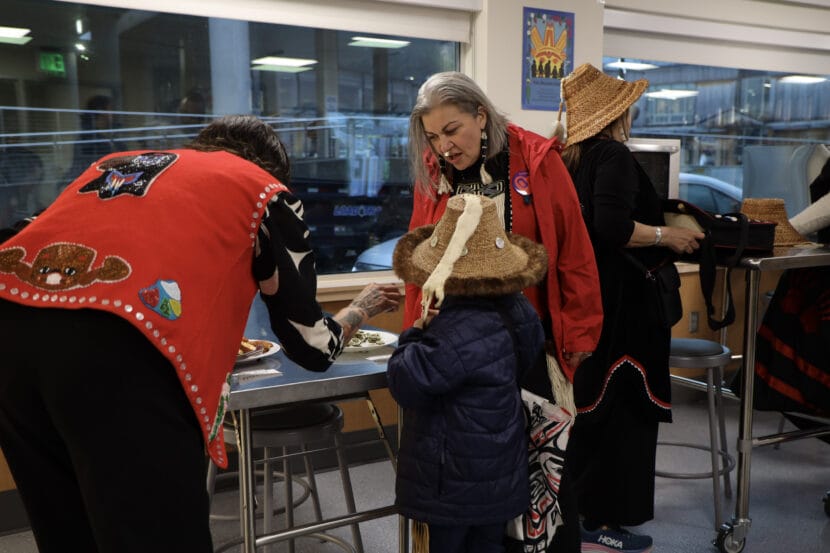
At a ceremony on Monday, Lingít language Professor X̱’unei Lance Twitchell said that bringing traditional ways of being into the present isn’t a contradiction.
“It’s not a ‘living in two worlds’ situation,” Twitchell said. “It’s living as an Indigenous person with multiple languages and multiple identities, and being just fine with it. You don’t have to be just one thing.”
The new Sealaska Heritage Institute Indigenous Science Building carries that sentiment in all the services it offers.
The building on Heritage Way hosts a digital media lab with a podcast booth and video production software, an Indigenous science research lab that studies cultural resources like seaweed and clams and a makerspace with a digital woodcarving machine. That last one made nametags instructors wore as they led tours of the new building on Monday.
In the Traditional Foods and Medicine Kitchen, instructor S’eiltin Jamiann Hasselquist said she and others are bringing old ways to process and preserve food into the present.
“Whatever people can dream up that they would like to do in this kitchen,” Hasselquist said. “I think that we could try to make their dreams happen”
With freeze dryers, pressure cookers, dehydrators and space to build traditional drying racks, Hasselquist said they are making and preserving traditional foods that elders would make when she was a kid, like cheese kaháakw — a rich and smoky paste made of fermented salmon eggs.
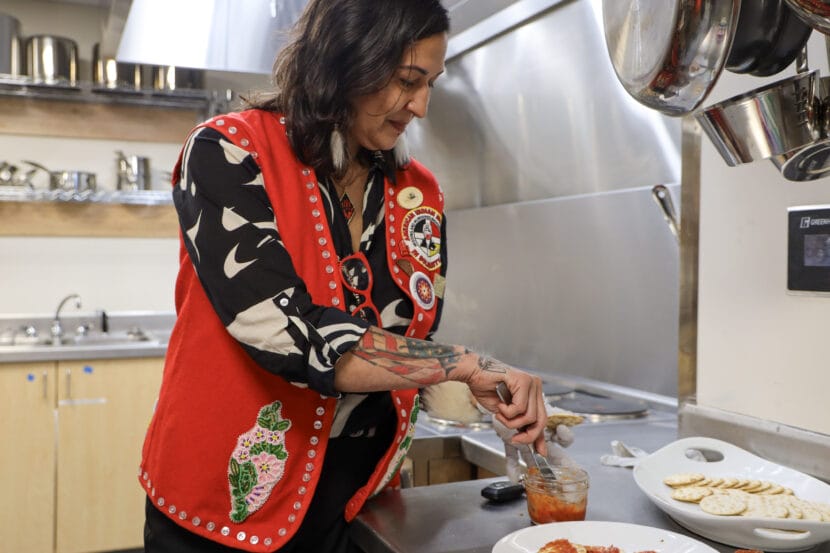
She scooped some out of a glass jar, and spread it on a cracker for anyone who wanted to try it.
“Someone tasted that cheese kaháakw, and they took one bite, and they said, ‘Oh my gosh, I’m getting emotional. I haven’t tasted this for 30 years.’ It’s been three decades, and they thought that they would never try it again,” she said.
Elders have been approaching Hasselquist with foods they remember from childhood, but don’t know how to make.
“So if we could have workshops and share that knowledge,” she said. “And we’re rebirthing, you know, this, this Indigenous way of living and being.”
Next, she wants to find out how to make cold-pressed seal grease.