
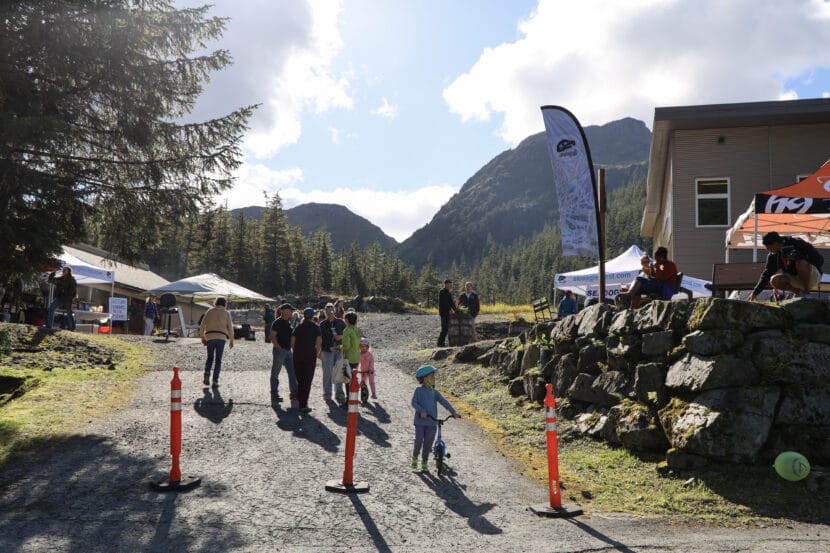
Eaglecrest Ski Area celebrated 50 years of downhill skiing and outdoor adventures in Alaska’s capital city on Saturday. But, the celebration comes amid questions about the financial viability of the city-owned ski area in the years ahead.
A live band played under the sun outside the lodge. Athena Morris was in the crowd with her family. She has been skiing most of her young life. She and her friend said their favorite thing about the local ski area isn’t the skiing.
“It’s the chairlift,” she said. “You get to sit on it and you get to go really high.”
Her dad, Ammon Morris, said his favorite part is the easy access to the sport and being able to share it with his daughter.
“I just love it,” he said. “I feel so privileged that we have this thing — and right in town. It’s just like, 20 minutes from my house. I get here every weekend, and we’re totally doing that this year.”
The Morrises were among the hundreds of residents who flocked to the ski area on Douglas Island on Saturday to celebrate its 50th year of operation. There was live music, food and auctions.
For five decades, Eaglecrest has drawn generations of local outdoor enthusiasts and travelers seeking Alaska snow adventures. It’s the only ski area in town.
Jim Calvin is the board chair for the Eaglecrest Foundation, a nonprofit dedicated to generating community support for the ski area.
“I think it’s hard to understate the value of Eaglecrest,” he said. “It’s hard to measure the value of Eaglecrest to the community, but it really is one of the things that makes Juneau a special place to live.”
Over the years, Eaglecrest has faced criticism for its growing reliance on city funding to build and maintain infrastructure and pay its staff. Now, management is looking to the future. The ski area is attempting to expand its services to operate year-round and become financially self-sustaining.
Calvin said Eaglecrest is at a turning point in its history.
“I think many of us see that summer development opportunities are part of the equation, part of the solution as we move to the next generation of Eaglecrest and we’re working hard to make that happen,” he said.
In the coming years, the ski area is slated to run into a multimillion-dollar deficit. It’s a part of a plan to repair some broken and aging infrastructure while boosting pay to employees and preparing to operate year-round.
Its expansion into summer operations relies heavily on the success of a gondola that the city bought for about $2 million three years ago. Its parts haven’t left the ground since arriving in Juneau, and it’s unclear how much it will cost to get it up and running. But once it’s operating, leaders say it will allow the ski area to stay open year-round and eventually make enough money for Eaglecrest to be self-sustaining.
Hannah Shively, Eaglecrest’s new board chair, said that’s critical to the next 50 years of operation. Eaglecrest’s former longtime board chair Mike Satre resigned earlier this month, saying he didn’t have enough time to dedicate to the position.
Shively said, despite the uncertainty, she thinks Eaglecrest’s future is bright.
“There’s a lot of opportunity to becoming more self-sustainable and maybe even subsidize winter recreation in the future,” she said. “I think it’s all potential, and it’s whether or not we can grab onto it.”
The ski area plans to host another anniversary celebration in January, which is when Eaglecrest officially opened in 1976.
