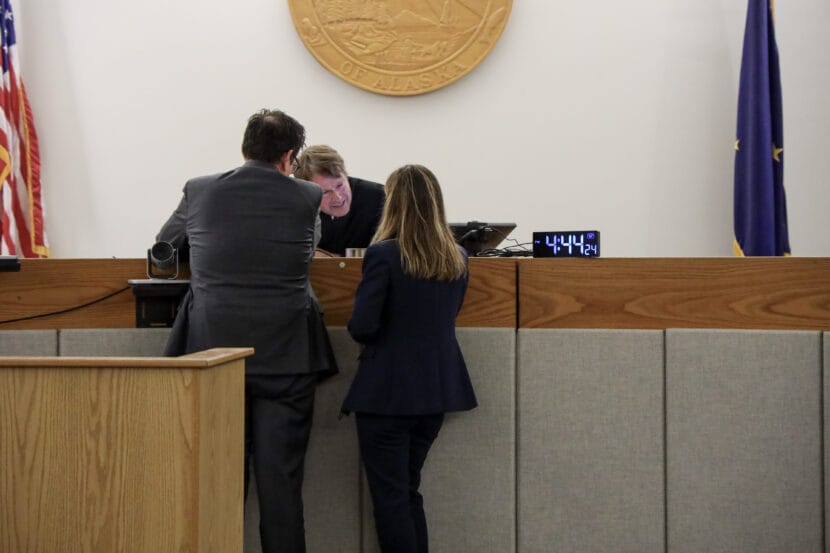
The trial against a former Juneau chiropractor accused of assaulting a dozen patients under the guise of medical care has ended, and jurors are set to begin deliberation.
The former patients that accuse Jeffrey Fultz of assault say the incidents took place during medical appointments between 2014 and 2020 while he was employed at Southeast Alaska Regional Health Consortium in Juneau.
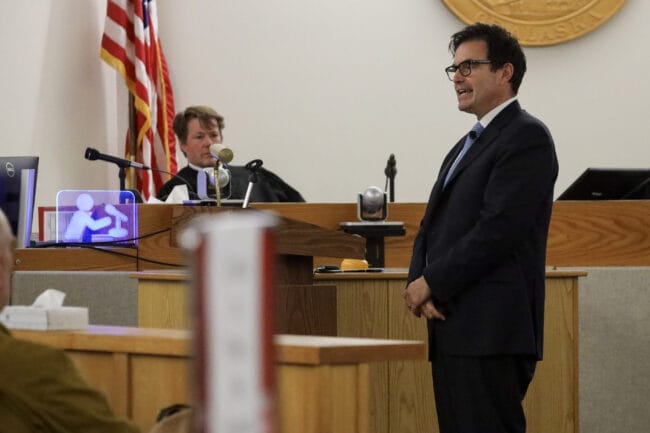
The state prosecutors and Fultz’s defense attorneys gave their closing arguments Friday. It was their last chance to show what all the testimony was intended to prove — or disprove – and to sway the jurors to their side.
State prosecutors argued that Fultz abused his patients’ trust and sexually assaulted them in a clinical setting. Fultz’s defense said that he provided appropriate medical care to those patients.
Prosecutor Krystyn Tendy told the jury that from the state’s perspective, the only verdict that is consistent with the evidence is guilty on all counts.
“He believed that he could count on their silence. He believed he could stay in control,” Tendy said. “But he was wrong. They didn’t stay silent. He is no longer in control. You are in control.”
Tendy said that Fultz took advantage of the power dynamic between doctors and patients. She pointed to witness testimony about the challenges of seeking care, and the pain the women sought treatment for.
“That is a relationship that is supposed to be based on trust that is supposed to be based on the principle of do no harm,” she said. “They are literally putting themselves in his hands.”
The prosecutor said all witnesses — the ones they called and the ones the defense called — showed that Fultz didn’t follow legitimate medical practices.
“This wasn’t about treatment,” Tendy said. “This was about what the defendant wanted to do and what he did.”
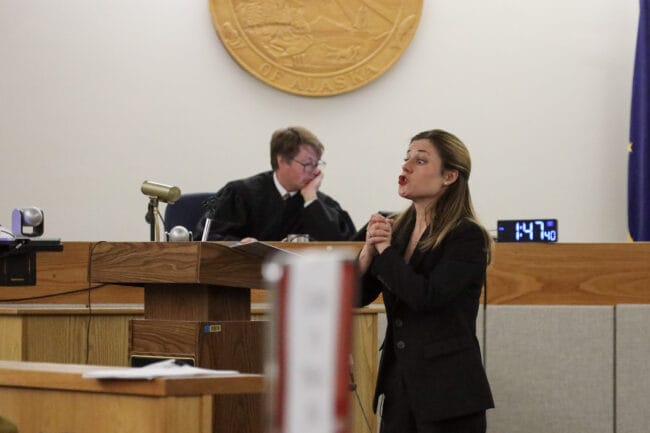
Defense attorney James Christie reminded jurors of Fultz’s education and expertise as a medical provider, and how some of the women accusing him also reported relief from his treatments. He said the questions of informed consent and how exposed the women’s bodies were during treatment come secondary to the primary question.
“Focus on the question,” he said. “Was the treatment recognized, legitimate, and lawful?”
Christie spent some time reminding the jurors of their role, and what it means to deliver a not guilty verdict.
“The first thing I’ll tell you is that criminal cases are not about choosing sides,” he said. “Voting not guilty doesn’t mean you are for Dr. Fultz. It doesn’t mean you are against the state, it doesn’t mean you are against the 12 women. It means the state did not prove its case beyond a reasonable doubt.”
He told the jury to put aside their feelings about victims of sexual assault. He said that criminal trials must come down to the state’s burden to prove Fultz’s guilt, based on more than speculation or probability.
“This is not a heart decision,” Christie said. “This is something that’s going to require thought, careful thought.”
Christie said that most of the women accusing Fultz of assault came forward after reading about initial accusations against him in the media.
He told the jury to deliberate carefully, and remember their duties.
“You all agreed that you would hold the state to its burden,” Christie said. “You all agreed to the presumption of Mr. Fultz’s innocence.”
And Christie told them to carefully consider the weight of their verdict.
“This is not a decision you can undo,” he said.
Jurors will now deliberate until they reach a unanimous verdict. The jury can return a verdict at any time. There is no time limit on their deliberations. The trial lasted six weeks and involved testimony from dozens of witnesses. If jurors cannot reach a verdict, it will be declared a mistrial.