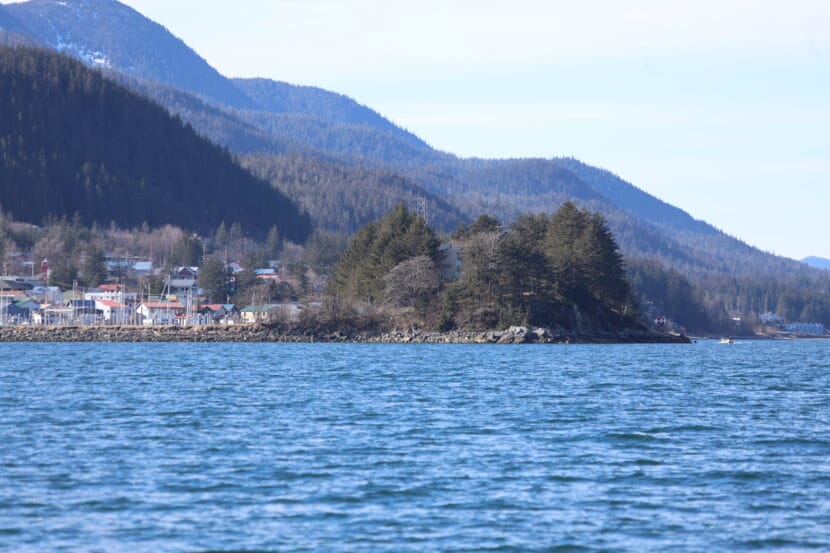
In Juneau, a traditional subsistence site owned by the federal government is now one step closer to returning to its original tribal owners.
On Monday, the Juneau Assembly unanimously approved a resolution to accept Mayflower Island from the U.S. Bureau of Land Management with the intent to give it to the Douglas Indian Association.
Mayflower Island is a small, 3-acre island adjacent to Douglas Harbor and Sandy Beach, and connected to Douglas Island. Its Lingít name is X’áat’ T’áak, which means “beside the island.”
DIA Council member Barbara Cadiente-Nelson spoke to the Assembly on behalf of the tribe’s president.
“This is a significant moment for the tribe, and one that, if we could, have all 800 members would be present to witness this,” she said. “It belongs to the tribe, and we thank you for all the due diligence and the work you’ve put forth since 2012 to this moment.”
Cadiente-Nelson referenced the year when construction workers accidentally unearthed three burial sites at Douglas Island’s Sayéik: Gastineau Community School. Since then, the city and association have collaborated on projects to acknowledge the historical trauma the tribe experienced.
Mayflower Island once served as a traditional subsistence site and yielded a herring run and spawn used by the Douglas Indian Village. The village was burned by Douglas’ city government in 1962. The City and Borough of Juneau formally apologized for the burning last fall.
Tribal member Dionne Cadiente-Laiti said the resolution was more than six decades in the making.
“Sixty-three years later, here we are today looking at this resolution,” she said. “Thank you for writing this resolution to affirm a promise made 63 years ago that this land will be restored to the tribe.”
The property has been under the federal government’s stewardship since 1890 under various departments, according to a spokesperson for the BLM. The island was originally reserved for the U.S. Navy to use as a naval station before it was transferred to the Federal Bureau of Mines, which built a mineral laboratory there. The BLM then took over the property in 1996 and the U.S. Coast Guard used the site under an agreement with the BLM until 2023.
Alyssa Cadiente-Laiti-Blattner thanked the Assembly and city staff for working with the Douglas Indian Association to make the transfer possible.
“Its return represents the restoration of a sacred connection and a step forward in healing historic harm following the city’s apology for the 1962 burning of our village,” she said. “This transfer shows what is possible when we work together with respect, truth and shared purpose.”
Dan Bleidorn, the city’s lands and resources manager, called the approval on Monday a critical step in the process. He said the property transfer will still likely take a few years to complete.