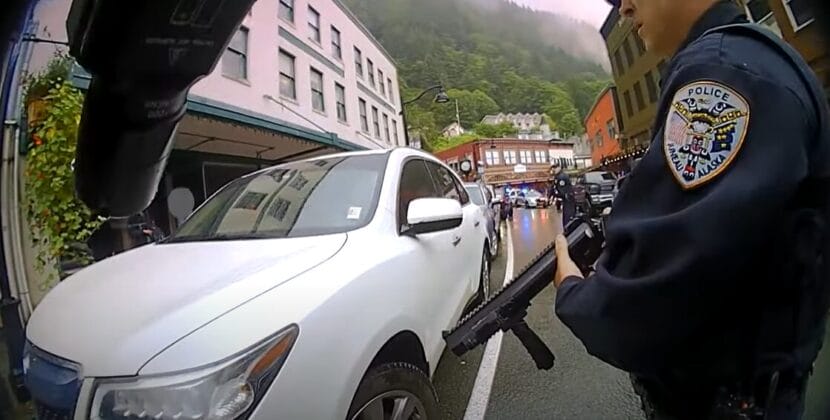
The Juneau Assembly passed an ordinance on Monday mandating that the Juneau Police Department release body-worn camera footage no more than 30 days after a city police officer shoots someone.
It’s a policy that’s been nearly a year in the making. Juneau Police Chief Derek Bos said its approval by the Assembly on Monday is a step toward more transparency between the department and the community.
“I think this opens up the door for us to be transparent at a faster pace with the community, to be open with the community,” he said. “If we make a mistake, we still want to be transparent. We don’t want to hide behind something. If we do make a mistake, we want to be open and honest with our community and build that public trust.”
Juneau officers have been wearing body-worn cameras since 2017, but there’s nothing on the books that dictates when the footage must be released to the public. Juneau residents advocated for that to change after two fatal shootings last year. No one from the public testified at Monday’s meeting.
Last year, it took the department about 60 days to release the body-worn camera footage after both shootings. The department did not release the footage until after the state’s Office of Special Prosecutions investigated the shootings. Both times, the state ruled that the officers involved were justified in their use of lethal force and declined to press charges.
Bos said he’s confident that the department will be able to meet the new policy’s deadline if a shooting occurs in the future.
“Ninety-five percent of the time, maybe even higher than that, the 30 days is going to be a non-issue, and there won’t be concerns,” he said.
Juneau’s new timeline is much more rigid than what the state’s Office of Special Prosecutions requests, which is at least 60 days. According to Angie Kemp, the director of the Criminal Division of the Alaska Department of Law, releasing footage prematurely could taint ongoing investigations.
“From my standpoint and the way that this is currently drafted, I do believe that it’s going to affect criminal prosecution in the community of Juneau — and I don’t say that lightly,” she said at an Assembly committee meeting in March. “I don’t say it because I have some interest in keeping body-worn cameras from being released, other than the effect that it might have on our ability to do our jobs.”
The Anchorage Police Department’s policy mandates that footage be released within 45 days of the incident. But they’ve only met that deadline about a quarter of the time since it went into place. According to a spokesperson for the department, for at least the past two shootings, the delays came at the request of the Office of Special Prosecutions.
Juneau’s policy only allows the state to request up to a 10-day delay for releasing footage and only for a narrow set of circumstances, like if someone’s safety could be at risk by releasing it.
The city manager and the police chief can also request a 10-day delay in certain circumstances and they would be required to provide a reason to the public. The new policy will go into effect in 30 days.