Southeast Alaska’s largest tribal government approved a rule change Friday that greatly reduces the number of representatives from communities outside the region.
Delegates from places like Seattle and Anchorage say the amendment limits the voices from some of the largest communities of tribal members, but delegates from Southeast say this gives rural tribal members more of a voice.
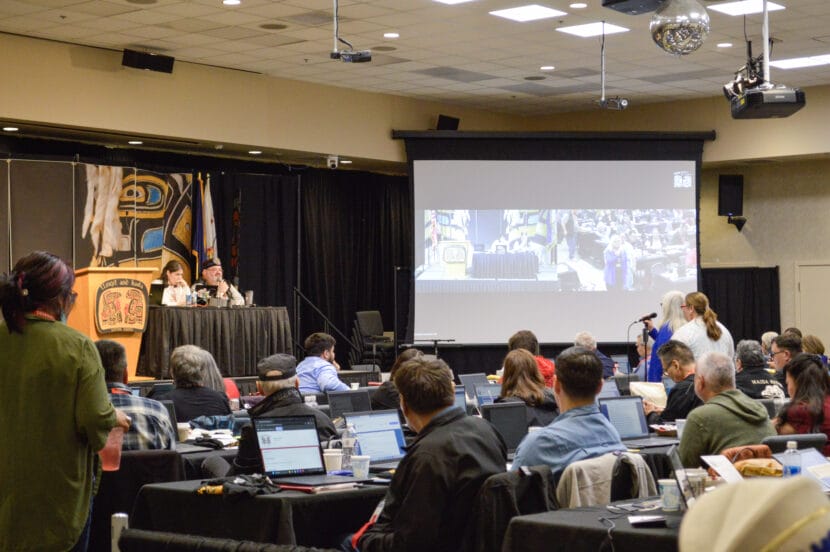
Friday was the last day of the Central Council of the Tlingit and Haida Indian Tribes of Alaska’s 90th tribal assembly in Juneau. The majority of delegates approved an amendment that reduces the maximum number of delegates from urban communities like Anchorage, Seattle and San Francisco to four delegates each.
One of Sitka’s delegates, Gerald Hope, said a larger proportion of representation from tribal villages would show support to those communities.
“The village communities are hurting really badly. How can we stand with them?” Hope said. “One of the things in this kind of form of government is to give them a modest increase in voice.”
The five-hour debate brought up questions of representation and belonging, and what leads people to leave their home communities.
“Those of us who live in urban areas are there for things that are out of our control,” said Anchorage Delegate Tasha Hotch, who said she left Southeast because of domestic violence.
“I’ve tried to move back to Juneau, I’ve tried to move back to Klukwan,” she said.
Other delegates who live in Anchorage and Seattle said that lack of opportunity and financial stability led them to leave their villages as well, but this shouldn’t limit their voice as tribal members.
According to representatives from Tlingit and Haida, the amendment is part of a broader plan to review the structure of government to better reflect the tribe’s citizenry.
It would also reduce Juneau’s delegation — and any within Southeast Alaska — to 20 people. Even with the reduction, Juneau will be allotted the most delegates in the assembly.
Before the amendment passed, Seattle was tied with Juneau with 25 delegates that represent the community’s interests to the broader tribal government. Communities elected one delegate per 200 tribal citizens. But this resolution raises that threshold to 275 citizens.
Seattle has the most enrolled tribal members of any community, with more than 9,000. Juneau has more than 7,000.
The resolution doesn’t propose any changes to tribal services in communities like Anchorage and Seattle, where Tlingit and Haida has offices, but the delegates that came from those communities said representation itself matters too.
Karen Elliott-Lauth, from Seattle, asked for more time to compromise on the resolution.
“So I’m just asking you guys to table this,” she said. “Let’s get together and make solutions instead of being so divided, that’s all I ask.”
Wrangell Delegate Mike Hoyt grew up in Seattle, so he empathized with what tribal members from urban areas are feeling about the loss of their delegates. But he says it’s vital that voices in the villages are heard too.
“I think what people are feeling, and the concerns that you guys have in terms of silencing of voices or having maybe a lack of that balance, is what the villages currently are feeling,” Hoyt said.
Despite the emotional testimony, speakers expressed respect for the other delegates present.
The amendment passed 63 to 52, and it takes effect immediately.