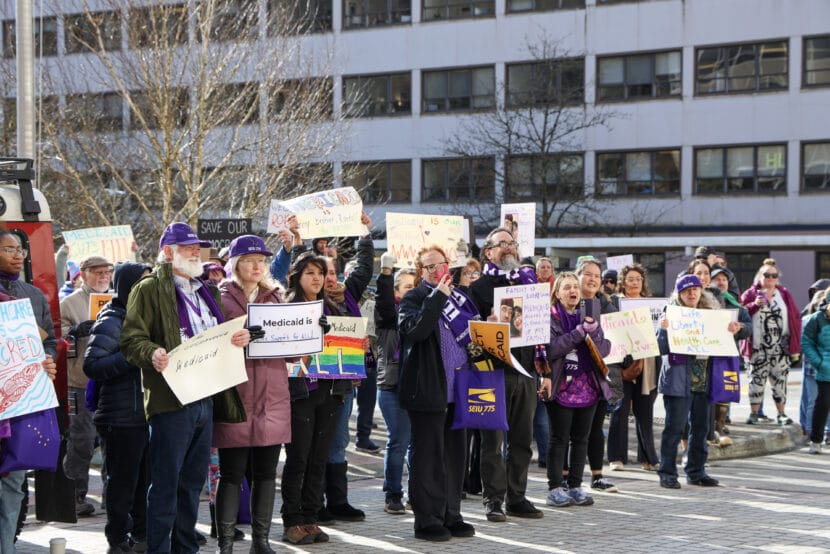
There have been a lot of protests at the Alaska State Capitol lately.
Janet Lopez, a retired teacher in Juneau, says she’s attended several because of big shifts at the federal level.
“We’re in trouble, we’re in a lot of trouble,” she said while sitting on a bench outside the Capitol on Wednesday.
She and dozens of Juneau residents were at it again as Congress considers drastic funding cuts to Medicaid, the government-funded health insurance program for low-income families and people with disabilities.
The cuts could jeopardize health care coverage for thousands of Alaskans and put rural hospitals at risk of reducing services – or closures.
Standing in a crowd of protesters, Tammalivis Salanoa said Medicaid cuts could be devastating for her family.
“If these cuts happen, I will have to start planning funerals,” she said.
Her mom has stage four kidney failure and her dad has Parkinson’s disease. She’s been taking care of both since she was in high school. She said Medicaid is a lifeline for her family.
“I will have to start either working more than two jobs I already do. I will have to figure out something else,” she said. “If I’m not able to provide for them, if there’s no other way, then it’s gonna be the final nail in their coffin.”

The spending bill comes from Republicans in Congress as a means to finance tax cuts proposed by the Trump Administration.
At stake is health care coverage for millions of Americans — including children — who rely on the program to get critical care. Joelle Hall, president of the state’s largest labor union, said the cuts could have an outsized impact in the state.
“This is Alaska to the core — we have the most expensive health care in the world,” she said.
Alaska has consistently ranked among the top states in the country for the highest health care costs per person, according to a 2022 study published by Health Affairs. Medicaid covers almost 40% of Alaska residents. It also helps fund tribal health care and is critical to keep rural hospitals afloat.
Cuts to the program could force the state to decide whether to maintain programs and shoulder the additional expense or leave people without coverage.
Sen. Forrest Dunbar, D – Anchorage, is chair of the Health and Social Services Committees in the state Senate. He called on Alaska’s congressional delegation to stop that from happening.
“It’s not just a question of economics. It’s also a moral question, because they’re not doing this so that they can lower the debt. They’re not doing this so they can fund other programs,” he said. “They’re doing this to fund a tax cut for billionaires, and that is morally wrong.”
U.S. Rep. Nick Begich voted in favor of a spending blueprint last month that would significantly cut down on government spending. President Donald Trump has said the cuts won’t affect Medicaid, but budget experts say it’s impossible to make such significant cuts without reducing health care coverage.
In a speech to the Alaska Legislature last month, Begich said he supports adding work requirements to Medicaid.
U.S. Sen. Lisa Murkowski has long been a defender of Medicaid and has been talking to Senate leaders about the impacts to Alaska if programs are cut.
Last week, U.S. Sen. Dan Sullivan told the Anchorage Daily News it was too early to comment on what could happen to Medicaid, but he did introduce an amendment to a Senate resolution aimed at improving Medicaid for the most vulnerable populations.