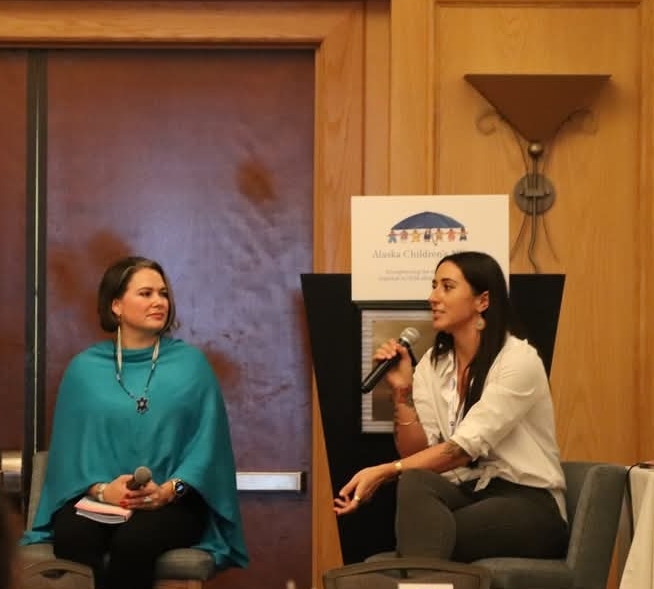
Alaskans Christina Love and Josie Heyano served on the U.S. Advisory Council on Human Trafficking and helped shape the council’s 2024 report.
It outlines the forms of human trafficking, suggests policies to address the underlying causes and points out holes in the justice system that allow this type of violence to continue.
Love, who lives in Juneau, and Heyano, an Anchorage resident, spoke with KTOO’s Yvonne Krumrey to talk about what it means to be a survivor and to take the stories of other survivors — and those who didn’t survive — to the desks of federal lawmakers.
And a warning, these advocates discuss homelessness, sexual violence, drug use and suicide in this interview.
Listen:
This transcript has been lightly edited for clarity.
Josie Heyano: My name is Josie Heyano. I am a presidential appointee to the United States Advisory Council on Human Trafficking, which is an Advisory Council tasked with creating recommendations to the President’s interagency task force to combat trafficking.
Christina Love: Hi. My name is Christina love and I’m 2024’s presidential appointee to the Council on Trafficking.
People entrusted us with their stories, and we have a responsibility to receive those words, to not let them hit the floor and to lift them up. We recognize that Josie and I are in seats of privilege, you know, that there’s a lot of other people that could be here who aren’t — like, literally — and people who aren’t with us, right? The recognition of people who died, you know, like, what it means to be a survivor, is the recognition that we survive something that a lot of people don’t.
Josie Heyano: In last year’s report, and I think we put it in this year’s report also there’s a dedication space. That was a really important piece to me when I first came into the council. And to tack onto what Christina said, like, my position on the council, the reason I accepted it wasn’t because necessarily of my own lived experience, but because I was carrying so many stories, and still I’m carrying so many stories.
And that when we work in direct care, when we work in our community, it is our responsibility, or it feels like my responsibility, to do something with those stories, especially my years working with youth experiencing homelessness in Anchorage, so many of those stories were incredibly similar, and there were so many points of intervention that could have been so impactful in those stories.
And so that’s what the council position meant to me, was taking those stories from not only the clients and the people that I’ve served in my community, but my colleagues at different agencies, law enforcement, NGOs, and being able to take that experience in those stories, and level it up to the federal government level, and say, these are our experiences in Alaska.
I struggle with the word survivor. A lot of the times I actually, I really don’t like it. It doesn’t resonate for me. And it maybe that’s even like a guilt thing, I’m not sure, but it always brings to mind to me that there’s a lot of people that I’ve worked with over the years who aren’t here anymore, and there’s a lot of people who won’t be here in the future.
And so it was really important to me that the council was rooted in the recognition of that, that when we show up as survivor leaders, we’re also showing up honoring and respecting that there is a lethality to this, that there are people who aren’t here.
I found that my time on the council, there’s a lot of — maybe because it feels protective — there’s a lot of need to like, be really high level, be really federal, be really just top level, macro, everything. And that’s valuable, because that’s where we make our recommendations. But we have to root in people too, and we have to remember that humanity piece, that I’m not just going to write this recommendation because it’s my job on the council. I’m going to write this recommendation because I sat with the people who this recommendation impacts, and I care about them, and I took the time to learn about their experiences.
And I think just in general, in the anti trafficking space, there’s a need to want to just only talk about the crime of trafficking, and so I continue to find myself kind of head-butting up against that. Even, you know, I’ve done trainings here locally where submit the feedback I got on the trafficking training was, “Well, we didn’t talk about trafficking enough. ” I’m like, true, but what we did talk about was traumatic brain injuries. We did talk about our suicide rates. We did talk about the lack of shelter beds in the city. We did talk about all of the things that we really should be talking about, and if you’re listening, you can connect those pieces.
Christina Love: Working professionally, where people didn’t know I was a survivor, and then the moment they knew I was a survivor, treated me so differently, completely differently. And then late, years later, at having this experience, and someone told me, “They’re not going, they’re never going to listen to you, because you’re a survivor. They don’t see you as equal to them.”
When we talk about the people that I’ve worked with who have experienced trafficking, or even my own experience that I never was the perfect victim and have never been the perfect survivor, you know? So we have people who are experiencing great harm, who are also committing crimes, and the majority of them do end up incarcerated. One of my favorite quotes in the council’s report, and there’s so many great quotes, so many, so many great quotes, is the recognition that that so many of them end up in jail, but the people who harm them never do.
Josie Heyano: There are a lot of Native people and Native women especially, who are doing this work, and they’re doing it grassroots. They’re doing it in their communities. Having Indigenous representation on the U.S. Advisory Council is great, and it is long overdue that should have been a really long time ago, because there’s a lot of people that are doing this work and have recognized this issue in Native communities that just haven’t had a voice in the federal spaces.
Alaska is so important to me to be talked about because of my experience and because of holding the stories of so many people who their trafficking experience is rooted in drug trafficking in Alaska, it’s rooted in forced criminality. It’s rooted in substance use, and we still do not have the resources to support that.
You know, if we have a young person who is — or a person at all — who is at the airport, who is being forced to transport substances into the community, there is no legal service or advocacy route for them to access safety whatsoever. It happens consistently, constantly in the state, and has for a really long time. And I’ve had so many conversations with law enforcement, with Department of Law, with service providers where they recognize this. Yet we have no methodology to help support people. So it just continues to happen.
And at the federal level, and you know, there’s so many toolkits that exist, there’s so many trainings that exist, and I still have yet to see this issue really being tackled head on, that forced criminality piece, the forced trafficking into our rural communities, it’s really heavily impacting all of our communities. I don’t know that there’s any community that’s excluded from that. I don’t have an answer for it, other than we need to be paying attention and we need to be doing better.
Christina Love: When we talk about what Alaska needs to be able to do this in a way that would translate to lives being saved, when we’re genuinely asking people what it is that they want — and we have other reports that show exactly that when we’re saying, “What is it that you need?” People are saying that they they want to be treated as a whole human being, that they want to have access to safe housing, that they want their own money to buy food, that they want help getting their children back, or clothes that fit or they want a washing machine, or they want their car to be fixed.
A big part of the report talks about substance use and mental health coercion, that substances are an incredible way to escape or to alleviate pain, and I will say this in every interview and in every presentation and anytime somebody will listen, that trauma and substance use are a very natural reaction to violence, and violence is the unnatural thing. And that people will end their pain in any way they can. For some people, that is suicide, which why we have such high rates.
We have to make services as easy to access as alcohol and heroin. Whenever I’m working with someone who’s experienced a lot of harm, who’s trying to leave a domestic violence situation or trafficking situation, substances are not my first priority. And in taking those coping mechanisms away, that can drive them right back.
And the same for people who are perpetrating harm. When we have removed substances, we see higher rates of lethality. So we deeply need to understand substances as a way of coping with pain as well as a tactic of violence.
People who traffic people, prey on people not having their basic needs. For a lot of people, it’s because they did not have transportation that they got a ride. It is because they did not have a place to stay that they were given what they thought was a safe place to stay, or maybe they knew it wasn’t safe, but they didn’t have another option. They had no other option.
Or from my own experience, that they met a need that I had, and it was so basic — that’s something that we should all be entitled to.
If we are really working toward a solution, then we would be communities and places that when a trafficker comes in, they would have no ability to be successful, that our children would be so protected, that our children would know what healthy and safe feels like. So the moment they come into contact with someone who means to do them harm, they could feel it in their bodies, and all the red flags would go off, and they would have people that they could go to that would trust and that would listen to them, and we would have a response that would also include the meaningful rehabilitation of this person who is doing harm because they are also not well.
Josie Heyano: I want to tag on to Christina’s message too. Like anybody that hears this or listens to this, doesn’t matter what you’ve experienced, what you’ve done — that shame can feel so crippling, and it doesn’t stay that way forever. If you keep going, it doesn’t stay that way. You find your people, you find the purpose for it. It could be really transformative.
My experience was like being in a house that was on fire when no one had ever told me what fire was, and I didn’t have a plan. I didn’t know how to put it out, I didn’t know if there was someone you could call. I didn’t know if it was hot, I didn’t know what to do. And I think that that shame, combined with the naivety, like the “how did I not know this? How can I even begin to comprehend or understand it?” It’s such an isolating, lonely place to be.
And so I think some of the work that’s impactful in the council and being in community with people like Christina is having the opportunity to if anybody that listens or hears this or reads this is in a space where they feel like it’s not overcomeable or believable or understandable, that it is. And I don’t know that you get past it, but life gets bigger.