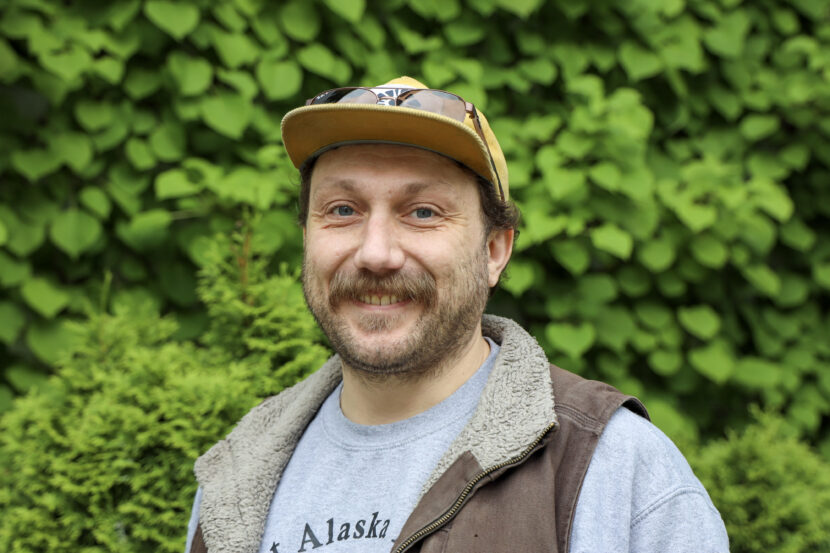
For almost three decades the Southeast Alaska Food Bank has served people in Juneau, as well as other Southeast communities. KTOO’s Mike Lane visited with Dan Parks, the executive director of the food bank, about the organization’s beginnings, how it works, and how community members can help.
Listen:
The following transcript has been lightly edited for clarity.
Mike Lane: For people who might not be familiar with the Southeast Alaska Food Bank, can you describe how it works and who can access it?
Dan Parks: Sure, yeah, that’s a common question, get that a lot, and it’s not so straightforward as one might think. We have currently about 40 member agencies, and we distribute food to those member agencies, Monday through Thursday, all week, each week. These are things like the Glory Hall, JAMHI, AWARE, Housing First, many churches, you go on and on. And all of these qualifying organizations that we distribute food to, then in turn redistribute that food to their target population. We also operate a weekly public pantry that is accessible to anybody, no questions asked. It’s every Thursday afternoon from 3 to 5:30 p.m.
Mike Lane: How did you get involved in the food bank in Juneau?
Dan Parks: I fell into it, like many of my colleagues did, as well. I came to Juneau originally as a guide, but then I fell into nonprofit work. I worked for SAIL – Southeastern Alaska Independent Living, for a couple years with their Orca program – the Outdoor Recreation Community Access Program, and I just found I really liked doing nonprofit work – helped me sleep at night, you know. So after I left SAIL , I wanted to stay in nonprofit work, but I wasn’t real sure what I wanted to do, and the food bank was hiring for a part-time driver, warehouse manager. I thought ‘That sounds like a job I’d like to do for a little while,’ and I did it for about a week before I ended up being promoted, and now I’m running the food bank.
Mike Lane: What do you enjoy about working there?
Dan Parks: I love my team the people that I work with, both the staff and the volunteers, and the board, for that matter, it’s all about the people. And on that note, you know, it’s also about the patrons, the people that we interact with that are using the food bank, or using food bank services. Handing somebody a bag of food is something that you can walk away from, knowing that’s an instantaneous positive impact on somebody’s life.
Mike Lane: When did the food bank in Juneau start, and do you know how and why?
Dan Parks: It was officially incorporated as a 501 c3 nonprofit in 1999 it started a little bit before that – a guy named Jim Wilcox, local guy, still around, started it. He noticed that there were just more and more people dumpster diving, and he just thought there’s got to be a better way. Rather than throw this food in the dumpster, maybe we can gather it up, collect it, and take it somewhere. So, Jim and his buddies, they just started doing it. It began very organically, very naturally.
Mike Lane: How many people does the food bank serve now, as far as community members?
Dan Parks: Each week, we expect to see a certain number of the general public come down, and most weeks it’s about 500. We expect to see somewhere in the ballpark of 120 to 160 households visit us each week, which you know, every household is three or four, five people.
Mike Lane: So that leads into this next question, what are the current needs of the food bank, and how can community members help?
Dan Parks: Always the thing that we need the most is just donations: food, cash, any sort of support. Whether it’s hard goods or financial support, that goes a long way for us. Donations, private donations of food that come into us. Often that’s the only way that we can source a lot of products. We buy a lot of food, we’re buying more and more food as demand rises, and there’s things that are easy for me to buy; staple foods like rice and pasta, peanut butter and tuna, those things I can get easily in bulk, but other things, you know, canned meats, cereals, shelf stable milk, those are the things that we really need the most.
Mike Lane: I wonder about the summer season, when we have a lot of tourists and people who work in the tourism industry. Are you seeing a lot of those transient workers come to the food bank, or or visit the other distribution centers as well?
Dan Parks: Historically we’ve always expected summer to be our slow season. However, over the last year or two, we’ve kind of broken the mold. Summer has continued to be as busy as spring or winter, and it’s just kind of continually growing our demand. The simple answer is the demand just keeps growing regardless of what season we’re in.
That was KTOO’s Mike Lane speaking with Dan Parks, the Executive Director of the Southeast Alaska Food Bank. Learn more about the local organization on their website.