After a struggle that’s lasted more than a decade, ancestral remains long removed from the Kodiak Archipelago will soon return home.
Following excavation in the 1960s, they traveled to the University of Wisconsin and ended up at Indiana University Bloomington. They’ve been the subject of study and research papers, but Alaska Native ancestors in Kodiak who would like them returned for burial.
Many places in Alaska, including Kodiak Island, have a history of non-Native archaeologists excavating and removing ancestral remains and artifacts.
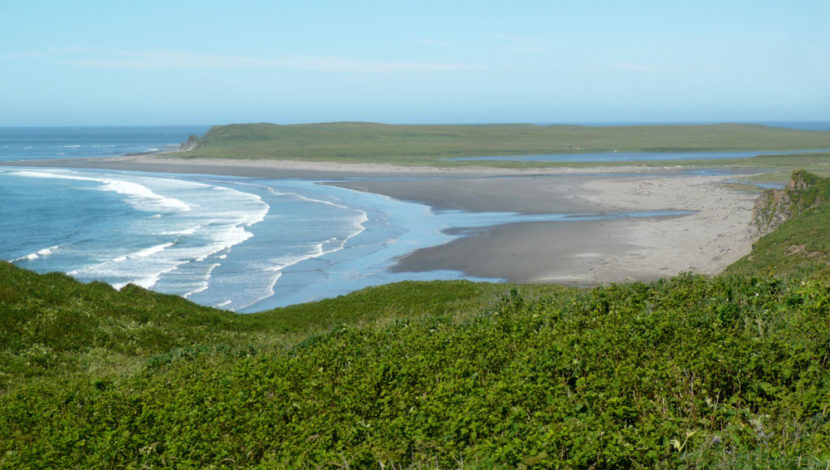
Alutiiq Museum Executive Director April Laktonen Counceller says archaeologists in the 1960s did an excavation of a graveyard that was eroding onto a beach south of Kodiak on Chirikof Island. They removed the remains of approximately 150 people.
“From what we had heard there was even exposed coffins and things like that, and so this is a graveyard from probably the 1800s when there was a Russian settlement on the island. There was also a historically Alutiiq habitation,” Counceller said.
The archaeologists transported the remains from the island and since then they’ve ended up at Indiana University. Counceller says she thinks of them as people’s great-grandparents.
“Forty boxes of human remains stacked floor to ceiling, and it’s really hard for me to remain emotionally neutral when I imagine that,” Counceller said. “I think of my own grandparents, I think of my own village where this happened, where archaeologists during that time would come into the village, and even when people would say, ‘Please don’t dig up our graveyard.’ They would just do whatever they wanted.”
Councellor is from Larsen Bay where one landmark repatriation case took place in the late 1980s. The Larsen Bay tribe and the Kodiak Area Native Association asked the Smithsonian Institution to return remains excavated in the 1930s.
Marnie Leist, the Alutiiq Museum’s curator of collections, says that case is part of the reason the Chirikof Island remains will soon come home to be reburied. It contributed to the establishment of a federal law called the Native American Graves Protection and Repatriation Act, or NAGPRA.
“Many tribes around the country have their ancestors and collections from their land scattered throughout the nation,” Leista said. “This law was developed to help tribes and also museums to develop procedures so that there’s a process for returning funerary objects, sacred objects and human remains to tribes.”
NAGPRA requires federally-funded institutions like universities and museums to inform Native tribes and peoples if they are holding any artifacts or remains that are connected to them. Leist and Councellor say the researcher at the university who was studying the remains did not do that.
A U.S. Fish and Wildlife archaeologist made the discovery of the collection’s whereabouts in the mid-2000s. Chirikof Island is federal land and managed by the U.S. Fish and Wildlife Service, which means they also manage the remains. The archaeologist was documenting the organization’s collection and discovered that many items had ended up at Indiana University.
The extent of the university’s research on the remains is unknown, but anthropology professor Della Collins Cook has included her observations on the collection in several papers.
Councellor and Leist are critical of Cook and the university for the delay and for failing to contact members of the Kodiak community about studying the remains of their ancestors. Leist says the university and Cook have an ethical responsibility.
“These human remains have been on loan, or whatever the circumstance may be, at Indiana University. Because they don’t have control … (they assert) they technically never had to comply with NAGPRA … and we feel like that since these are literal ancestors for the Kodiak Alutiiq people that they should have lived up to the spirit of the law,” Leist said.
Cook would not agree to an interview with KMXT.
Jayne Leigh-Thomas, director for the university’s Native American Graves Protection and Repatriation Act office, said she could not speak for Cook or the university, but she said she’s been assisting with returning the collection to Fish and Wildlife so they can get the remains back to the tribe since last summer.
Leist says it’s taken years for Fish and Wildlife to finally take control of the remains.
“That’s where we are feeling frustrated because the NAGPRA process can’t begin until that happens. … Until the U.S. Fish and Wildlife Service has the human remains, has access to them, and has the project documentation, we can’t move forward. They can’t create an inventory for human remains they don’t have.”
She says Fish and Wildlife needed to establish a legal right to the remains before they could make plans to take control of them with the help of the U.S. Army Corps of Engineers.
Now that those plans are finally in place, Leist will travel to Indiana along with Army Corps representatives to retrieve the remains in early March. She will represent the Sun’aq tribe, which has claimed cultural affiliation with the remains on geographic grounds.
Leist says they hope the repatriation process will be completed by 2018, and they will finally be able to bury their Chirikof ancestors.