Archives for:

"AFN"

AFN rallies against Safari Club International federal subsistence management proposals

Kuskokwim River salmon drying on a rack at a fish camp near Napaskiak, 2016.
Kuskokwim River salmon drying on a rack at a fish camp near Napaskiak, 2016. (Rhonda McBride)

As the deadline for public comment approaches, the Alaska Federation of Natives is pulling out all the stops to block a national sport hunting and fishing group’s push to reform the federal subsistence board.

This comes after Safari Club International successfully petitioned the U.S. Interior and Agriculture Departments to review federal subsistence management policies.

Last month, the Interior Department announced a 60-day scoping period, or review, on federal subsistence management.

AFN held a webinar Tuesday afternoon to give Native hunters and fishers an update on the status of subsistence management in Alaska and explain why it believes the Safari Club proposals pose a serious threat to the Native subsistence way of life.

Attorney Jaelene Kookesh, a longtime legal counsel for the Sealaska native corporation, was one of the presenters. She currently is senior legal counsel at the Van Ness Feldman firm. Kookesh says many Alaska Natives were elated last week, when the U.S. Supreme Court decided not to take up the State of Alaska’s challenge of federal subsistence protections under the Alaska National Interest Lands Conservation Act, or ANILCA. But Kookesh says, the battle goes on.

“It’s like you can celebrate for not even for a day, maybe, but then you can say, ‘Okay, we won that, but now we have to comment on this scoping at Department of the Interior,” Kookesh said. “And Safari Club also has draft legislation that they’re pushing at Congress. to amend ANILCA. So, we’re getting hit at every arm of government, so we can’t rest, even with the win at the Supreme Court.”

Kookesh says she worries most about the Safari Club’s campaign to limit the federal subsistence board to state and federal agency heads, a move that would undo recent efforts to diversify the board.

“So you had five federal agency representatives, who obviously are not subsistence users. And so, we worked very hard to have three tribally nominated members for the Federal Subsistence Board, with real concrete knowledge of these practices. And this just happened within the past year,” Kookesh said.

The Safari Club also wants to change the make-up of the Rural Advisory Councils to give sport hunters and fishers a voice in the process, as well as require federal wildlife managers to defer to the state’s regulatory decisions.

Regina Lennox, Safari Club International’s senior legal counsel, says it is seeking these changes to make ANILCA work as Congress intended.

“I don’t think anything that we have sought in any way diminishes the potential representation of Alaska Native voices anywhere,” Lennox said.

“We’re working on behalf of hunters within the state, subsistence and non-subsistence alike, just to ensure that the federal agencies don’t overreach,” she said. “Over 60% of Alaska is federal land, and so if you have agencies that are doing the wrong thing and, stepping on the toes of the state and closing down hunting opportunity, that’s a lot of acreage that’s potentially at risk.”

The Safari Club says one of its top priorities is to protect the resources, which benefits all hunters. It claims the federal government has ignored state data in some of its management decisions to the detriment of wildlife.

AFN and other Native groups say the federal government has done a better job than the state in balancing ANILCA’s rural subsistence priority with conservation.

Kookesh says AFN’s webinar will be a good Subsistence 101 on the decades-long fight to protect subsistence.

“It’s been a battle going on for many years, but it kind of goes quiet every once in a while, and then it comes back up again,” Kookesh said. “So right now, we’re heavy in the fight again. So, hopefully, we can take some steps forward and not some steps back.”

The deadline for public comment is February 13. AFN’s Jan. 20 webinar is posted on AFN’s website.
From food to financing, Alaska Native organizations feel the shutdown’s pinch

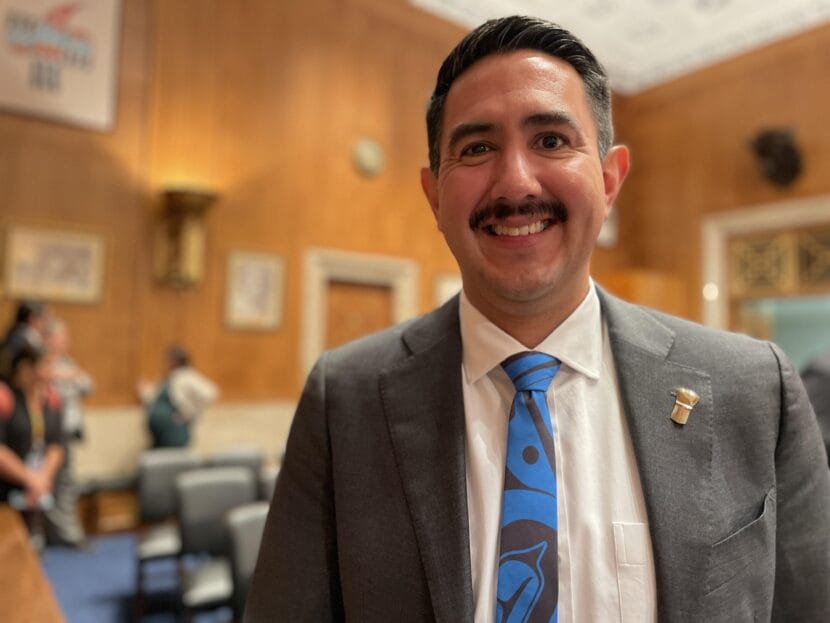
AFN President Ben Mallott testified to the Senate Indian Affairs Committee Oct. 29, 2025 about the impact of the goverment shutdown on Alaska Native communities.
AFN President Ben Mallott testified to the Senate Indian Affairs Committee Oct. 29, 2025 about the impact of the goverment shutdown on Alaska Native communities. (Liz Ruskin/Alaska Public Media)

WASHINGTON — The government shutdown is creating a lot of uncertainty and disruption for Alaska Native communities, and for tribal organizations that administer federal programs.

These include SNAP, for food assistance, and the Low Income Home Energy Assistance Program, which subsidizes energy bills.

Ben Mallott, president of the Alaska Federation of Natives, said the prospect that both of those programs would run out of money, just as winter begins, puts some Alaskans in a life-threatening bind.

“Without LIHEAP, without SNAP, our communities, our tribal citizens will have to decide between fuel and food,” he testified to the Senate Indian Affairs Committee Wednesday.

During the pandemic, the Federal Subsistence Board allowed emergency hunting to improve food security. Now, with the government shutdown, Mallott said the Subsistence Board can’t even meet to consider it.

Since the second Trump administration began, advocates for Native American and Alaska Native people have stressed that programs that help them aren’t D.E.I. initiatives but the result of promises, treaties and laws. Now, between the administration’s cuts to government services and the shutdown, they say the government is dodging its responsibilities.

Hearing witnesses said tribal Head Start programs will run low on money if the shutdown extends into November, and that many agency experts tribes normally turn to have lost their jobs.

Pete Upton testified about the Trump administration’s plan to abolish a fund at the Treasury Department called the Community Development Financial Institutions Fund. Upton runs the Native CDFI Network, whose Alaska members include the Cook Inlet Lending Center. He said tribal communities are often in banking deserts.

“Native CDFIs are typically the only financial institutions serving these communities, providing access to capital, credit and financial education where no alternative exists,” he said.

Early in the shutdown, the Treasury Department fired the entire staff of the CDFI Fund. With no one at the federal office to certify the CDFIs, Upton said it’s hard for the community finance organizations to attract private-sector and philanthropic investment.

Certification is “a stamp for investors to say that ‘you are investable,'” Upton said. With it, “we bring in private capital at a rate of eight to one.”

Sen. Lisa Murkowski, chair of the Indian Affairs Committee, said tribes face enormous uncertainty as the stalemate in Congress nears the one-month mark.

“We can’t figure out the path forward right now on our spending bills, although I am a little bit more optimistic on that today,” she said.

She didn’t elaborate but said earlier this week that senators are engaged in productive talks.

Alaska Federation of Natives convention highlights typhoon response and Indigenous cultures

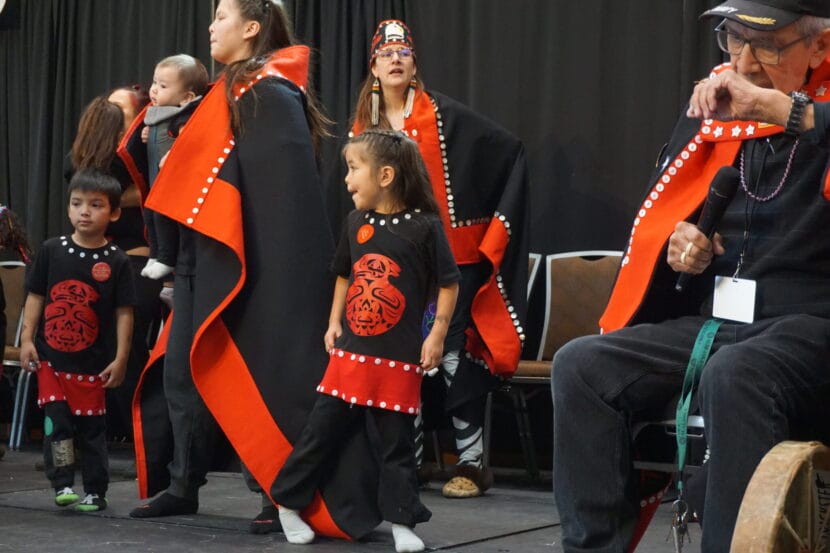
Members of the Tlingit, Haida and Tsimshian group Aanchich’x Kwaan perform on Oct. 18, 2025, at the Alaska Federation of Natives convention in Anchorage. The dance and singing group has members of all age groups, from young children to elders. The group was among several that performed traditional dances at the convention. (Photo by Yereth Rosen/Alaska Beacon)

The Alaska Federation of Natives convention in Anchorage, while it featured the usual cultural celebrations, socializing and discussions of state and federal policies, had a strong focus this year on a particular subject: the ravages on the Yukon-Kuskokwim Delta of ex-Typhoon Halong.

Speaker after speaker at the convention, the largest annual convention of any kind in Alaska and one of the largest Indigenous gatherings in the nation, referenced the storm. It has displaced more than 1,500 people, killed at least one person and dislodged houses from their foundations. Residents of stricken villages have been airlifted away, with hundreds getting temporary residency in Anchorage. The state’s largest city is about 490 miles east of the evacuees’ home villages, and vastly different in culture and character from the highly rural Indigenous communities.

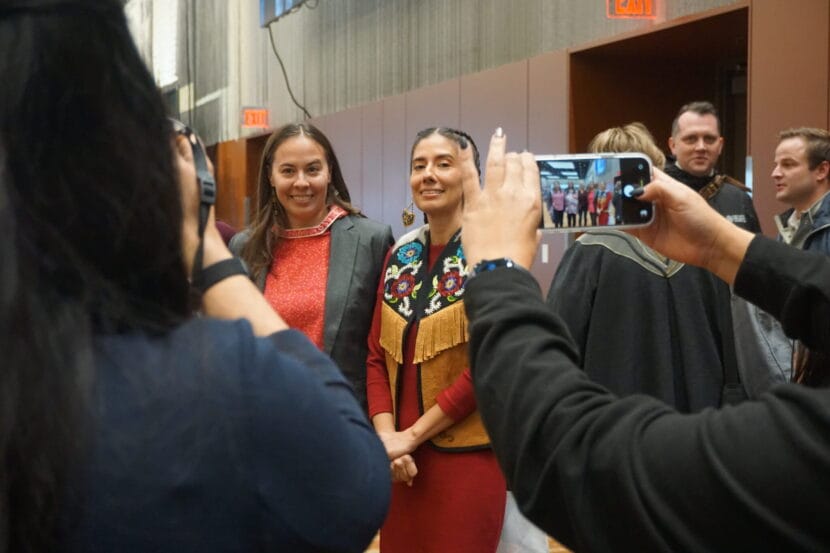
Natasha Singh poses for photos in the hallway of the Dena’ina Civic and Convention Center, site of the Alaska Federation of Natives annual convention. Singh, who is president of the Alaska Native Tribal Health Consortium, had just delivered her keynote speech on the opening morning of the convention. (Photo by Yereth Rosen/Alaska Beacon)

“My heart with everyone impacted by the recent coastal storms,” Natasha Singh, the president of the Alaska Native Tribal Health Consortium and the keynote speaker on the first day of the convention, said at the start of her address.

“While the damage is so vast, the love for our people is even greater. And even as we feel the pain and the loss, I also feel a sense of inspiration to see so many people reach out to help,” she continued.

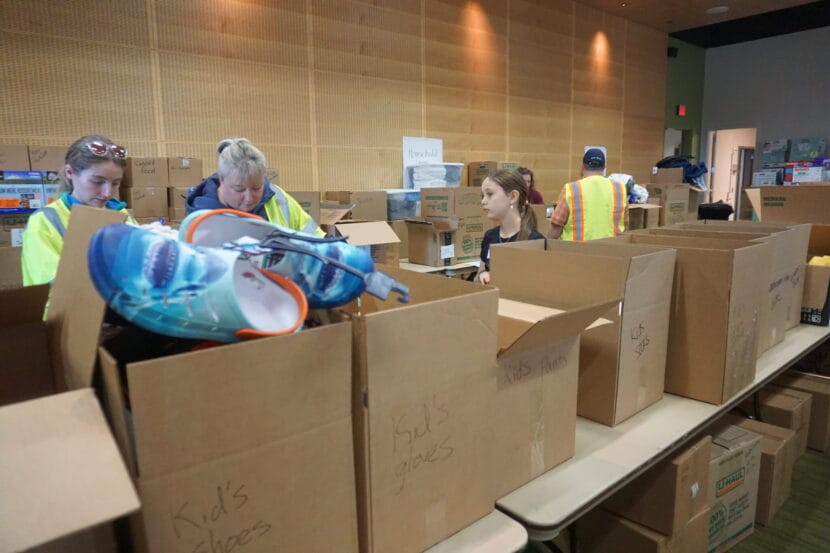
Volunteers work on Oct. 18, 2025, to sort donated items being collected in a room in the Dena’ina Civic and Coonvention Center, site of the Alaska Federation of Natives annual convention. Donations of diapers, clothing, hygiene products, bottled water, shelf-stable food and other items were being collected for Yukon-Kuskokwim Delta residents displaced by the remnants of Typhoon Halong. (Photo by Yereth Rosen/Alaska Beacon)

A special feature of the convention was a second-floor room at the Dena’ina Civic and Convention Center that was set aside to collect donations headed to the storm victims. Over two days, as convention proceedings unfolded in the third-floor ballroom, the collection room became filled with boxes of diapers, toiletries, clothing items, shelf-stable food and other necessities that were sorted by volunteers.

On Saturday, the final day, delegates passed a resolution seeking an immediate national disaster declaration, and investment by the federal government in better infrastructure in rural Alaska to protect against future disasters.

The ravages of the remnants of Typhoon Halong demand more than an emergency response, the resolution said. The disaster “has continued to expose vulnerabilities in infrastructure, housing, and emergency preparedness for rural Alaska/extreme remote America, and highlights the need for stronger tribal-state-federal collaboration,” it said.

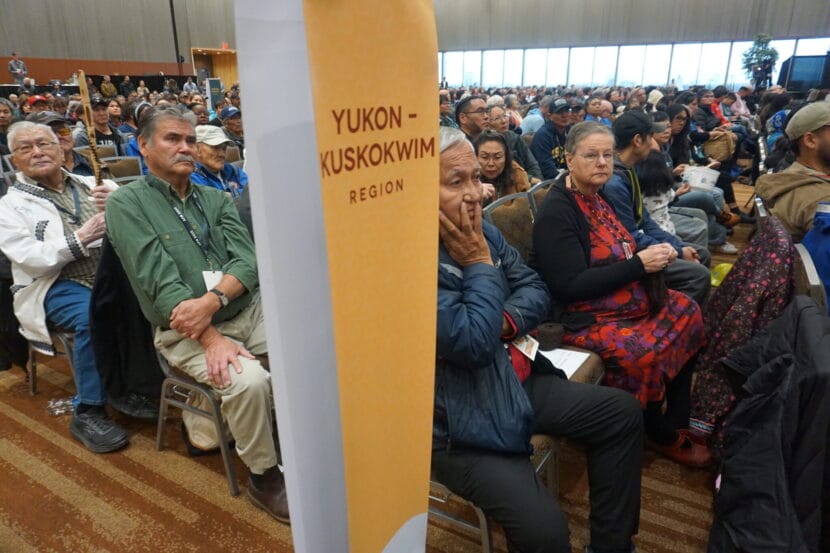
Alaska Federation of Natives convention attendees from the Yukon-Kuskokwim region listen on Oct. 16, 2025, to the keynote address delivered by Natasha Singh, president of the Alaska Native Tribal Health Consortium. (Photo by Yereth Rosen/Alaska Beacon)

The call for a national disaster declaration and the aid that would come with it was among a packet of resolutions passed on Saturday. Many of the resolutions concerned food security and efforts to ensure that Alaska Natives can safely practice their traditional fishing and hunting practices.

One highly anticipated convention speaker was former U.S. Rep. Mary Peltola, D-Alaska, who is considered a possible candidate for governor or U.S. Senate.

But Peltola made no campaign announcement.

“I want to preface everything I’m saying with: This is going to be very anticlimactic for everybody, I think,” she said at the start of her speech. “No big announcements, no big declarations.”

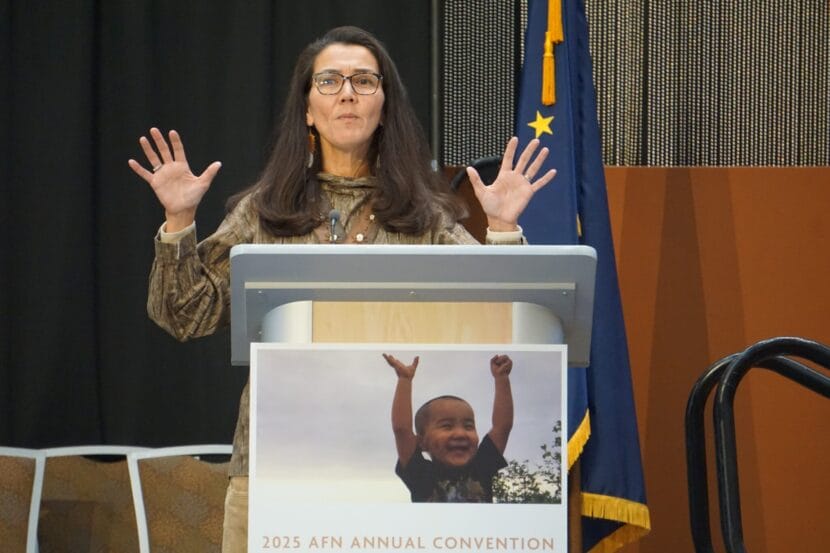
Former U.S. Rep. Mary Peltola, D-Alaska, speaks at the Alaska Federation of Natives convention on Oct. 17, 2025, about subsistence food gathering. Peltola is Yup’ik and from Bethel. (Photo by Yereth Rosen/Alaska Beacon)

Instead, she discussed subsistence – the traditional harvests of wild foods and arts materials – and the legal and environmental threats to its continued practice.

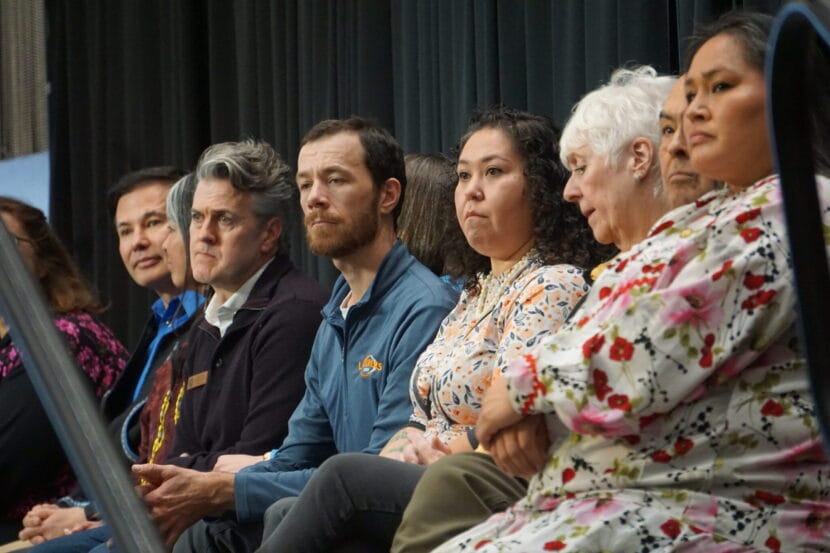
State legislators sit onstage at the Alaska Federation of Natives convention on Oct. 17, 2025, as House Speaker Bryce Edgmon, I-Dillingham, addresses the audience. Lawmakers pictured are, from the left, Rep. Neal Foster, D-Nome; Rep. Maxine Dibert, D-Fairbanks; Rep. Andrew Gray, D-Anchorage; Rep. Zack Fields, D-Anchorage; Rep. Robyn Burke, D-Utqiagvik; Rep. Louise Stutes, R-Kodiak; Sen. Donny Olson, D-Golovin; and Rep. Nellie Jimmie, D-Toksook Bay. (Photo by Yereth Rosen/Alaska Beacon)

She spoke about the way subsistence ties Alaska Natives to their home regions.

“Those spots, the places that we hunt and fish, they’re like another personality to us,” Peltola said.

She referred to a close friend who recently died. When she was on her deathbed, her family gathered around, Peltola said. “And at one point, they just talked about places. They just said the names of the places where they pick berries, or get whitefish, gather greens. And it was one of the most beautiful moments I’ve ever experienced, just reciting names.”

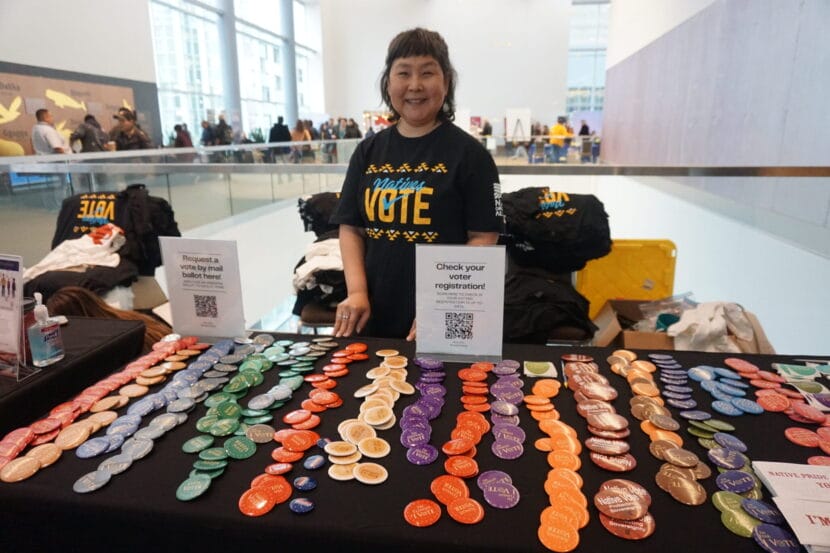
Kendra Berlin mans a pro-voting table at the Alaska Federation of Natives convention on Oct. 16, 2025. Berlin, originally from Bethel but now living in Palmer, was distributing T-shirt and buttons promoting the Natives Vote cause. (Phot by Yereth Rosen/Alaska Beacon)
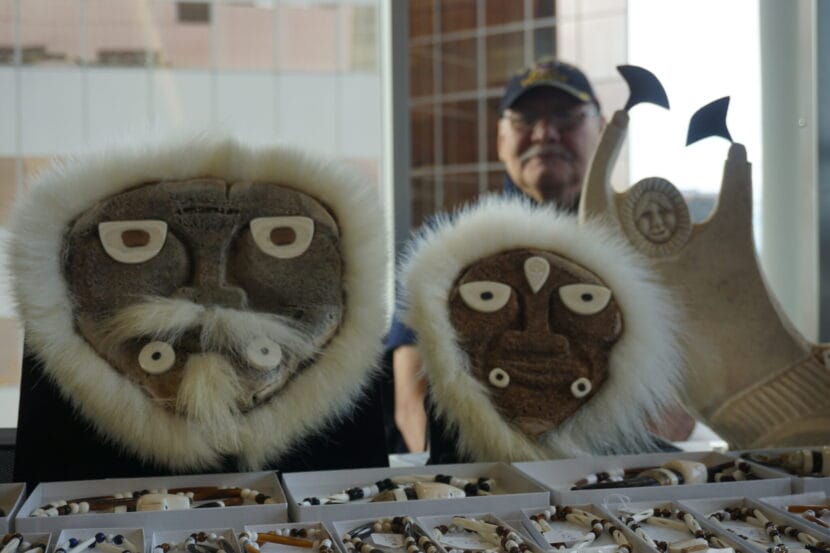
Victor Geffe sits behind a table displaying his artwoork on Oct. 16, 2025, at the Alaska Federation of Natives convention in Anchorage. Geffe, from Kotzebue, has been honored for his carvings of whalebones and other materials. He was one of the many artists displaying and selling work at the convention. (Photo by Yereth Rosen/Alaska Beacon)

Advocates seize AFN convention as opportunity to rally the Native vote

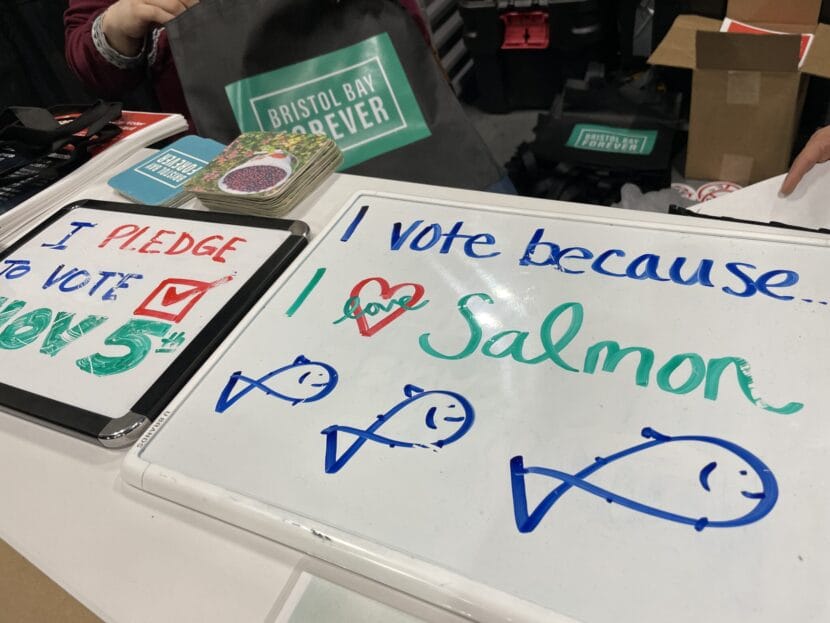
United Tribes of Bristol Bay was among the organizations that promoted voting at the 2024 AFN convention. (Liz Ruskin/Alaska Public Media)

A person could barely move a few yards at the Alaska Federation of Natives convention in Anchorage last week without bumping into a message to vote.

Daniella Tebib was working the ground at the artisans’ market on the first floor.

“Hello! Do you guys have a plan to vote this November?” she asked of passers-by

“In November?” a man responded, a little tentative. “Everybody’s going to vote, right?”

“I hope so. That’s the goal,” Tebib said, thrusting a brochure at him. “Would you like some more information?”

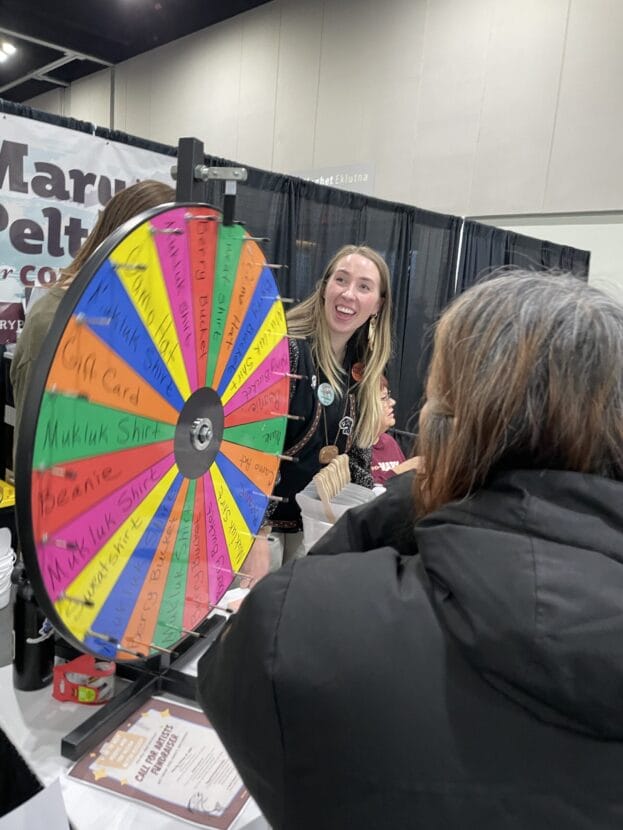
Tebib, a volunteer for Congresswoman Mary Peltola’s re-election campaign, sweetened her pitch with invitations to spin the prize wheel at the Peltola booth for t-shirts, hats and other campaign swag.

The AFN convention is in October, and in election years, there’s always some emphasis on voting. But this year, AFN co-chair Joe Nelson said the convention is especially focused on encouraging a strong Native vote.

“Yes, because we know there are forces in play that are trying to marginalize our communities,” he said.

Shannon Mason staffs a popular prize wheel at Rep. Mary Peltola’s campaign booth at the 2024 AFN convention. (Liz Ruskin/Alaska Public Media)

For Nelson and other AFN leaders, an effort to suppress Native votes came into clear view this month, when a pair of Republican legislators were guests on a conservative talk radio show. State House Speaker Cathy Tilton, R-Wasilla, told host Michael Dukes that she and fellow Republicans killed a bill that would have eliminated the witness signature requirement on mail-in ballots, which she acknowledged is a barrier for rural voters.

“The changes in that bill definitely would’ve leaned the election towards, you know, towards Mary Peltola, to be quite honest,” Tilton said during the broadcast.

Tilton did not respond to an interview request for this story.

Nelson said Alaska Native voters need to show up in huge numbers to overcome barriers like the signature requirement. He’s passionate about re-electing Peltola, the first Alaska Native person elected to Congress — and, incidentally, Nelson’s ex-wife. He’s also plugging a “no” vote on Ballot Measure 2. That’s the measure that would repeal Alaska’s open primary and ranked choice voting. Nelson said Alaska’s current voting method helps eliminate partisan gridlock and serves most Alaska Native voters, who he describes as common-sense moderates.

“We’re, you know, 17-ish percent of the population, 120,000-plus Alaska Natives,” he said. “If we actually aligned on all of our things and showed up and voted, there would be no denying that our vote actually matters.”

The No on 2 campaign was one of the convention sponsors this year, so that message was on banners, pencils, buttons and brochures.

(The Yes on 2 campaign wasn’t present at the convention, but supporters of repeal say that ranked chance voting is confusing and that the open primary is unfair to conservatives.)

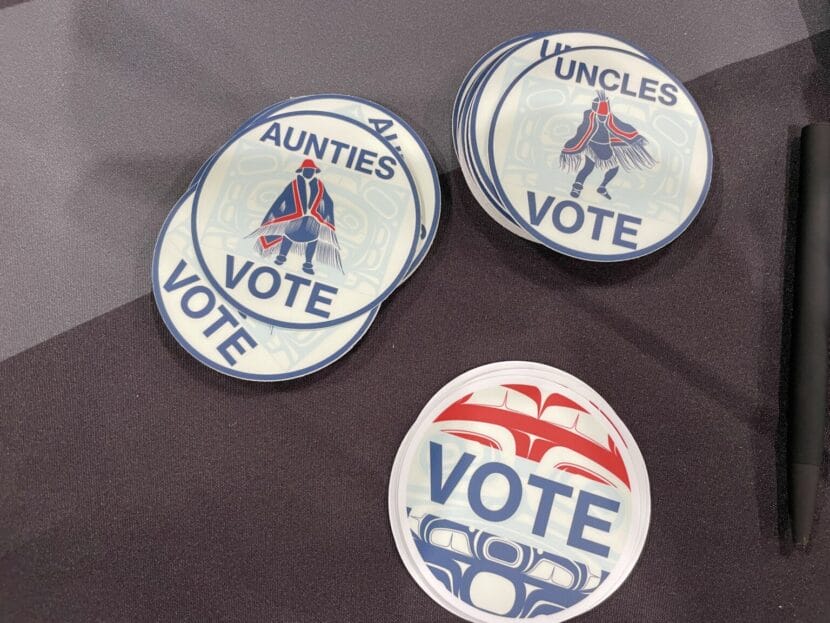
Some of the voting stickers available at a Sealaska table at the 2024 AFN convention. (Liz Ruskin/Alaska Public Media)

Some of the get-out-the vote effort was generic, not promoting any particular candidate.

Shelley Cotton, chief strategy director of United Tribes of Bristol Bay, was reeling in shoppers at the AFN artisans market with a non-partisan approach. She invited voters to sign a pledge to vote, with check boxes to indicate they’d welcome reminder messages or translation services.

“Getting out the vote is really important for us, because we want Native people to decide who’s best for our people and for those people to be in position so we can work with them as well doing our advocacy work,” she said.

Cotton said United Tribes of Bristol Bay has 11 interns spread out in their region, to engage communities and make sure everyone knows when and where to vote.

Upstairs, Michelle Sparck beamed as she handed out indigenous-specific “I vote” buttons.

“Here we go,” Sparck said, sizing up one young family. “That’s for your baby: ‘future Alaska Native voter.’ YayI”

Sparck leads the non-partisan Get out the Native Vote. She has labored largely alone in past years. Not this time. Several Alaska Native organizations pitched in so that she could hire 30 workers for the election season, to spread the word. And, Sparck said, they’re determined not to see a repeat of what happened in the primary, where voting stations didn’t open in some rural villages, for lack of poll workers.

“We’re actually ready to fly out our volunteers to any vulnerable precinct that does not have an election worker signed up, lined up, or will fall out before Election Day on Nov. 5,” she said.

A few yards away, convention participants thronged to a Sealaska table with Native-themed voting stickers and signs. “Aunties vote” was particularly popular.

“We’re not endorsing any candidates here, but we’re just making sure that Alaska Natives have a plan to get to the polls and cast their vote,” Christian Ḵaat’aawu Gomez of Juneau said, “because we know that our voices need to be heard and that we have a huge impact.”

Near him a poster summed up the aspiration: “Voting is our way of life.”

Alaska Federation of Natives endorses Peltola, opposes ranked choice repeal

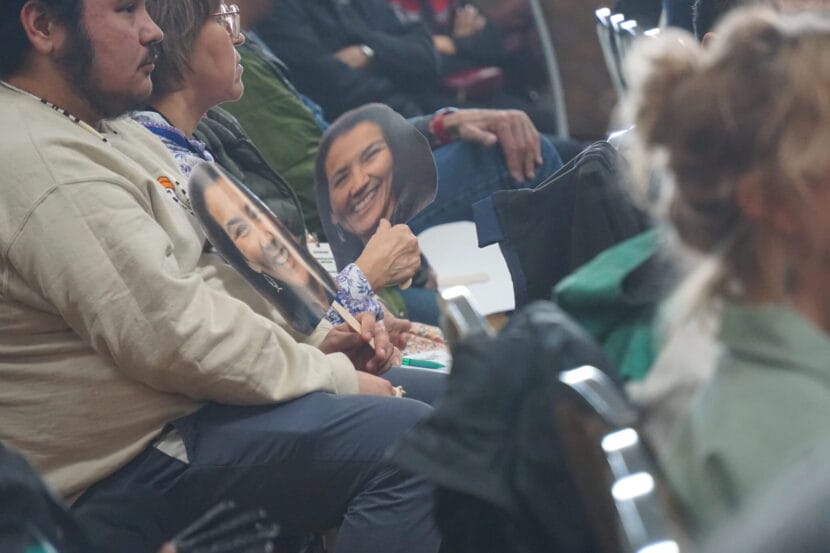
Attendees at the 2024 AFN convention, listening to an address by U.S. Sen. Lisa Murkowski, R-Alaska, on Oct. 19, 2024, hold signs with Mary Peltola’s face on Oct. 19, 2024. (Photo by Yereth Rosen/Alaska Beacon)

The Alaska Federation of Natives voted Saturday to endorse the reelection of Democratic U.S. Rep. Mary Peltola and to oppose the ballot measure to repeal the state’s open primaries and ranked choice voting.

The votes came on the last day of its annual three-day convention, which had the theme this year of “Our Children, Our Future Ancestors.” The delegates from tribes, nonprofit tribal organizations and regional and village Native corporations passed 18 resolutions on issues ranging from a call for Congress to amend federal law to explicitly recognize Native rights to subsistence hunting, fishing and gathering to support for the state prioritizing public education funding.

Peltola, who is Yup’ik, from Bethel and the first Alaska Native member of Congress, drew broad support from the delegates, though some groups abstained from the vote.

The resolution endorsing Peltola was introduced by Sealaska, the regional Native corporation for Southeast Alaska.

“Representative Peltola has been a strong advocate for Alaska’s fisheries and subsistence users by introducing and working with her colleagues, regardless of party affiliation, for legislation to strengthen US seafood competitiveness in international markets, taking actions to enhance research to improve federal programs that support domestic seafood production and working tirelessly to reduce bycatch and protect fisheries habitat,” the resolution said.

Peltola’s top opponent is Republican Nick Begich. AFN did not host a candidate forum this year, after having hosted forums at previous conventions.

The resolution opposing Ballot Measure 2 — which would repeal the voting system — passed without opposition. But a resolution in support of Ballot Measure 1 never made it to a vote.

Ballot Measure 1 would raise the state’s minimum wage to $15 per hour by 2027, require employers to pay sick leave, and bar employers from requiring workers to attend political or religious meetings.

A motion to table the resolution supporting Ballot Measure 1 was introduced by Curtiss Chamberlain, assistant general counsel for Calista Corp., the regional Native corporation for the Yukon-Kuskokwim Delta region.

Chamberlain noted that many village corporations face declining revenue because of the projected decline in revenue being shared by the Red Dog mine. The potential added costs from the ballot measure trouble village corporations in Calista’s region, he said.

“A few brought their concerns to our attention,” he said. “And with that, and based on those discussions and concerns, I respectfully ask that this be tabled.”

Debra Call, a member of the Cook Inlet Tribal Council, unsuccessfully spoke in favor of the resolution and against the motion to table it.

“You really need to raise the standard of living of many of our people, and this is the start to do that,” Call said of the minimum wage increase.

She later added: “I would request that we support this resolution for the betterment of all of Alaska, particularly those who are in jobs that don’t pay what they can live on, so it’s about a living wage.”

The delegates tabled the resolution by a voice vote.

The AFN passed all of the other resolutions. A full list of the resolutions in their draft form — before they were amended on the convention floor — can be found at this link.

Alaska Federation of Natives annual photo contest captures the spirit of the convention

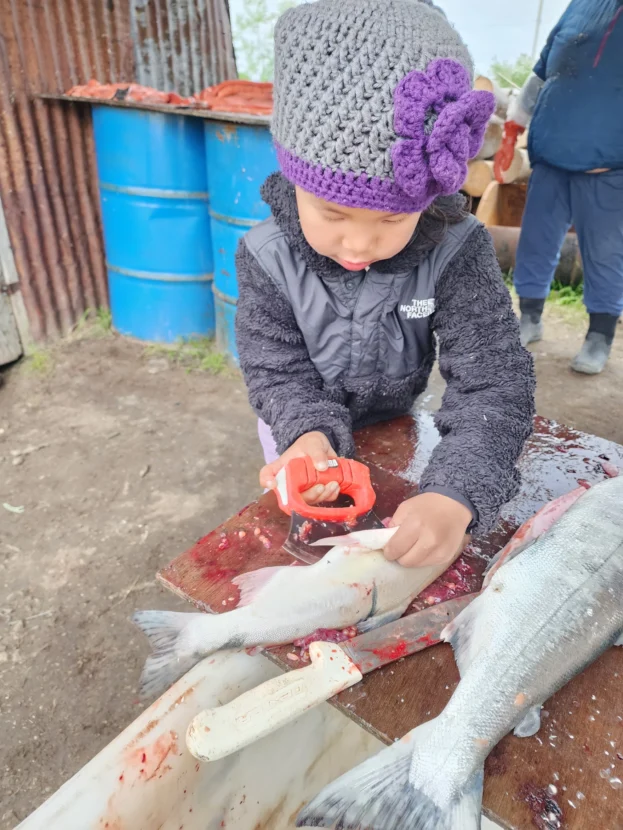
Don’t interrupt Halle Grey Andrews-Seton. This six-year-old girl is very busy being her mama’s little helper. Jacklyn Andrews, snapped this photo of her daughter while cutting fish in Emmonak. It won second place in this year’s AFN Subsistence Photo contest. (Photo by Jacklyn Andrews)

When this year’s Alaska Federation of Natives Convention gets underway in Anchorage this week, you’ll see pictures of children everywhere at the Dena’ina Center. From posters on the wall to signs at the entrance of the main convention hall, to the cover of the program guide, you’ll see lots of round, sweet faces smiling at you

Proud parents from across the state submitted these snapshots to AFN’s annual subsistence photo contest, which showcases the wide variety of wild foods that are gathered year-round.

The contest is not so much a competition as a celebration of the Alaska Native subsistence lifestyle.

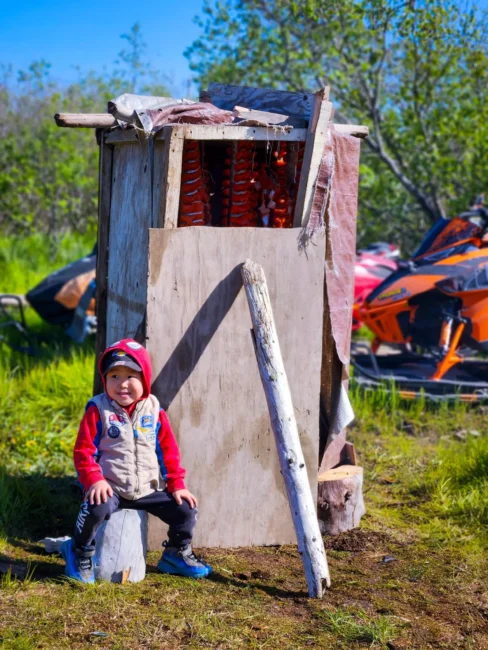
Austin Redfox, a future elder, peers out at his parents who are busy building a smokehouse for their fish. Redfox is a four-year-old whose family lives in Emmonak on the Lower Yukon River. His mother, Lila, won first place for photo of her son. (Photo by Lila Red Fox)

This year’s AFN conference coordinator, Nikki Stoops, says every photo is sure to bring a smile.

“We had over a hundred entries,” Stoops said. “They were all phenomenal pictures that captured our convention theme.”

Stoops says the photos are meant to tug at the heart strings, to bring about a serious reflection on the status of Alaska Native children, who struggle at home, at school and in the community for a variety of reasons. Some of those include historical and intergenerational trauma, the lack of health and social services to address the high rates of suicide and mental health problems, as well as inequities in education funding, especially for rural schools.

The theme is inspired in part by the late Dr. Walter Soboleff, a Lingít leader who championed education.

A national commission named in memory of Soboleff and another Great Plains tribal leader, Alyce Spotted Bear, produced “The Way Forward Report.” Its recommendations which will be taken up at the convention.

Before Soboleff died at the age of 102, he often encouraged young people to “take care of the older person you are going to become.” He told them their own Native culture could help them do that.

The photos are intended to inspire convention-goers to think about this message. The challenge for the judges — after hours of sifting through pictures of kids picking berries and catching fish — was to decide which one best spoke to that progression from childhood to elderhood. They finally settled on four-year-old Austin Redfox, who sat on a tree stump with his hands firmly planted on his knees, as he watched his parents build a smokehouse for their salmon.

“He looked like a little old man, a little grandpa, sitting there watching the smokehouse,” Stoops said. “It just made us all so happy, just emulating probably what he sees in his hometown,” which happens to be Emmonak on the Lower Yukon River.

Austin’s mother, Lila Redfox, says her son constantly asks to help the family put dinner on the table. She listed off some of the foods her son has helped to gather. “Fish, whale, seal, moose, birds,” says Redfox, who appreciates Austin’s help, kneading the dough for her home-baked bread.

Although Yup’ik children are taught to learn through observation, Redfox was surprised that her son, at the age of one, had seen enough and was ready to pitch in.

“I was tanning a sealskin hide,” she said, “and he came up to me and grabbed the tanning tool — and tried to scrape the seal skin hide.”

Redfox says it’s important to teach children early about the sacred role subsistence plays in Native culture. She says she’s discovered that with some support and encouragement from the family, it becomes second nature for children.

“It makes me and my husband proud,” she said. “It makes us feel like we’re raising them right, doing a great job as a parent.”

For her winning photo, Redfox received two roundtrip Alaska Airlines tickets. She says she’ll use one of them to bring her son, Austin,

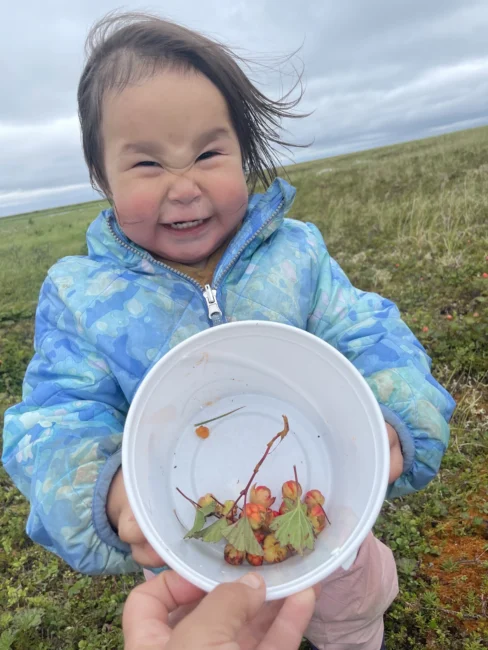
Tanya Chikigak of Alakanak says it was important to capture this photograph of her two-year-old daughter Christine, picking her very first berries. In Yup’ik culture, it’s a cause for celebration when children harvest their first berries or catch their first fish, because it marks the transition to becoming a contributing member of the community. Chikigak took third place in this year’s AFN Subsistence Photo Contest. (Photo by Tanya Chikigak)

to the Alaska Federation of Natives convention this week.

She wonders what his reaction will be when he sees his face all over the place.

And there will be many others to see. Each, like Austin’s, tells a story.

The two other top finishers are from the Lower Yukon River. Jacklyn Andrews, also from Emmonak, won second place for her photo of her six-year-old daughter, Halle, cutting fish.

“All summer I was cutting fish to put away for the winter,” Andrews said. “Every time I’d be cutting fish, she’d ask to help. But I didn’t let her.”

Finally, Andrews gave in.

“She was crying her lungs out to cut fish,” she said. “She got so happy when I told her to start cutting. She said, ‘Mom, I’m so busy.’”

Third place went to Tanya Chikigak from Alakanuk. Her photo shows her two-year-old daughter, Christine, squinting her eyes, almost like a little elder, as she proudly presented her berries to her mother.

Chikigak says the picture was taken in July, after a two-hour boat ride to a spot where you can find lots of cloud berries.

“It was her very first, time picking berries, and those were her very first berries,” Chikigak said. “When we were done picking, she kept asking to pick more.”

Site notifications
Update notification options
Subscribe to notifications