Listen here:
This week, Thunder Mountain Middle School joined the growing number of schools composting food waste. Before rolling out the program, students in an environmental club led their peers through sorting out their trash and seeing how much of it can avoid the landfill.
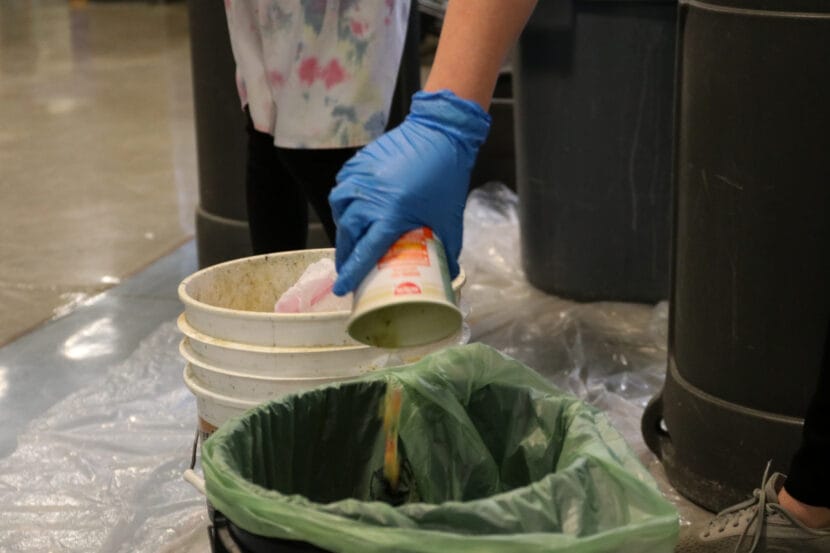
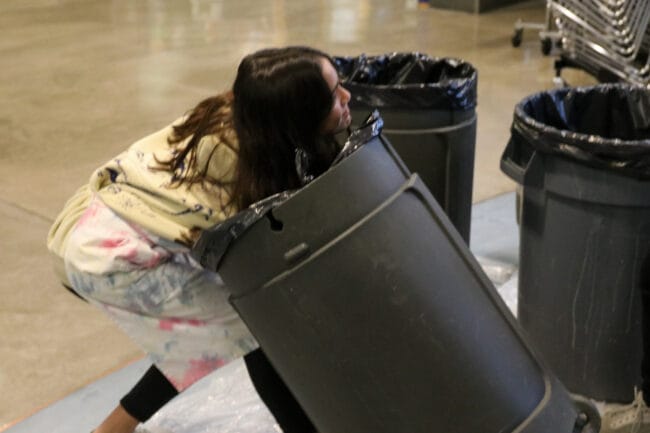
Seventh grader Thalea Headings stuck her arm deep into a trash can, and seemed pretty grossed out by what she found. Dressed in aprons and blue plastic gloves, her science class sorts through the remains of lunch at Thunder Mountain Middle School.
They dug through trash cans filled with yogurt, half eaten sandwiches, loose vegetables and seemingly endless cartons of chocolate milk. They sort the trash into two separate buckets: one for food waste and one for everything else. At the end of the class, they weighed and kept a record of the different types of waste.
Thalea found some interesting items, to the disgust of her classmates. And sometimes it was hard to tell what’s what. She said sorting through trash hasn’t been as gross as she thought it would be.
“There’s more plastic than actual food,” Thalea said. “I was thinking there’s gonna be more food because when I’ve seen the trash cans before, there’s a lot of ranch and gross stuff in it.”
What these students are doing is called a waste audit. All the food waste they sorted out will be composted. This effort is being led by a newly formed club at the middle school called Ocean Guardians. It’s part of a program from the National Oceanic and Atmospheric Administration that encourages schools to protect the ocean.
Seventh grader Maebell Bos helped bring the club to Thunder Mountain. She was part of the Ocean Guardian club at her former elementary school, Sayéik: Gastineau Community School, and didn’t want to give it up.
“When we went to middle school, we kind of thought to just bring it over, and we are excited that we can do that,” she said.
Maebell worked with her friends in the club to create presentations to all of the middle school science classes about what a waste audit is and what things are compostable before actually doing the audits.
Cheyenne Cuellar teaches science and math at the middle school and supervises the club. She worked with Monica Haygood, the Ocean Guardians teacher at Sayéik, to learn what the process was and applied for grant funding to bring composting to the middle school.
Though she’s in charge, she said it’s the club members that have done the bulk of the work for the waste audits.
“It’s not like I’m there helping to make sure this happened,” she said. “The Ocean Guardian kids are really just taking the lead of teaching these, for each science class, two to three class periods, of being the leaders within that class.”
The students are auditing their trash while Juneau is having its own reckoning with waste. Juneau’s landfill will likely fill up in the next decade. Composting is a way to keep food waste out of there. Maebell, the club member, said it was challenging to get some students to get on board with the waste audit and composting.
“Some people are either unaware of, like, the problems that are going on, like, on how fast our landfill is filling up and they aren’t aware. And then other people, they just don’t care for it as much,” she said. “We’re trying to make it something positive and something that we can do to help our environment.”
Still, some students simply didn’t want to go through trash. But, Aria Gribbin, another club member, said once the audit happened, those students realized it’s not that bad.
“It’s been a bit hectic trying to get all the classes to agree to it and not have a bunch of kids be like, ‘Oh, I’m gonna be sick tomorrow,’ so they don’t have to do it,” Aria said. “It’s been hectic trying to get that, but once they did it, I think they realized it’s a bit gross, but it’s also kind of fun.”
By the end of all the audits, students sorted out 319.88 pounds of food waste. And instead of going to the landfill, it was composted. Thunder Mountain joins four other schools in the district all composting their food waste.