
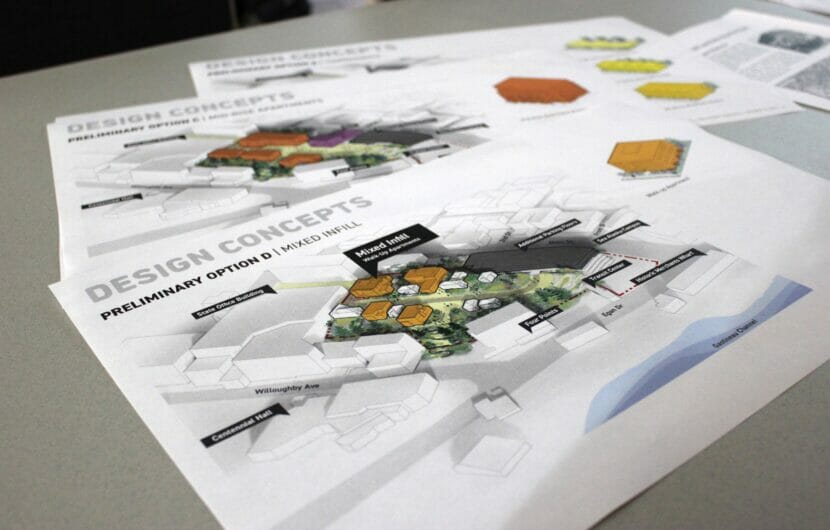
Designers unveiled four possible development options for Telephone Hill at a community meeting on Wednesday.
About 50 people attended to review potential plans, and many of them called for the city to consider a “no build” option instead of adding new units.
There are currently seven houses and one five-unit apartment building on Telephone Hill, and the city estimates that 17 people live there. All of the designs presented Wednesday add new housing to the area, and just one involves preserving the existing homes.
The city contracted First Forty Feet, an Oregon-based design company, to come up with a development plan for Telephone Hill after the state transferred ownership of the property to the city in March. Then-City Manager Rorie Watt said the city would likely put more housing on the property.
Telephone Hill residents, many of whom have rented homes there for decades, have objected to any plan that involves displacing them and forcing them to find new housing in an expensive, limited market. But city leaders say Telephone Hill is an ideal place to expand that market.
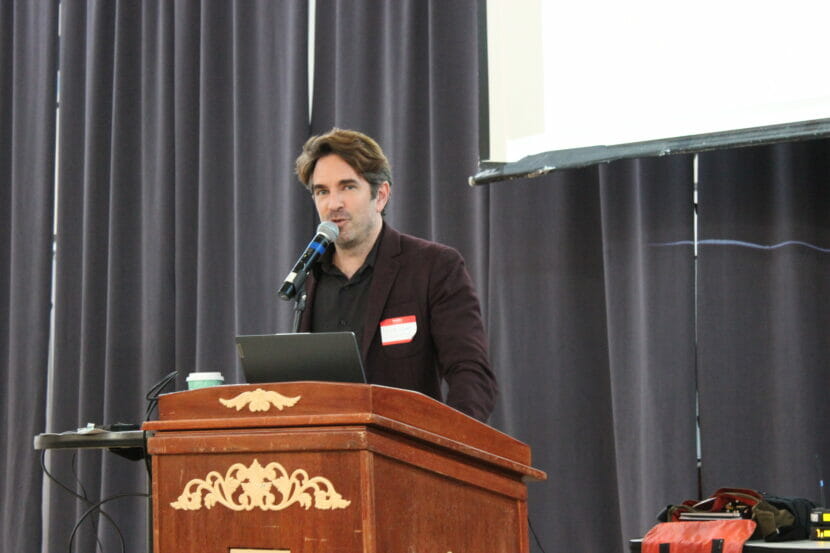
“Everything is possible,” First Forty Feet designer Jason Graf told attendees on Wednesday. “The four concepts we’re showing you today are not concepts that say, ‘No change.’ So there is some anticipated change on the hill.”
Wednesday’s meeting was the second community engagement event meant to gather input from residents on the potential designs. First Forty Feet aims to have a master plan ready for the city manager, city staff and Juneau Assembly in December.
The design options
All four designs shared on Wednesday add more housing to Telephone Hill, but the types of housing vary. One design has just townhomes, one just has apartments and the other two have a mix of both.
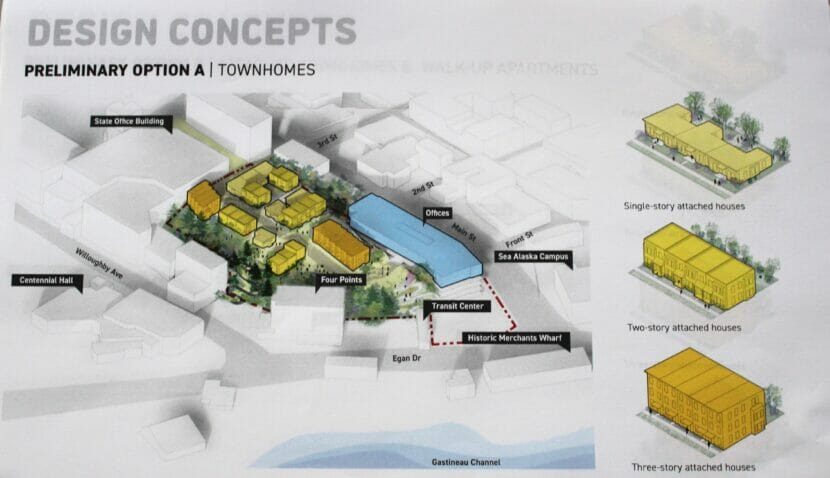
Graf said the parking structure next to the downtown transit center could either have additional parking levels or two floors of office space added to it.
Option A is the lowest density option. It would include about 30 single-family townhomes. Small groups of them would be attached to each other, and they could be one, two or three stories tall.
Option A is the only option that puts office space on top of the parking structure.
“We felt we could do that because there’s lower density on the site – you don’t need as much parking on the site itself,” First Forty Feet architect James Brackenhoff told attendees.
Option B has about 60 units, with a mix of attached townhomes and three-story apartments without elevators. Option B would add parking to the parking garage.

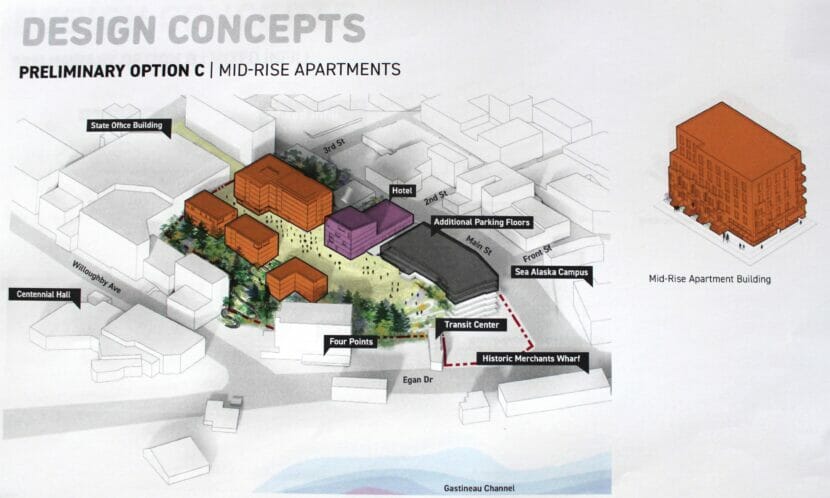
Option C features mid-rise apartment buildings, which would have elevators. Brackenhoff said there could be 100 to 200 units, with parking levels added to the parking garage. Those apartment buildings could have space on the first floor for restaurants or other commercial spaces.
Option C also has a hotel, which Brackenhoff said may work with other types of housing, too. The design features a plaza in the center of the hotel and apartments.
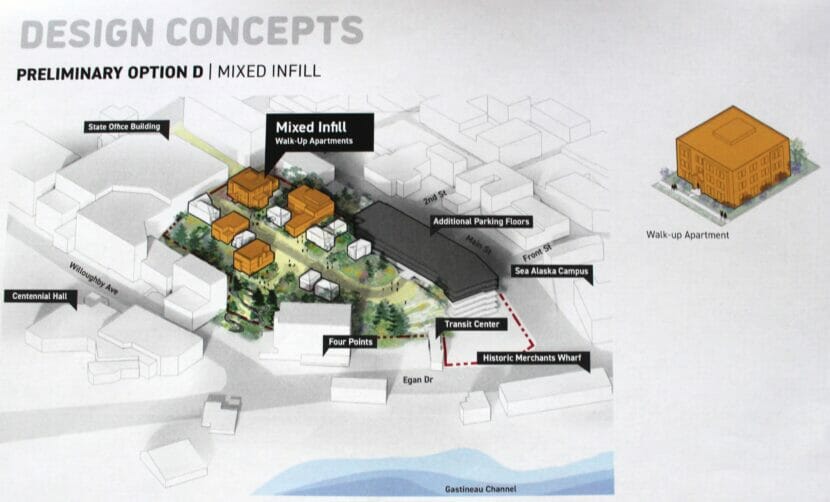
Option D would put walk-up apartment buildings in spaces between some of the existing houses. Brackenhoff said the design adds 40 units to Telephone Hill. He called it an “acupunctural approach” that would mix the old with the new.
“We wanted to make sure we provided an option that took on board what we’ve been hearing from some of the folks in the community about preserving some of the homes,” Brackenhoff said at the meeting.
Brackenhoff said they still need to determine whether or not it’s feasible to preserve the homes.
“What we have to do is go through the survey process to make sure these homes are actually structurally sound, that there’s not a significant burden that the city would need to carry to renovate these homes,” Brackenhoff told attendees.
Downtown resident Joshua Adams told the designers and attendees that he was skeptical the city would consider keeping the homes, even if the community favored that option.
“We all know that the city is going to look at this and say none of these buildings can be feasibly restored. Anybody who knows anything about historic restoration knows it’s at least three times as expensive to restore something properly than it is to tear it down and build it new,” he said. “Does that mean we shouldn’t preserve our history?”
Some attendees suggested the city sell the homes in their current condition. But Graf said those kinds of decisions are up to city leaders, not the designers.
“What we’re trying to look at is, if we preserve those, can we add additional housing, and what is that development like?” he said.
Community response
Most of the Juneau residents who spoke at the meeting said the city should preserve the houses and not add additional housing.
Tony Tengs, who lived on Telephone Hill for nearly three decades before moving out this spring, looked through the designs before the meeting started. He pointed to Option D, which has orange apartment buildings amid gray houses.
“The only one that has the buildings in place, they look like ghost buildings on the drawing,” he said. “Even in the one where they’re still shown, they look like ghosts.”
Skip Gray, who has advocated for the city to restore the existing houses, said he’s frustrated that questionnaires haven’t given him the opportunity to vote for a “no build” option.
“There just aren’t any answers on these surveys that I want to push the button on,” he said in an interview.
But Betsy Brenneman, a former Telephone Hill resident, told attendees that the planning commission and Assembly were the right people to contact about a “no build” option.
“You’re shooting the messenger a lot tonight,” she told attendees. “The city asked for this plan.”
Brenneman was a member of the Blueprint Downtown Steering Committee, which drafted a revitalization plan for downtown Juneau that lists adding housing as the top priority.
“If we don’t get more people living downtown, you are going to have more closed storefronts in the winter, you are not going to have any businesses downtown,” she said. “We have to get more people downtown.”
Brenneman said she favors keeping the existing homes, but she’s open to adding more units around them.
“I will be laying down in front of the bulldozers if anybody tries to take down the historic homes,” she said. “However, I do think there are ways on Telephone Hill to add a little more housing.”
Incentivizing affordability
Some attendees wanted assurance that the new houses or apartments would be affordable.
Graf said the city will have the opportunity to require a certain amount of affordable housing in its contracts with developers.
“Because it’s under the CBJ, they create the carrots to incentivize affordability as an option as well as market rate,” Graf told meeting attendees. “There will be an opportunity for affordability if that’s valued, which I think it is.”
Chris Zahas, a consultant with Leland Consulting Group, agreed. He’s tasked with identifying developers who can make the master plan happen. He said in an interview that the city could offer subsidies to developers, which could come with conditions.
“The city is in a position to kind of put strings attached to it to get what the community wants out of it,” he said.
Zahas said developers’ proposals usually go before the Assembly for approval.
“So there’s going to be multiple points along the way where the public and the Assembly get to have a conversation about it,” he said.
