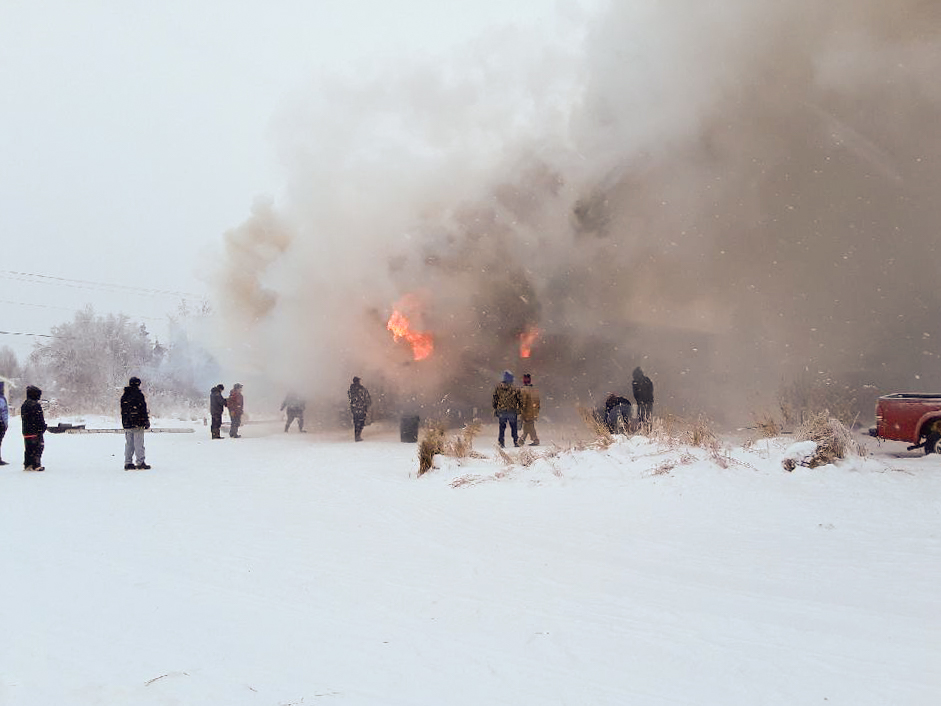
It’s been three weeks since a fire destroyed Tuluksak’s only source of drinking water. Since then, the village has been living on donations of bottled water that have come from activists, a gold mining company and even an Indigenous rapper from pop-rap group the Black Eyed Peas.
But noticeably absent have been supplies or funds from the state government.
Gov. Dunleavy has yet to declare a state-level disaster to address Tuluksak’s water crisis. In doing so, he’s holding back up to $1 million in disaster relief funding for the village.
State legislators who represent Tuluksak say they’re working on the issue. Sen. Lyman Hoffman said that he’s looking at options to pay for the long-term response to the crisis. But Rep. Tiffany Zulkosky said that the House can’t do much right now because they’re currently unorganized.
She says the governor should declare a state disaster.
“The sphere of influence related to the circumstances in the village of Tuluksak and its water crisis is most influenced by the administration and the executive branch’s ability to move the disaster request forward within its own process,” said Zulkosky.
Zulkosky told KYUK that she has contacted Dunleavy’s office multiple times in recent weeks, asking him to declare a disaster and to send in the National Guard. But she says she hasn’t gotten answers.
“I have not heard a response from the governor’s office on my inquiries related to National Guard support — whether they’ve pursued unspent CARES [Act] funding that have been provided to the state or anything related to that issue and Tuluksak,” Zulkosky said.
KYUK also contacted the governor’s office, which put us in touch with the Alaska Division of Homeland Security and Emergency Management. Spokesperson Jeremy Zidek said that although the division has not donated supplies, it can provide relief to Tuluksak without a disaster declaration.
Jeremy Zidek: In order to respond to emergencies in Alaska, we don’t need a disaster declaration. We don’t need the disaster declaration to provide water to folks.
Olivia Ebertz: So I guess I’m just curious if the state has a capability to send water without any sort of disaster declaration. How come they didn’t?
Zidek: Well, one of the one of the requests that we had from Tuluksak was that they didn’t have access to fresh, er, the requests that we had from Tuluksak were that they didn’t have access to potable water. So our primary concern was restoring that access.
He said that rather than providing Tuluksak with fresh drinking water, part of the division’s job is to make sure that if the community can’t respond to the emergency, someone else does — like nonprofits or private companies.
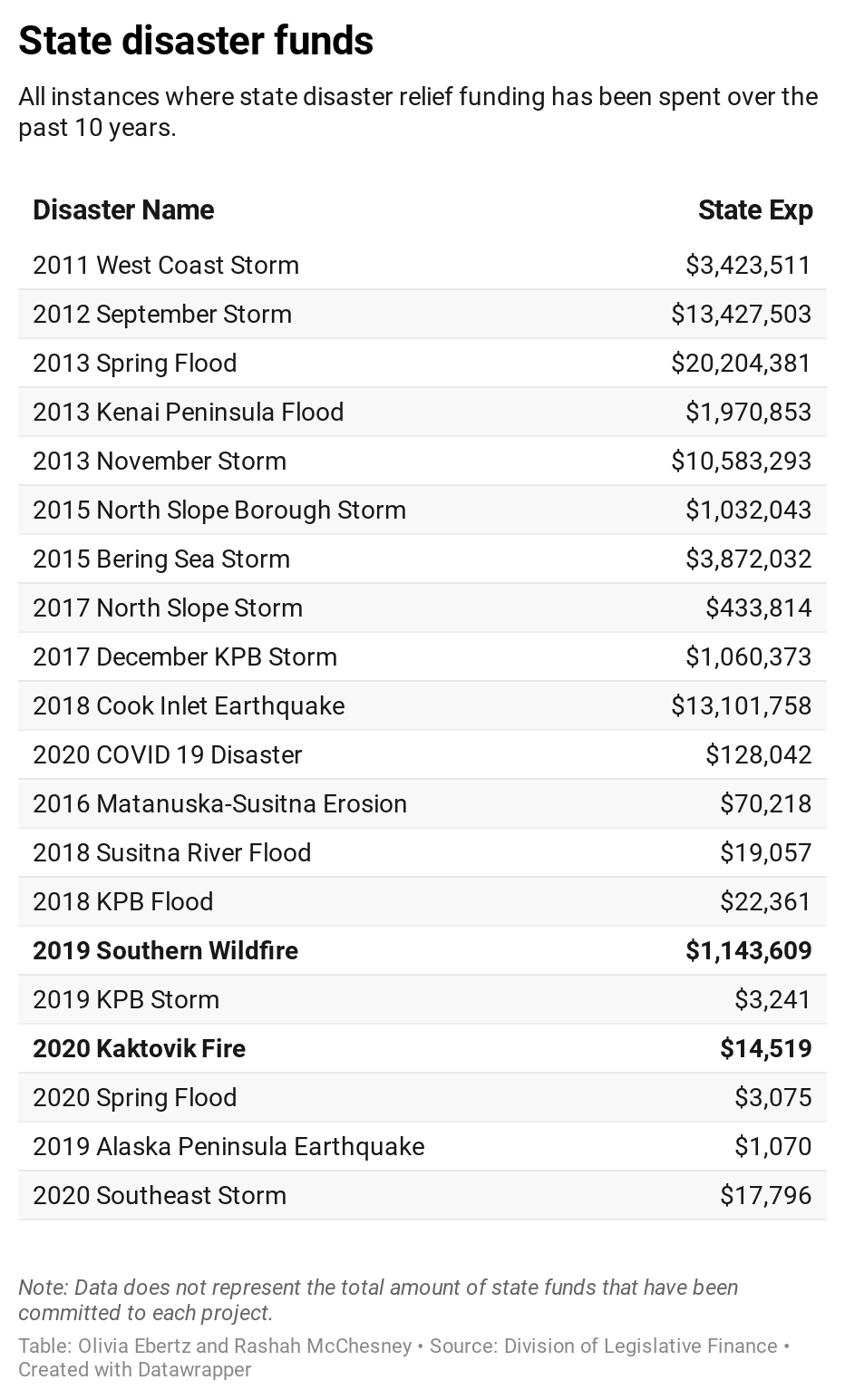
(Legislative Finance Division)
Zidek said a gubernatorial disaster declaration is more for a long-term approach to recovery, and that the state government likely won’t need to respond in the long term because the tribe has already filed a grant request with the federal Indian Health Service for a permanent water plant.
That new water plant could take three to four years. Yukon-Kuskokwim Health Corporation plans to install a portable treatment plant as a stop-gap, but that will take weeks or months to get in place.
Zidek said that his division is writing a report on the water crisis to send to the governor’s disaster policy cabinet, after which the cabinet could recommend that the governor declare a disaster. The governor could then release up to $1 million in relief funds without legislative approval. Zidek didn’t say when, or if, this would happen.
But Alaska has used state disaster relief funding for fires before, including last year’s school fire in Kaktovik.
And Rep. Zulkosky says that Alaskans who live in Tuluksak deserve just as much access to state emergency resources as Alaskans in other communities.
“If any larger community in Alaska was without reliable access to water during a global public health crisis,” she wrote in an email, “it is almost certain a disaster would be declared.”