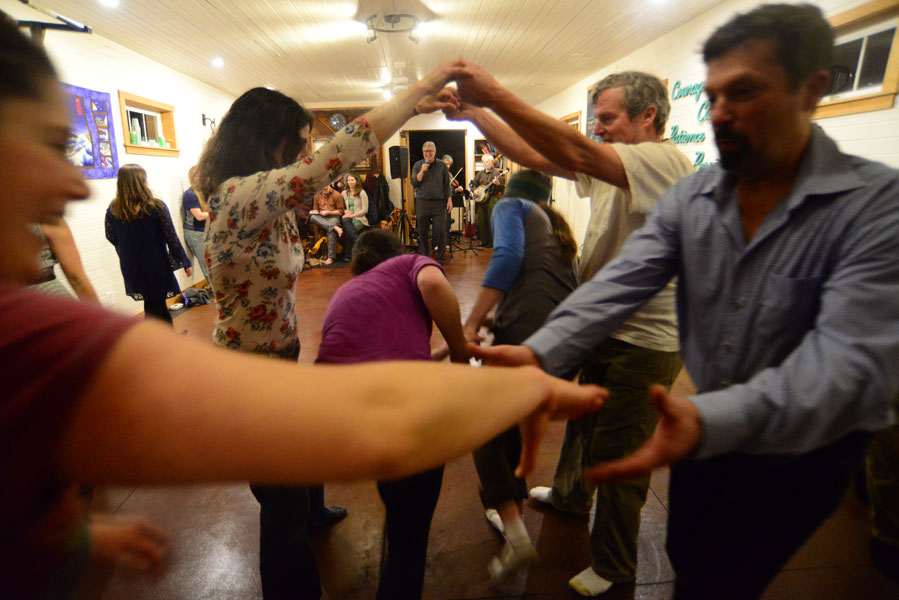
Haines can feel cold and quiet in the winter. But for Haines’ homegrown square dance caller, the dark and chill are perfect conditions to heat up the dance floor.
It’s the middle of winter and long past sunset, but the doors and windows of the old Fort Seward fire hall are lit up and standing open.
When you get close, you realize why — it’s really hot inside. And there’s a banjo going.
Twenty people and an old-time band are squeezed together, doing the Texas Star and the Virginia Reel.
Spencer Douthit has been calling a square dance for almost two hours.
“When you’re done swinging that corner, gents, you’re going to be bringing the lady along with you,” he calls.
Douthit is a union millwright, leaving Haines for long stretches to work on a power plant out of Healy.
He got hooked on square dance working near Fairbanks when some neighbors threw a dance in their barn.
“I guess I feel like I discovered what dance meant. We have some natural feeling, in ourselves, that basically, you tap into when you’re dancing,” Douthit said. “It’s different for every person, how they manifest that, but square dancing is really what caught me.”
Soon, he was going to monthly dances in nearby in Ester.
Little did he know, he’d stumbled into of Alaska’s oldest old-time music hot spots.
From what he’s read, Douthit knows the music arrived in the Interior with fiddle wielding traders and trappers from Canada and Europe in the mid-1800s.
It spread from there: Alaska Native people created their own style — the Athabascan Fiddle tradition humming along for over 150 years.
The Klondike Gold rush brought an influx of mandolins, banjos, and miners straight up Lynn Canal, looking for ways to pass dark nights.
“Going from cabin to cabin, it would be one little square and a little band crammed in the corner, and the caller crammed in another corner,” Douthit said. “Basically just trying to get through the winter.”
Though he got dancing in Fairbanks, it was moving to Haines that got him to start calling.
“I want to say, two weeks after I arrived there was a flier for a barn dance,” he said. “And I thought — oh, Haines, has all these wonderful things and it even has a dance scene!”
Little did he know, it was the first dance that had happened in a quite a while.
Eric Holle, a banjo player, said there used to be more when he arrived in 1989, but it died out in the ’90s.
“Recently, there’s been an influx of younger folks — I don’t know if they’re wanting to get in touch with their roots and culture, or need an outlet for energy on cold winter nights, or both,” he said. “But there’s been a real resurgence. And I have to credit Spencer Douthit.”
At the end of Douthit’s first dance in his new home, the caller asked if there was anyone in the audience who’d like to learn the craft.
“No one else raised their hand or said anything. But I went up at the end, and said, hey, I just moved to town. I fell in love with square dancing, and he said OK — well here, here’s this book.”
He plopped a tome into Douthit’s hands: Cowboy Dances.
“It’s like a 1953 printing of a 1930s book, and it has like these wonderful plate images,” Douthit said. “Basically, that was the beginning.”
He did his homework. Because he was learning, they had more dances. He started by calling one square, then a couple. Before long, he could run the entire evening.
“I’ve reached a point where people are having fun. At this point, I’m just kind of working on refining my technique.”
In early January, on leave from his job and visiting home, Douthit wanted to dance.
It turns out, did 20 of his friends. And a band. Holle said they were ready.
“The beauty of this kind of music is that you don’t have to be too involved with the technical aspects of music. You can kind of get into the zone where, you know, everything just starts to flow and you’re not wrapped up in worrying about whether someone’s going to hear.”
Douthit wants to train someone else to call — that way, he can dance, too.
But he won’t be back from his job up north until the end of April. To get a dance going before then, someone else will have to step up.