
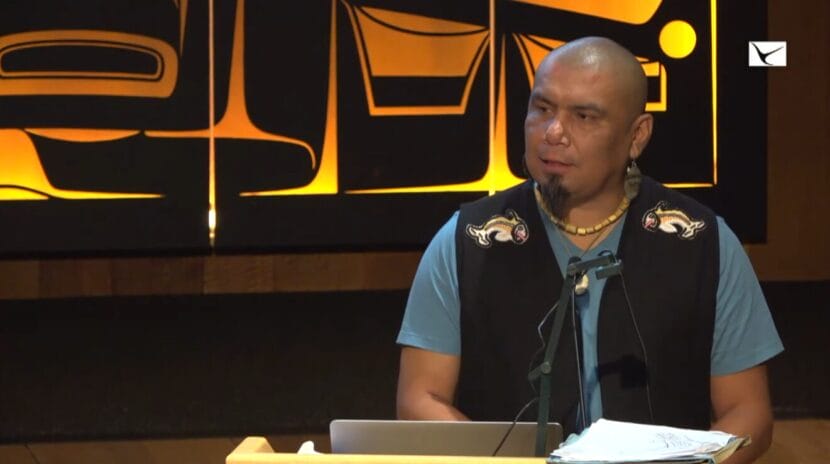
This is Tongass Voices, a series from KTOO sharing perspectives from the homelands of the Áak’w Kwáan and beyond.
Xeetli.éesh Lyle James has been learning and teaching the Lingít language for more than two decades. His passion grew through attending classes and leading songs.
He lives in Juneau and has taught more than 1,000 students, emphasizing the importance of making mistakes and maintaining a non-judgmental environment. He encourages others to try learning the language, regardless of initial fears.
Listen:
This transcript has been lightly edited for clarity.
Xeetli.éesh Lyle James: It’s exciting for me to see my students outside of classrooms. It makes me happy when I see them out in the community, and they say, “Hey Xeetli.éesh!” or “Wáa sá iyatee? Wáa sá tuwatee?” and ask me general questions.
Yei x̱at duwasáakw Lingít x̱ʼéináx̱ Xeetli.éesh. Kaagwaantaan naax̱ x̱at sitee. G̱ooch hít dax áyá x̱at. Kax̱noowú Ḵwáan dax̱.
My name is Xeetli.éesh. I am Kaagwaantaan Eagle Wolf from Hoonah, and I come from the Mud Bay area, clan-wise. I was born in Sitka and I was raised in Hoonah and in Kake.
Growing up in Hoonah, I went to Hoonah schools. Got to hear and learn from a lot of the elders in that community. Like, for instance, Jenny Lindoff, and even my great grandmother, Elsie Pratt. and they spoke only Lingít to me.
I grew up around language, but I didn’t start learning Lingít until I was 23 years old, learning how to speak it myself. I attended a ku.eex here in Juneau. The family that were hosting the ku.eex knew I was learning how to lead the songs, so they called me up to ask and lead some of the songs for them.
After that, I met my wife. She took me to one of her language classes with Florence Marks Sheakley, and that was my hook – attending the class and seeing how much fun they were having with the language.
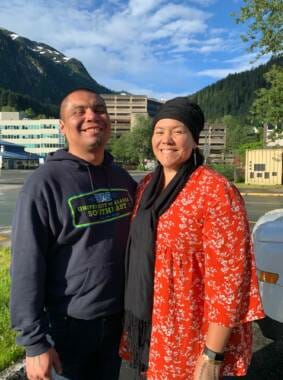
At my GED graduation, the principal of Yaaḵoosgé Daakahídi was at my graduation. I introduced myself in the language, what I knew from attending Florence’s class, and right afterward she asked me, “Are you looking for a job?”
She asked me if I would be interested in teaching the Lingít language.
And I told her straight up, “I don’t speak it fluently. I am a student in the language.”
And she said, “You’re perfect. You are going to make our students feel comfortable learning the language with you.”
And that’s what encouraged me to do language full time. I try to figure out what the students are interested in, and if I find something that aligns with what the students enjoy, then I try to incorporate it in the language as much as possible.
If the students are not afraid of playing a game in the language, then they are learning at the same time, without the fear of making mistakes.
I think that’s the biggest thing, making sure the students are not judged when they make their mistakes. Because, shoot, I make mistakes all the time. I want my students to come back and take over my classes and make it bigger and better than what I’ve left behind.
I gu.aa yáx̱ xʼwán! I gu.aa yáx̱ xʼwán! Have courage.
Go out there and try it, whether it be in Lingít, whether it be in X̱aad Kíl, Haida language, Sm’algya̱x, the Ts’msyen language. Go out there and enjoy it. Don’t be afraid to make mistakes, and have fun with the language.
It’s in you. It’s always been in you.
Yéi áwé Gunalchéesh.
