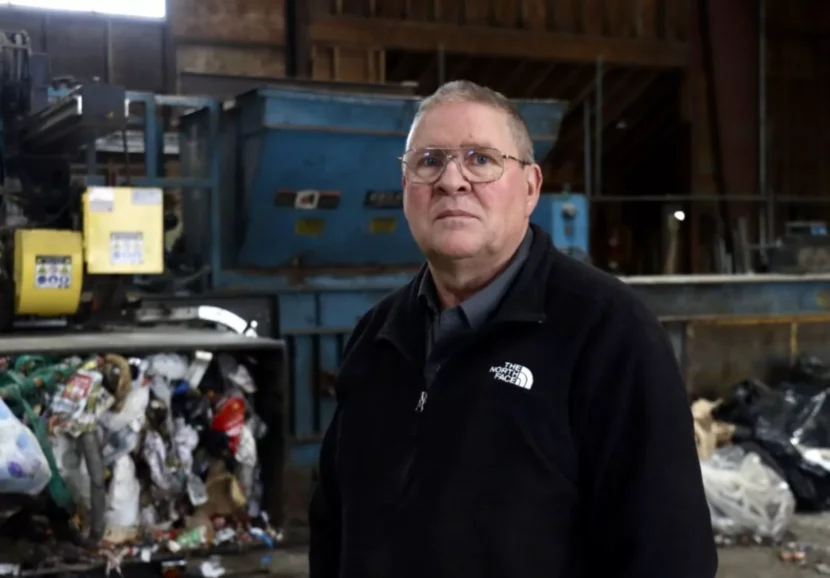
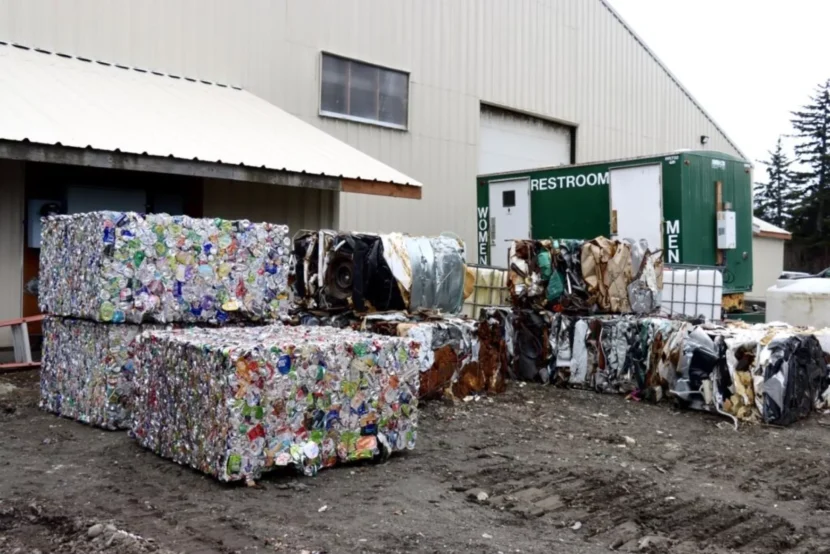
Once a week, employees at the Haines landfill scoop mountains of trash into a machine that squashes it into gigantic cubes.
The baling process significantly reduces how much space the garbage occupies, solving a major real estate problem. But it also takes a lot of power, which historically has come from the local utility, Alaska Power and Telephone.
That’s about to change.
Community Waste Solutions is on track to go completely off-grid and soon will be powered by a mixture of solar, batteries and diesel generators. The driving factor: soaring utility bills.
“I’d love to say it’s all a green initiative, but it’s just cost,” Craig Franke, the company’s general manager, told KHNS.
“Our power increases have been 19%, 29% and the most recent one over 100% over the last three years,” he added. “It’s just time for us to move on.”
In Alaska – and throughout much of the United States – utilities are considered regulated monopolies. So in many communities, there’s only one power company, leaving unsatisfied customers without other options.
Phil Wight, an energy historian with the University of Alaska Fairbanks, said he thinks that has contributed to a “populist backlash” against high electricity prices, which are currently surging even more amid the war in Iran.
“I think that is one of the reasons that explains why people are so frustrated,” Wright said. “They feel a lack of choices.”
Some, like the Haines landfill, choose to go off-grid altogether.
Community Waste Solution’s case is pretty stark. In 2024, the waste management company spent more than $9,000 on power from AP&T. But that figure more than doubled in 2025, according to data reviewed by KHNS.
The company’s energy use had increased by just 13% over the same period.
Driving the increase is something called a demand charge. That’s a line item on some utility bills that’s based on how much electricity a customer needs delivered over a short period of time, like 15 minutes, as opposed to how much electricity they use over a full billing period.
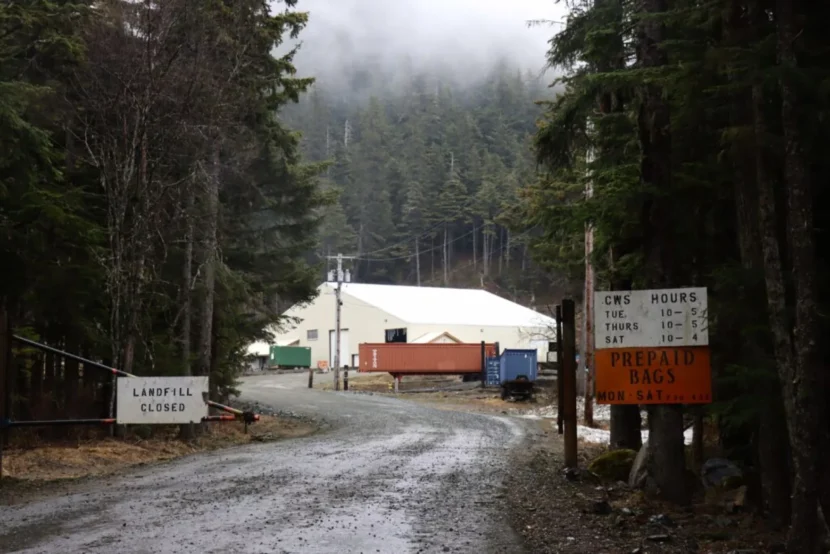
Utilities implement demand charges when businesses need a lot of electricity fast — like starting up an industrial baler that squashes a week’s worth of garbage in Haines in just three hours.
“You might actually not use that many kilowatt hours in a month,” Wight said. “But there are certain days where you’re really cranking it.”
In those cases, power companies tack on demand charges so they can operate the backup generators they might need to meet that peak demand. Which is how Franke got into this situation. AP&T notified him in March of last year that Community Waste Solutions would be moved from a “residential and small commercial rate” to a “bulk power rate” that includes a demand charge.
The result: the landfill now pays anywhere from $800 to $1,300 on top of the normal power bill each month, Franke said.
AP&T did not respond to multiple interview requests. Vice President Jason Custer said in an email that the company cannot discuss individual accounts, but that AP&T has reviewed the matter with the customer.
Franke, for his part, said he did recently connect with someone from the company who was helpful, after months of trying to get clarity on the matter. Still, he’s moving forward with his plan.
Soon, the landfill’s heavy industrial equipment will run off of an existing large diesel generator that’s currently offline. The rest of the operation will run on a new system Franke is purchasing from Alaska Power & Engineering, a Haines-based construction management firm that works on utility-scale renewable projects around the country and world.
The primary power source will be solar panels that will charge a set of batteries, said Alaska Power & Engineering CEO Clayton Jones. When the solar isn’t sufficient, a small diesel generator will top them off.
The system “should keep his operations running,” Jones said. “But we can scale it as needed to support.”
Franke said he expects the full system will cost upwards of $60,000. And even with recent spikes in the cost of diesel, he thinks the move will save money.
“You know you’re in trouble when you can afford to run a diesel generator in Haines for about two-thirds of the cost of running it on electricity,” he said.
Wight, the UAF expert, said he understands why frustrated utility customers might have that response. But in general, he cautioned against going off-grid – even though doing so is more straightforward and less expensive now than ever.
“It’s not easy or cheap,” Wight said. “The real challenge is maintaining the infrastructure to deliver a constant supply of power, 24/7.”
An alternative, he said, could be relying on the utility for day-to-day electricity, but then installing solar, wind or hydro to cover peak usage – eliminating the need for the demand charge.
Back at the landfill, Franke said if he had it his way, the project would be done today. But if all goes to plan, Community Waste Solutions should be off grid by fall.
“I can’t just keep sustaining these increases,” he said.