Listen to this story:
Summer is in full-swing, and that means many coastal Alaskans are flocking to the shoreline. Scientists are testing a few popular beaches in Juneau for fecal contamination and so far, they’re mostly poop-free.
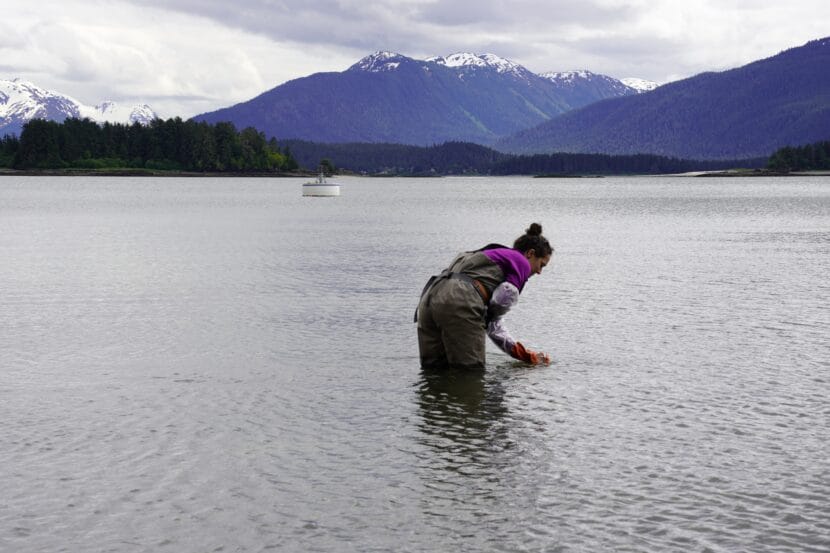
At low tide on a bright June afternoon, Rebecca Bellmore waded about knee-deep into the sea at Auke Village Recreation Area and scooped a couple of water samples into glass bottles.
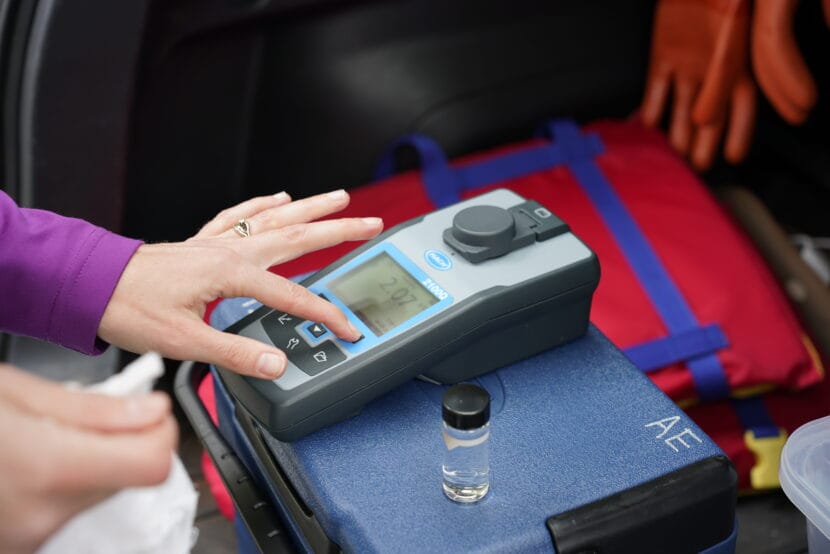
She’s the science director at Southeast Alaska Watershed Coalition, a local nonprofit sampling for two bacteria called fecal coliform and enterococcus, “which are bacteria that live in mammals’ guts,” Bellmore said. “If we find those, it’s an indicator that there could be fecal contamination in the water.”
Bellmore scoops a little less than half a cup of seawater from Auke Village Recreation Area, Lena Cove Beach and Sandy Beach every week, from late May through early September.
“We picked beaches where people recreate a lot, and so these are popular places where kiddos are in the water, people are out kayaking, paddle boarding,” she said.
SAWC received about $74,000 from the state through a U.S. Environmental Protection Agency grant to test Juneau beaches in 2025 and 2026.
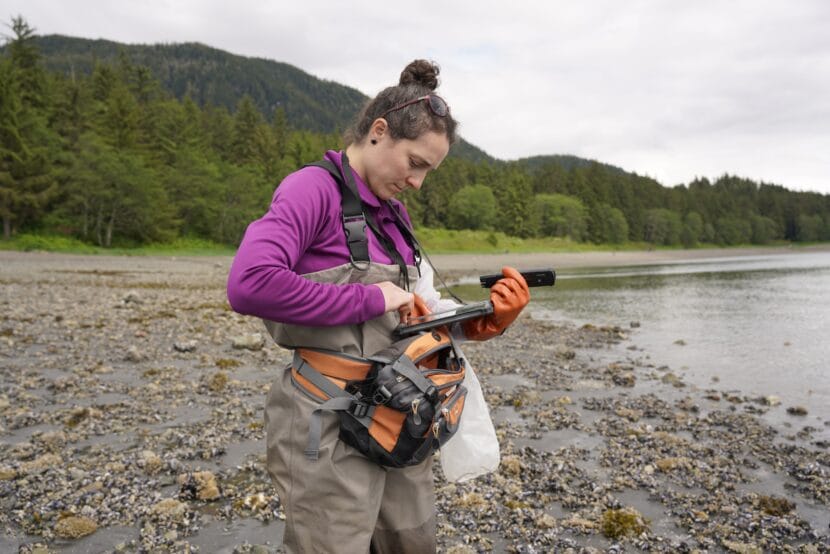
Bellmore sends the samples to the Admiralty Environmental Laboratory in Juneau. If samples collected over the month average out to exceed state standards for safe water recreation, the Alaska Department of Environmental Conservation will notify the public and post signage at the beach.
If the samples come in below state limits, the data simply goes into DEC’s Juneau Beaches webpage. Bellmore said so far, Juneau’s top beaches haven’t posed problems for water recreators.
“We’ve never found high concentrations here, and we sample in all kinds of conditions,” she said.
But that’s not the case for some Alaska communities tested in the past. Between 2017 and 2020, Ketchikan beaches had high levels of fecal contamination, including from human and dog poop, according to a report by the Southeast Alaska Watershed Coalition.
Laura Eldred manages Alaska’s beach monitoring program at DEC. When samples show high bacteria levels, she said scientists can test the DNA to see which animals the bacteria are coming from.
“Is it wildlife? Is it whales? Is it seals? Is it, you know, birds that are in the water, or is it some type of human source, like dogs or horses or chickens, or even human sewage?” Eldred said.
But she said DNA tests don’t narrow it down to the exact source, like sewer outfalls, wastewater treatment plants or boat waste.
Eldred said the state program, which received $150,000 from the EPA this year, depends on federal dollars through the Beach Act that Congress passed in 2000.
“If we don’t get these federal grants, there is no backup plan for the state to be collecting water samples,” Eldred said. “That’s the reality of it.”
She said the state has reliably received those grants since the federal program started.
Scientists are also testing beaches in Haines and Homer this summer. It’s the second year of testing for these sites, and every couple of years, the program bops around to different beaches. Eldred said Alaska communities can apply for beach testing next fall, assuming funding continues.