Listen:
Canagold Resources, the company proposing to open the New Polaris gold mine on the Tulsequah River in British Columbia, says it’s taking steps to protect the environment.
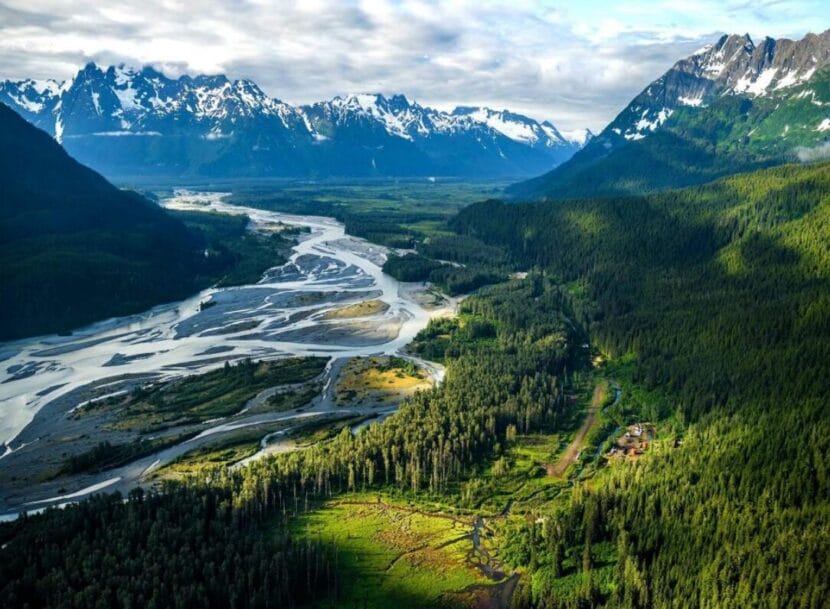
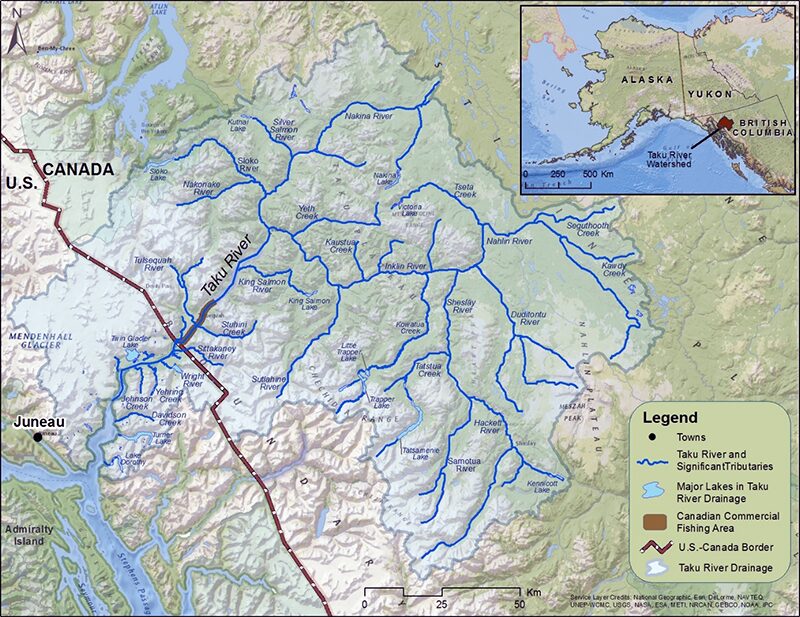
The Tulsequah is a tributary of the Taku River in Alaska, which is known as the most productive salmon stream in Southeast. All five Pacific salmon species spawn in the river, including the largest Chinook run in the region. Although there hasn’t been a concerted effort to study whether mining has affected Taku River salmon, some are concerned it could.
Chris Pharness is the senior vice president of sustainability and permitting at Canagold. He said the company plans to operate in ways that avoid harming the watershed and the fish in it.
For instance, he said Canagold originally planned to use cyanide to separate gold on-site.
“We were going to produce doré, which is unrefined gold, on site,” Pharness said. “But, you know, in consideration of the fisheries values and water quality values and things like that, we decided against that.”
Instead, Pharness said they’ll use another method that involves less chemical processing, called flotation. A foaming agent creates bubbles to concentrate gold out of waste rock. He said the gold concentrate will be shipped somewhere else for further processing.
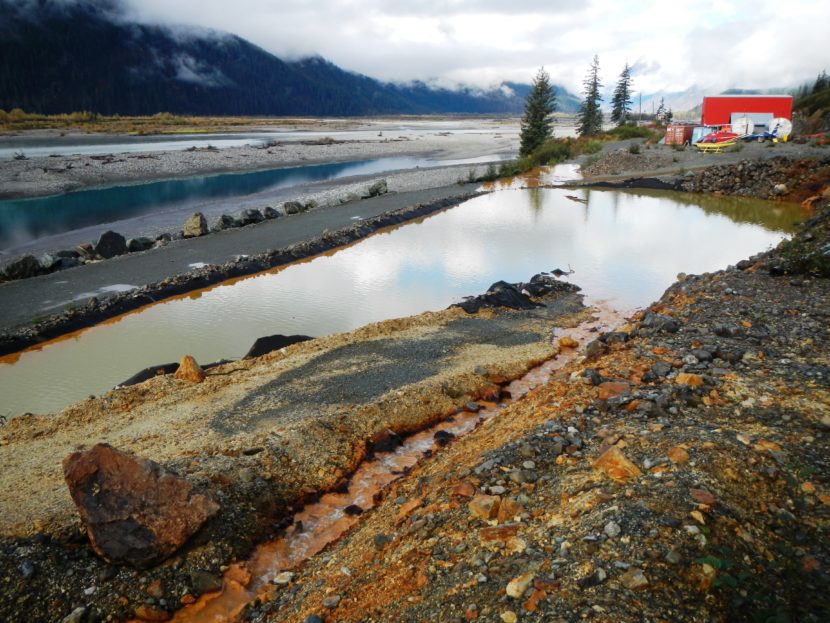
The mine site still has old infrastructure from its past, including five mine portals, a small airstrip, storage tanks, a barge landing and more than 700,000 cubic feet of mine tailings. To rebuild the site — which was formerly called the Polaris Taku mine — Canagold expects to excavate tailings stored near Whitewater Creek, a salmon spawning ground connected to the Tulsequah River. The excavation must be done carefully to avoid mobilizing pollutants or disturbing the creek.
“Protecting Whitewater Creek — that’s definitely, you know, that’s what’s going to make our mine very unique, is having a salmon-bearing stream right in the middle of the mine site,” Pharness said.
Fish in Whitewater Creek have likely been exposed to contaminants from past mining activities. Dolly Varden collected in Whitewater Creek in 2018 and 2019 had greater concentrations of arsenic, cadmium, lead and mercury than fish sampled downstream, in the Tulsequah River. That’s according to data compiled in 2021 as part of a joint sampling program between Alaska and British Columbia.
Pharness said citizens from the Taku River Tlingit First Nation will monitor the environmental status of the operation. In 2023, Canagold signed an agreement that the mine won’t move forward without consent from the First Nation.
In its environmental review filings with British Columbia, Canagold proposes to build a new airstrip and barge landing where the Tulsequah and Taku Rivers meet, haul roads, storage facilities for explosives, fuel and reagents, an ore crushing mill, a water treatment plant, a hydroelectric powerstation, a combined storage facility for tailings and waste rock and a camp that can house 300 workers.
At a House State Affairs Committee hearing on transboundary mining last week, Alaskans voiced concerns over a lack of engagement with people on the U.S. side of the border and fears that potential pollution could affect salmon.
Paulette Moreno is vice president of the Central Council of the Tlingit & Haida Indian Tribes of Alaska. She said the state of Alaska must work with tribes to monitor and restore transboundary rivers.
“Anything less is not under control,” Moreno said. “It is a failure to act in the face of known risk to some of the most productive salmon rivers in the world and the Indigenous communities that depend on them. Our people have stewarded these waters for generations. We are more than stakeholders.”
Many concerns stem from decades of inaction on the Tulsequah Chief Mine. That mine was abandoned in 1957 and has been visibly polluting the watershed on the Canada side of the border ever since. That’s just across the river from the New Polaris site.
Doug Vincent-Lang is the commissioner of the Alaska Department of Fish & Game and participates in biannual transboundary watershed meetings with officials in British Columbia. Those meetings happen under a non-binding memorandum of understanding and statement of cooperation the state and province signed a decade ago, which are meant to keep Alaskans informed about water quality beneath existing mines and to engage them in the public process for developing new ones.
At the hearing, he said the derelict mine’s reputation has been looming over proposals for new mines.
“Every time we meet with Canada, we talk about Tulsequah Chief,” Vincent-Land said. “It’s a black eye, and whatever they do in any other mines is going to be influenced by the inability to make progress on Tulsequah Chief. So they’ve heard us loud and clear.”
He said he’s starting to see progress on the cleanup, which has been voluntarily taken on by Teck Resources Limited. Teck is a Canadian mining company that runs the Red Dog mine near Kotzebue and has proposed the Galore Creek mine in British Columbia within the Stikine River watershed, upstream from Wrangell.
Vincent-Lang also said he’s confident future mines in British Columbia will be managed properly, since the province created an interim policy in 2022 designed to make mining companies pay the full cost of cleanup.
He said mining pollution on the Tulsequah River hasn’t reached Alaska.
“We’ve never found violations of water quality in our side of the border from DEC’s water quality sampling, and we’ve never seen contamination in fish on our side of the border,” Vincent-Lang said. “But one of the questions we always get asked is, ‘What is the baseline?’”
Patrick Moran is a biologist who manages the Alaska transboundary rivers monitoring program at the U.S. Geological Survey. He said more work still needs to be done to distinguish sources of metal contamination, since the watershed is known to have some naturally occurring metals.
“The question everybody really wants to know is, what contributions are coming from the mine and what contributions are just coming from naturally elevated background,” Moran said.
He said metals generally don’t break down in the environment. Instead, they accumulate.
According to data collected in 2018 as part of the joint sampling program, Taku River sediments in Alaska exceeded NOAA guidelines for arsenic, copper and nickel.
Although salmon don’t spend their whole lives in the river, Moran said they are there at a sensitive time in their life cycle.
“Juvenile salmon are known to be more vulnerable to metals than adults, and that process of going from freshwater to saltwater transition — smoltification — is particularly challenging and the added stressors need to be considered during that particularly critical life stage,” Moran said.
But there hasn’t been a concerted effort to study the effect of mining on Pacific salmon in the Taku River, specifically. Just four individual salmon from the Taku River, three Chinook and one sockeye, were included in the 2021 report by the joint sampling program.
Moran said researchers typically test Dolly Varden char and sculpin for contamination since they move less.