
Calculating school funding is complicated. It’s currently based on enrollment projections, which can create uncertainty in a school district’s budgeting process. House Bill 261 would allow districts to use known numbers instead of projections to build budgets.
In the bill, districts could use enrollment numbers from the previous year, or a three-year average of prior years. But if the district’s count in the current year is at least 5% greater than the other options, that can be used instead.
On top of that, districts could have options for how to count students who receive intensive services, such as students who need multiple services to help with communication and motor skills. The bill would ensure all students are accounted for when determining funding. School districts would be able to use the previous year’s count, the current year’s count in October or in February.
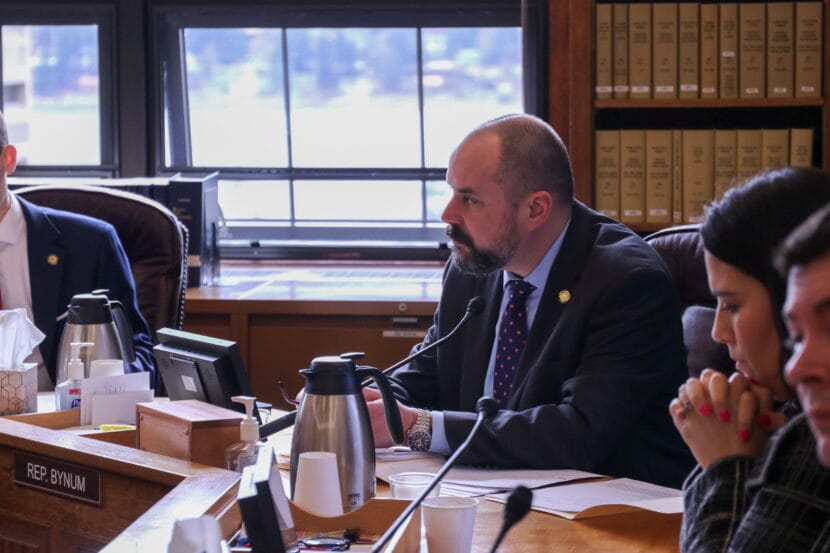
Ketchikan Republican Rep. Jeremy Bynum attempted to simplify the options by only requiring a three-year average be used across the board. He said during Tuesday’s House Finance Committee meeting that taking an average gives districts predictability while placing the responsibility on them to plan for changing enrollments.
“In years that they have lower counts, they’re getting more money, and in years they have higher counts, they might be getting just a little bit less, but ultimately they still have fund balance that they’re able to absorb those,” he said.
Rep. Alyse Galvin, an Anchorage independent, opposed the amendment. She said school districts are legally required to provide intensive services for students who need them, and taking an average won’t work for them. Those students get 13 times the funding of other students in the state’s funding formula.
“If we’re smoothing out, and in some years we have over, and some a little under, I guess that’s where I do draw the line, because we have legal responsibilities that absolutely cannot be underfunded when it comes to our intensive need students,” Galvin said.
Rep. Andi Story, a Juneau Democrat and the bill’s sponsor, said districts with growing enrollments should be able to have the opportunity to receive the funding to serve incoming students.
“If their district was showing an upturn, they didn’t want to have to wait to have that accounted. They wanted to be able to make sure that our formula adjusted for what they saw as a bright spot, and wanted to make those students and families have those resources,” she said.
Lawmakers narrowly rejected the amendment in a 6-5 vote.
According to the most recent fiscal notes, the bill is expected to cost more than $113 million. Most districts are estimated to receive more funding.
If the bill passes, the Aleutian Region, Pelican and Pribilof school districts are estimated to receive the same amount of funding as expected for the upcoming fiscal year. Bristol Bay Borough, Chugach, Chatham and Nenana school districts and the state-run Mt. Edgecumbe High School are expected to receive less money.
Bynum says he wants to see more specific modeling on how school districts will be affected.
“I don’t believe that we’ve done the necessary work that we need to do for this complex bill, but … I won’t be getting in the way for us to continue moving the ball forward on it,” Bynum said.
After the committee meeting, Story said she is working to get more specific data, and that it will be presented as the bill moves through the legislative process.
The bill was referred to the House Rules Committee on Wednesday. The committee has not met yet this year. The regular session is scheduled to end on May 20.

