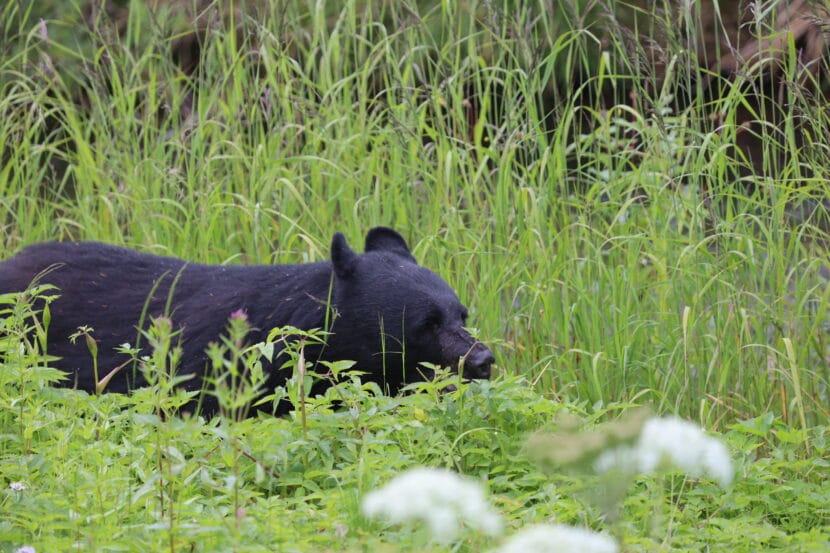
It’s that time of year again when we’re all told to be “bear aware.” Bear encounters can happen when we’re hiking, camping or even just walking through town.
KTOO’s Mike Lane recently sat down with Area Management Biologist Carl Koch with Fish and Game Wildlife Conservation to learn what attracts the bears and how we can limit encounters.
Listen:
The following transcript has been lightly edited for clarity.
Mike Lane: We’re beginning to hear a lot about bears waking up. What’s happening right now, biologically, as they come out of hibernation?
Carl Koch: Yeah, so they’ve been in the den for anywhere from five to seven months, and before they went in the den, they spent a lot of time packing on as much weight as they could, because they’ll lose 25% — up to a third of their body weight — while they’re in the den. So now they’re starting to come out of the den. We’ve had a few calls about bears out and about, typically, males will come out first, and sub adults and then sows with cubs will come later, because those cubs are tiny. They’re going to be maybe 10 pounds when they come out of the den. It’s hard to traverse snow and things like that, so they they tend to come out a little bit later, maybe into more into May. Of course, there’s exceptions to all the rules. So what’s happening is they’ve lost all that weight, and they want food. And that’s their main driver right now, is to put on weight. But of course, we’ve had this big winter, and not a lot of stuff is greening up yet. So natural foods are going to be scarce for a little while, unless they can find a deer carcass, things like that.
Mike Lane: Is there a particular food that they’re after?
Carl Koch: Yeah, that’s a great question. Well, if stuff greens up, they’ll go for sedges and grasses. They’ll eat seeds. They’ll look for carcasses and things like that. But there’s a lot of human food around, and if it’s not secured, they’ll happily go to that because it’s easy calories.

Mike Lane: Can you tell us what the proper method would be for storage of recyclables and trash and compost?
Carl Koch: Yeah, so for trash, it’s required to be secured by city ordinance and also even state law, so you need a bear resistant container if it’s outside, or, you know, certainly need to follow the city ordinance, which you can’t put it out till 4 a.m. on pickup day. And the shorter it’s out at the curb and vulnerable, the better. And then it’s time to take down those bird feeders. You know, lots of people love to see birds. The birds, you know, are going to start to have plenty of natural foods pretty soon. And bears, you know, can get a lot of calories from bird feeders. Another thing that folks will want to be aware of if they aren’t already doing it, is that, you know, if they have chickens and livestock, they want to secure them with an electric fence if, if they turned it off during the winter to save money, it’s time to turn it back on. If they don’t have one, Fish and Game actually has loaners, and we’ll be happy to educate them on what the proper setup would be. And we lend out these electric fences to buy them time so they can then order one of their own.
Mike Lane: Can you tell us about bear populations in our area? Are they going up, down?
Carl Koch: Yeah, we don’t have population estimates for black bears. But one thing that is kind of interesting that we see is, when natural foods are scarce — so if we get a year with poor berry crop, or, for example, 2020 had bad berries and bad salmon, so it was one of the highest call volumes. We had almost 1000 calls between us and JPD. But that didn’t mean there were a sudden increase in the bear population. It’s just that there’s not enough to eat out in nature, so they come toward the unsecure human stuff.
Mike Lane: Is there any one thing that you really want people to remember as bear season begins?
Carl Koch: Just reminding folks to secure the attractants, you know, bears are going to follow their nose. If they get a good reward, they’ll come back and look for more. And so if you can prevent them from getting the reward in the first place, that’s great. If there’s a slip up and they do get the bird feeder or something, then that’s your reminder to take it down. If it’s chickens, you know you want to get an electric fence as soon as possible, or secure the garbage.