
Listen to this story:
Grande Portage Resources, Ltd., the Canadian company proposing to open the New Amalga gold mine in Juneau, announced this week that it plans to build an ore barge dock at Cascade Point regardless of whether the state moves forward with its controversial ferry terminal at the same location.
The company also provided more detailed mining plans, including how the operation could affect jobs and recreation in the area. But there’s still no timeline for when the mine might open.
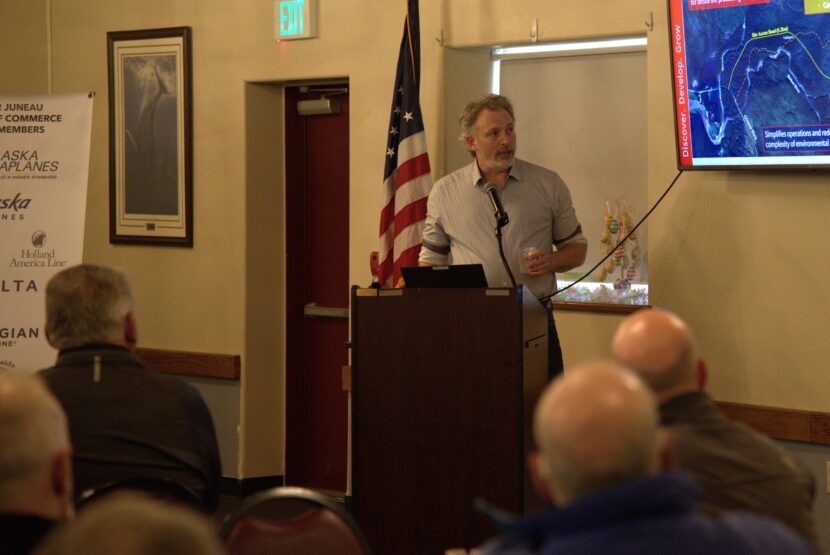
Graham Neale is the director of corporate and external communications for Grande Portage. At a Juneau Chamber of Commerce luncheon at the Moose Lodge on Thursday, he told dozens of local business representatives that a barge dock for the New Amalga mine isn’t tethered to the state’s proposed Cascade Point ferry terminal.
“It’s completely separate from (an) Alaska Marine Highway ferry terminal,” Neale said. “The economics of the mine don’t depend on a ferry terminal at all.”
The first phase of that ferry terminal project was originally slated for construction this summer, but was postponed when a federal agency asked the Alaska Department of Transportation and Public Facilities to submit design plans for the second phase, too. The proposed terminal has drawn widespread opposition from community members who’ve said it would benefit mining companies and inconvenience ferry passengers.
Neale said the only piece of shared infrastructure at the site would be an access road from the end of Glacier Highway to the barge dock.
“To access this facility, we would need a road,” he said. “So if, ultimately, you know, Department of Transportation Public Facilities doesn’t build a road, Grande Portage would look at doing it themselves.”
According to its preliminary economic assessment published this month, Grande Portage plans to haul truckloads of ore about 20 miles to the Cascade Point ore barge dock and ship it somewhere overseas for processing.
Neale said that would allow the mine to restrict its footprint in Juneau. Since the material would be shipped, he said there wouldn’t be processing facilities and tailings storage in town.
The company expects to run about 72 trucks from the mine to the ore barge dock per day. Neale said the company would hold off on trucking during warm weather weekends and holidays to limit traffic noise.
“Especially in the summer, on weekends, significant events, Fourth of July, grad weekend, something like that — when there’s going to be a lot of anticipated traffic on the road – get the trucks off there,” he said.
Grande Portage also plans to sort mined rock by crushing it and passing it under sensors that read elemental composition, instead of using chemicals.
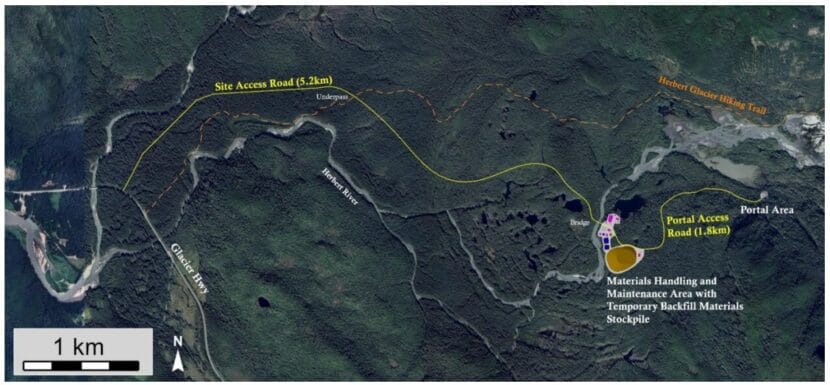
Mining operations would cut through forest and wetlands in a popular hiking area near the Herbert Glacier, Eagle Glacier and Windfall Lake trails.
The company is seeking approval from the state to build a 1.3 mile-long road between Herbert River and Eagle River this summer. Neale said this would be the first segment of road that would eventually intersect Herbert Glacier Trail, cross the Herbert River to a materials handling area and then extend to a portal with a tunnel to the mine site near the face of Herbert Glacier. According to press releases, Grande Portage is preparing to apply for fast federal permitting.
Neale said the mine will supply Juneau with an estimated 277 jobs.
At the luncheon, Juneau resident Drew Green said he’s involved in tourism and mining and that both are important for providing jobs and taxes that sustain the city’s economy.
“So I see this as a critical necessity for Juneau to survive,” Green said during the presentation. “This is a sustainability of Juneau project.”
The preliminary economic assessment projects an initial mine lifespan of seven years, with a total of 1.05 million ounces of gold. Neale said the company expects to turn a profit after about a year of production, based on an estimated gold value of $3,200 per ounce that’s highly subject to change.
Tyler Breen is an environmental policy analyst at Southeast Alaska Conservation Council. Following the luncheon, he said the development should get a hard look and that it’s important to protect other economic drivers in the area.
“Our concerns are, I mean, ultimately, impacts to watersheds — salmon, the cascading impacts that that has on related industries like tourism, like fisheries,” Breen said.
This year, Grande Portage plans to drill up to 14 holes to gather data for mine development, install meteorological and stream monitoring equipment and conduct baseline environmental surveys to support its permit applications.
