Last month, the Southeast Alaska Cities Against Drugs task force arrested a Juneau man and found nearly $160,000-worth of controlled substances at his residence – most of which was fentanyl.
Elsewhere in the region, SEACAD has seized pounds of methamphetamine in Ketchikan, Haines and Wrangell in the past few months.
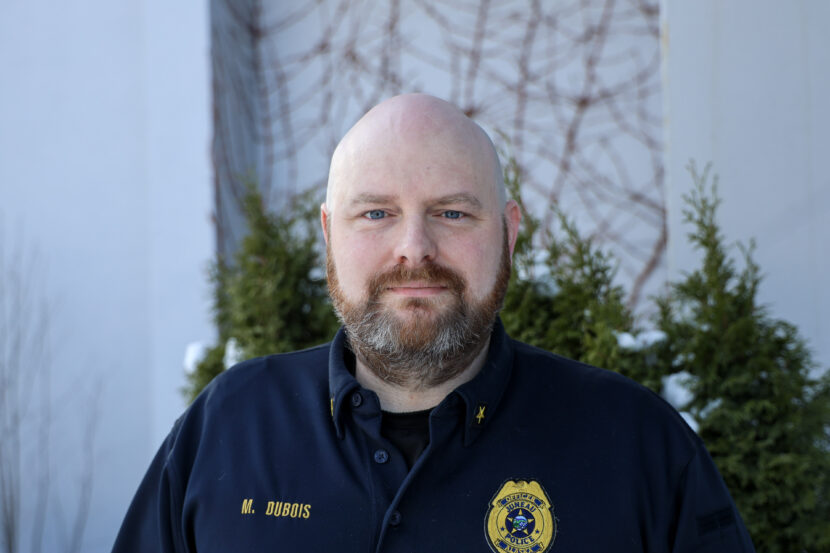
Juneau Police commander Matt DuBois oversees many aspects of the regional task force that investigates illegal drugs coming in and being distributed in Southeast Alaska.
SEACAD is one of a few regional task forces in Alaska that receives federal funding for things like intelligence sharing, coordination, technology and training for regional agencies to work together.
KTOO’s Mike Lane recently sat down with DuBois to learn more about SEACAD and the recent Juneau arrest.
Listen to part one of the interview here:
And to part two here:
The following transcript has been lightly edited for clarity.
Mike Lane: What is SEACAD?
Matt Dubois: So SEACAD is Southeast Alaska Cities Against Drugs. That’s what it stands for. We also have two other task forces in the regions up north, so Anchorage area and then the Fairbanks area. But as far as SEACAD down here in Southeast, our region goes from Yakutat down to Ketchikan, and so we’re responsible for that area for Southeast Alaska.
Mike Lane: SEACAD cooperates with other agencies and departments. What other agencies and departments are we talking about?
Matt Dubois: So with see SEACAD, the task force consists of municipal police departments throughout Southeast and then we have the Alaska State Troopers, the Federal Bureau of Investigation, Drug Enforcement Administration, U.S. Coast Guard, and additionally too, U.S. Border Patrol. And so it’s a federal and local and state law enforcement agencies that come together to do these missions.
Mike Lane: That’s a lot of people.
Matt Dubois: It can be, yes. It’s great because it’s the strength of working with all these agencies. All agencies have strengths to bring and different parts and information and resources. It’s makes us successful because it’s like, let’s say, you have a small town like Haines or Wrangell, for example. These smaller communities may not have the staffing to be able to put all the eggs in one basket for this thing. And so we come together to be more successful for our communities in the region.
Mike Lane: Recently, there was a JPD information release regarding the arrest of an individual in late February that led to the discovery of more than $150,000 worth of drugs and $100 grand in cash was seized as well. Is that considered a significant bust to you guys?
Matt Dubois: To me, I would consider that fairly significant – just the amount of the street value of the drugs and the amount of drugs that were seized, and then also the money that’s tied with it. I mean, that’s obviously not personal use. So that was drugs that were seized that I believe were intended to distribute within our community and with our outlying communities as well, possibly. And so, for me, that amount of drugs was significant because it took it off the streets where it wouldn’t be in the hands of other people.
Mike Lane: How does this bust compare to other busts that have happened in Juneau or throughout the region for SEACAD?
Matt Dubois: Well, our main mission is ultimately about protecting families in the community, the communities within our region, within Southeast. And drug trafficking brings violence, addiction and other crimes with it. And by targeting these networks early, we help keep Southeast Alaska safer. And SEACAD really focuses on identifying and disrupting those supply networks before they can do more harm in our communities. So typically, for the most part, you’re going to see larger quantities. These are quantities that are, again, not for personal use. Recently, in the last few months, SEACAD did an investigation where we seized, I believe, if my recollection is right, approximately four pounds of methamphetamine in Ketchikan. And then there was, I don’t remember the weights exactly, but there was a significant amount as it relates to the community of Wrangel.
When I stepped in, my goal for the team was like, let’s try to get a case in every one of these cities to help these communities. And that’s a strength of SEACAD, the task force, is when you bring together partnerships and sharing intel, we’re able to do more work in bigger cases that like one police department wouldn’t be able to do by themselves, especially now today, with like short staffing issues across law enforcement in the country. When we come together as a task force, we’re stronger in numbers, and we’re stronger when you share information, and that’s kind of a big strength of ours.
Mike Lane: I would imagine that the relationships between agencies and departments throughout the state and federally, is a huge benefit when it comes to sharing the information.
Matt Dubois: Absolutely. And everybody knows, for the most part, that really Southeast is accessible by boat or plane. And so our task force, they are moving throughout the region, dealing with those logistics and planning those logistics to time the investigation perfectly to be successful.
Mike Lane: It must take an incredible amount of patience when you’re doing these sorts of investigations, as well.
Matt Dubois: It does, very much so. Just generally speaking about investigations, it isn’t just something that we found out about yesterday. These are long, lots of time dedicated to investigate, to digest the intel, to put the pieces together and to make it a strong case and to make it a good case to present to prosecution.
Mike Lane: Do you see a specific trend of illegal drug activity throughout Juneau or Southeast Alaska? And have we been seeing a decline or an increase in drug activity?
Matt Dubois: Yeah. What we’re really seeing a lot of right now is methamphetamine and fentanyl, and it kind of fluctuates depending on timing and stuff and whatever the reasons may be, we’re still seeing fentanyl in the powder form. We’re still seeing it in counterfeit pill forms. But I think in the last couple months, I think it’s safe to say that we see more of an uptick in seizures of methamphetamine.
Mike Lane: These drugs, they’re coming into town in multiple avenues. But do we see one avenue more frequently than the other?
Matt Dubois: We know in Juneau how we all get our Amazon packages, right? And so that’s going to be the airlines. It’s going to be the mail, which are UPS or FedEx, but we know the airlines transport a lot of that stuff to get into our town. But then there’s also avenues, like the Alaska Marine Highway System. Also there’s the barge. Any way how we would normally receive goods here in town is basically how they’re being transported here. Because it’s the only way we can get goods here.
Mike Lane: Is there anything that community members, residents in Juneau or Ketchikan or throughout Southeast can do to help with the job that SEACAD does?
Matt Dubois: Yes. So we always want to remind people that community tips matter. When residents speak up and share concerns with their local departments, that information often helps us start or strengthen our investigations. You may not get feedback right away, because there could be an open investigation. It could be the piece of the puzzle that really paints the picture for us. And so anytime that anybody has any information, no matter how little or how big, we ask that you get a hold of us. And then also, here locally, we have Juneau Crime Line. That’s a nonprofit organization that takes anonymous tips and passes it on. You can also call the police department directly and talk to our drug enforcement unit, our SEACAD task force members. But, yeah, I mean, we asked for people to come forward with any information. They can remain anonymous, but it helps. And again, in partnership with our citizens, makes our communities safer places to live.
Mike Lane: Commander Matt Dubois, thank you for joining us today.
Matt Dubois: Thank you, sir.