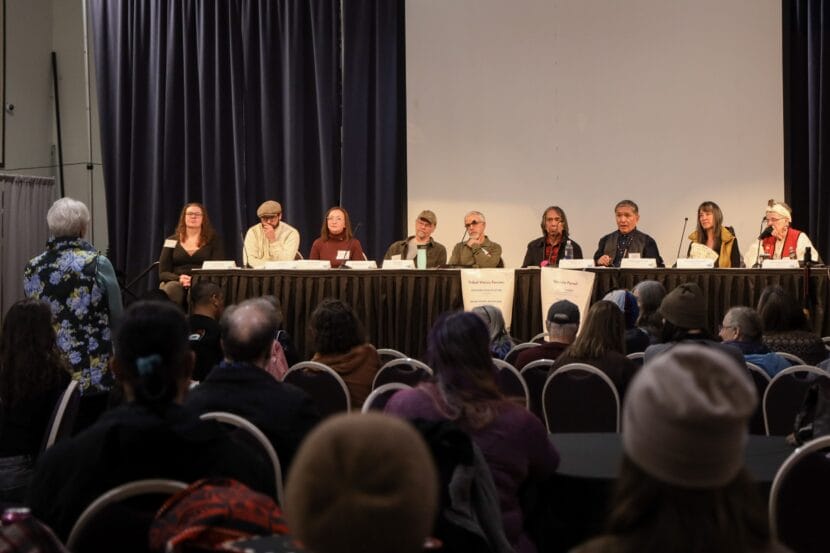
Tribal members spoke out against the state’s proposed Cascade Point Ferry Terminal in Juneau at a panel hosted by the Southeast Alaska Conservation Council on Wednesday.
The state’s plan for the first phase of the ferry terminal includes developing an access road and a construction staging area at the end of Glacier Highway on the south side of Berners Bay. It would be roughly 30 miles from the existing Auke Bay Ferry Terminal on land owned by Goldbelt Inc., an Alaska Native corporation.
At the panel, Lingít members said the land around Berners Bay is sacred and has gravesites and petroglyphs. A village site has been recorded there.
Áak’w Ḵwáan elder Seikoonie Fran Houston spoke about what the place means to Native people in the region.
“Not only is it sacred, but it’s been — it’s our way of life. We use that area for hunting, fishing,” she said.
A NOAA study in 2004 found 24 species of fish in Berners Bay. Some of the fish known to run there, including salmon, hooligan and herring, are culturally important to Lingít people.
Shaagunastaa Robert Sam is a caretaker of Native cemeteries in Southeast and has helped repatriate human remains. He said his ancestor, Kaawa.e’e, a leader of the Áak’w Ḵwáan who died in 1855, is buried there.
“I have dedicated my life to protect ancestors, sacred places,” he said. “I am willing to die. I will give my life to protect Berners Bay.”
The Alaska Department of Transportation and Public Facilities has been pushing for the new terminal for several years and has said it would benefit travelers in Southeast by reducing operating costs and travel time between Juneau, Haines and Skagway. The department plans to break ground this fall. Construction was initially planned to begin this summer.
Sonny Mauricio, a public information officer for the department, said in an email that “this adjustment accounts for the time required to navigate permitting and environmental review processes, and is subject to change up or down as we learn more about what the permit process will require.”
The department approved the construction contract before completing its highly criticized economic study or engaging in tribal government consultation.
Mauricio said that the department takes reports of ancestral graves and sensitive cultural sites seriously and plans to consult with the tribe.
“The permitting application, just filed, marks the beginning of the coming consultations,” he said in an email.
More than 90% of the public comments submitted to the state oppose the project. It stands to benefit the New Amalga gold mine proposed by Grande Portage Resources, a Canadian company, which plans to build an ore terminal alongside Cascade Point.
Kaasei Naomi Michalsen lives in Ketchikan, but said her ancestral home is in Berners Bay and she doesn’t want to see the area developed.
“I do not believe that a ferry terminal is going to be our legacy,” she said at the panel. “Our legacy is to protect that area so that we can tell our children and show our children who they are and where they come from.”
Since the land is owned by Goldbelt, some panel attendees suggested that Native shareholders could try to sway the corporation to pull out of the deal.
The Department of Transportation is currently working through the Clean Water Act permitting process with the U.S. Army Corps of Engineers. Mauricio said the department plans to hold public meetings in Skagway, Haines and Juneau at the end of March and into early April, and that dates will be announced soon.