Listen to this story:
The Arctic Winter Games begin March 8 in Whitehorse, Yukon, where middle and high school athletes from most circumpolar regions of the world will compete in a wide variety of sports.
At the start of Pioneer Road in North Douglas, half of Team Alaska’s snowshoers gathered for practice Thursday evening to run on the hard-packed snow.
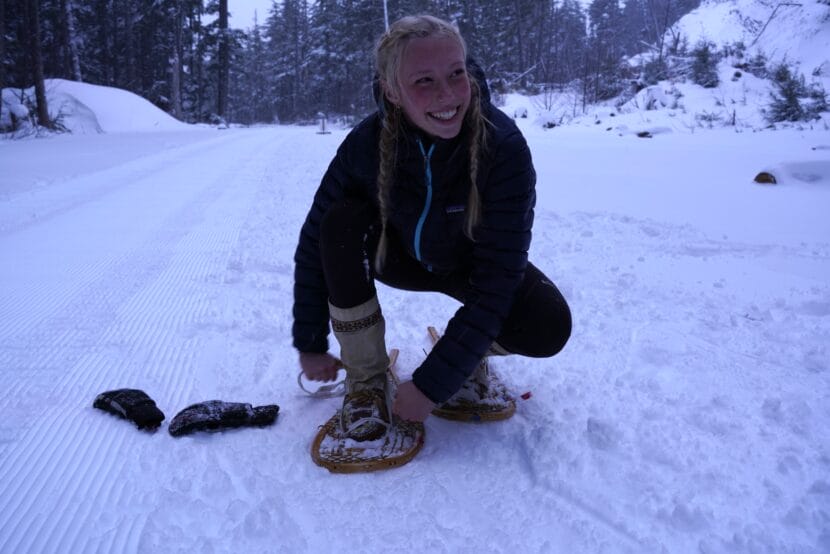
Sigrid Eller, a 15-year-old athlete, strapped on traditional racing snowshoes that have little in common with newer aluminum models. Traditional snowshoes have a wooden frame laced with webbing made of animal sinew. Eller tied them to her rawhide mukluks with a long string of oil lamp wick.
“You put around your heel on the back, cross it over your top of your foot, then you go under here,” she said as she fastened the lamp wick. She said half the battle is tying them on properly so they stay secure during the race.
These very snowshoes have been passed between generations of athletes, who treat them with wood varnish to make them last through Juneau’s wet winters.
Eller is one of four Juneau snowshoers representing Team Alaska in the 2026 Arctic Winter Games. The four will join 270 other young athletes from around the state. Juneau is sending a total of 29 athletes who will compete in hockey, basketball, alpine skiing, volleyball, figure skating, futsal and Arctic sports — those last two are a version of indoor soccer and a series of traditional games like the Alaskan high kick and the knuckle hop.
Eller competed at the games in Palmer two years ago. She said she’s excited to see some of her teammates experience the fun for the first time.
“There’s just so many kids there, and they’re all doing like this different, really cool Arctic sport,” she said. “It’s like just a lot of spirit and friendly competition — it’s really fun.”
Nine teams will compete in the games this year, representing Arctic regions in the U.S., Canada, Greenland and Scandinavia. Russia has been excluded since its 2022 invasion of Ukraine.
As the sun set and the wind whipped up, coaches timed the snowshoers as they ran 5 kilometers along the Nordic ski trail. Coach Merry Ellefson said form is key — the athletes want to keep the long pointed heels of the snowshoes on the ground.
“Generally, you develop some blisters underneath your feet,” Ellefson said. “So we want to get through those phases and give them a chance to really relax into their form, because it is different. Their adductors are gonna hurt. Just — they’re using different things when you don’t do a normal running form.”
Ellefson has been snowshoeing since the 1990s and has gone to several Arctic Winter Games. She can’t attend this year, but she said other coaches, Davya Flaharty and Finn Morley, are taking up the helm.
Ellefson said the most wonderful thing about the Arctic Winter Games is the camaraderie between the teams.
“Everyone comes in in their Team Alaska gear … By the closing ceremonies of the week, they’ve traded it all,” she said, bundled up in a puffy jacket emblazoned with the logo of Team Nunavut, representing Canada’s vast northern island archipelago. “It’s just this great sharing of who we are sort of manifested in what we wear. It doesn’t really matter — we’re still out here and we’re celebrating the North.”