
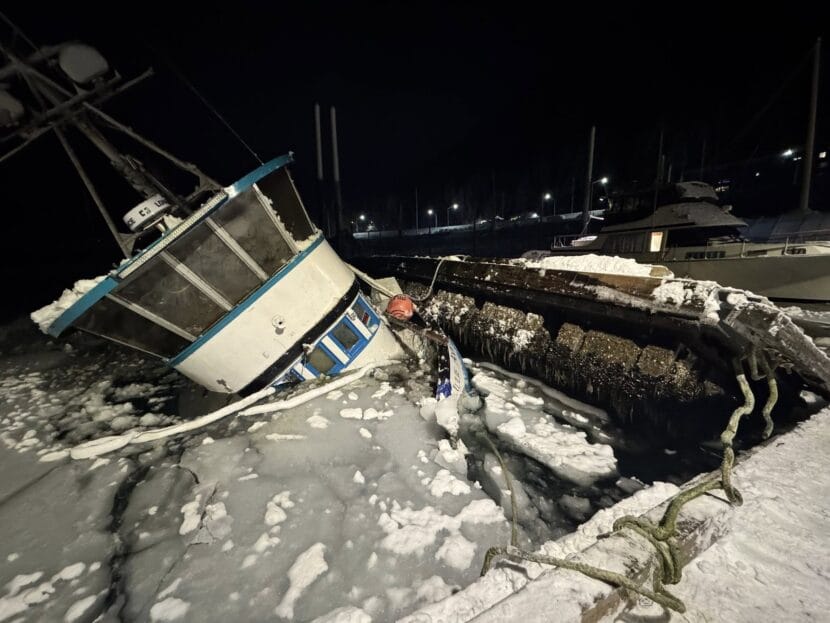
Ten boats sank in Juneau harbors during the intense winter storms that struck at the beginning of the year. The city is still dealing with the aftermath.
KTOO’s Mike Lane sat down with Juneau Harbormaster Matt Creswell to learn about the cleanup efforts, and what boat owners and community members can do to prevent other vessels from sinking.
Listen:
The following transcript has been lightly edited for clarity.
Matt Creswell: That big snow hit and things started happening. Docks and Harbors is really equipped and able to handle our normal snowfall, and our boats generally do well in the harbors and normal snowfalls. But this was, this was very large and way outside of what we’re used to dealing with.
In that late December storm, we ended up having 10 vessels completely sink. So there was a period there of very rough weather that caused us to continue to lose boats, and those boats that sank ranged from, you know, 20 feet, all the way up to a large 58 foot seine vessel. They were scattered kind of evenly throughout the four harbors — Statter, Aurora, Harris and Douglas. They were all different types of vessels, from commercial fishing vessels to pleasure craft to sail boats. And so we completely lost 10 vessels, and our best guess is we probably saved another three dozen that were in danger of imminent sinking, and that was just a result of our staff seeing it happen, jumping on board and shoveling off those boats, as well as our patrons down in the harbors, they would see things happening and jump into jump into action and start clearing snow. We would have had a lot bigger problem, if not for the amazing people that that have boats and are in and out of our harbor. So a huge thanks to every one of them that helped, helped us through this.
Mike Lane: And for the 10 boats that did sink, how do you deal with the environmental protection, the fuel spills and marine debris?
Matt Creswell: So that falls to the responsibility of the Coast Guard and DEC however, we’re great partners with them, and it’s we are the property owner, if you will. So we do have some responsibility in that as well, but ultimately, the owner is is responsible for mitigating the pollution, pollution threat and reporting. But we know that that may not always happen. A lot of times, especially in December, folks are out of town. There’s many things where people can’t respond immediately. We work great with the Coast Guard and DEC, so anytime a vessel sinks, whether there’s a sheen on the water or not, we go ahead we notify the National Response Center. They, in turn, notify our local Coast Guard sector and DEC. Investigators come on scene, we determine the the level of threat, level of visible pollution, and a decision is made from there. And if the owner is present, and the owner or responsible party, can can get to it and get the boat up, then that’s kind of end of story.
However, when the weather’s like it was — things were frozen in, we had boats that sank and then they were immediately iced in — it becomes a little more difficult to tell what the pollution threat is. But we treat every vessel as an active threat until we’ve decided that it’s not, or the Coast Guard DC have decided it’s not, and if there’s a if the vessel is insured, then that there’s generally pollution coverage on that, but sometimes there’s not, or we can’t get in touch with the owner and the Coast Guard works with us. Occasionally, those those vessels will get what we call federalized, they open the Oil Spill Liability Trust Fund to fund removing the pollution. And occasionally that means that divers go down and pump out the tanks underwater. Occasionally, it means that the Coast Guard, hires a contractor to come in and raise the vessel, and then they remove the pollutants off of it. So it’s a case-by-case basis. You’ve seen one sunken boat. You’ve seen only one sunken boat. Every one of them is different. There’s a different ownership story behind it, a different responsible party and different pollution threats. So we take everyone seriously until we know that the threat is mitigated.
Mike Lane: What can the public do to save their vessels and help alleviate the pressure from Docks and Harbors department?
Matt Creswell: Every boat that’s in the harbor needs, if the owner goes out of town, or the responsible party goes out of town, there needs to be a boat watch or somebody. Somebody that can take care of the boat, that can answer the phone and emergency contact, if you will. When things like this happen, we do a great job, we feel of getting word out when big storms are coming in, when snow loads are increasing, got a big following on Facebook. We have an SMS system. We rely on the National Weather Service. So we try to do everything we can to let people know that heavy weather is coming.
But ultimately, people just really need to take it seriously and come down, or have somebody come down and shovel these boats off. When we get these huge loads of snow, it doesn’t take long for them to to weigh the vessels down. And what we’re thinking maybe happened with a couple other boats is, it’s not only the snow weight. It’s when we get these really cold spells, like in December, when we drop below zero for a while, there was about, I think, eight or nine consecutive days of really cold temperatures. Things freeze in boats, and as we all know, when things freeze, they expand. Things crack. And if it’s super cold, then you might not get water intrusion at that point, but soon as it starts warming up and thawing a bit, then if you’ve had a cracked-through hull fitting or something like that, and that ice is gone, then then water comes into the vessel, and there you go. You got water in the boat, got another sunk boat. So it’s not only when the snow’s falling, it’s storm recovery, too, that things still need to be checked on.
