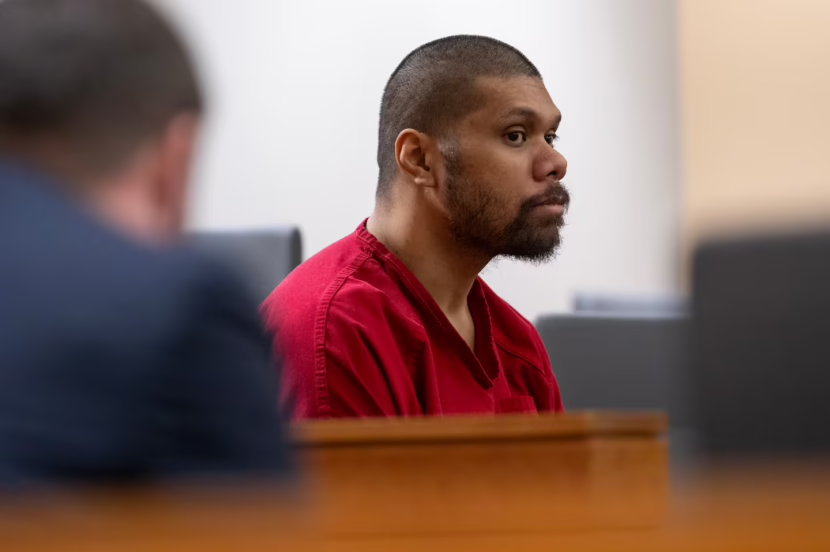
Lawrence Fenumiai, the 34-year-old Juneau man charged with killing his Anchorage jail cellmate in a December 2024 assault, will return to the criminal justice system after being found mentally competent to stand trial.
Both Fenumiai and his cellmate, 36-year-old William Farmer, were diagnosed with schizophrenia in their 20s. Their family members say the state should never have housed them together.
Less than 24 hours after Farmer entered custody, prosecutors say, the brief but violent assault occurred, leaving Farmer with a traumatic brain injury. He never regained consciousness and died at Providence Alaska Medical Center in January 2025.
Now the Alaska Department of Corrections needs to house Fenumiai again in a way that safeguards his mental state and protects others in custody with him.
Farmer’s twin sister, Robin Farmer, told the Daily News this week that her family does not want Fenumiai put through the trial process.
“What good would a guilty verdict do?” Farmer wrote in a message. “It would only put him back in the same environment and circumstances it happened in.”
Fenumiai was found incompetent to stand trial in this case three times: in February, May and August of last year, according to filings in the case.
He was found competent last month.
Fenumiai spent a total of 335 days in restoration programs at the Alaska Psychiatric Institute starting in February 2025, according to court filings.
The programs help prepare criminal defendants with mental illness to stand trial. In Alaska, a defendant must understand court processes enough to meaningfully assist in their defense. Otherwise, the charges against them are dismissed.
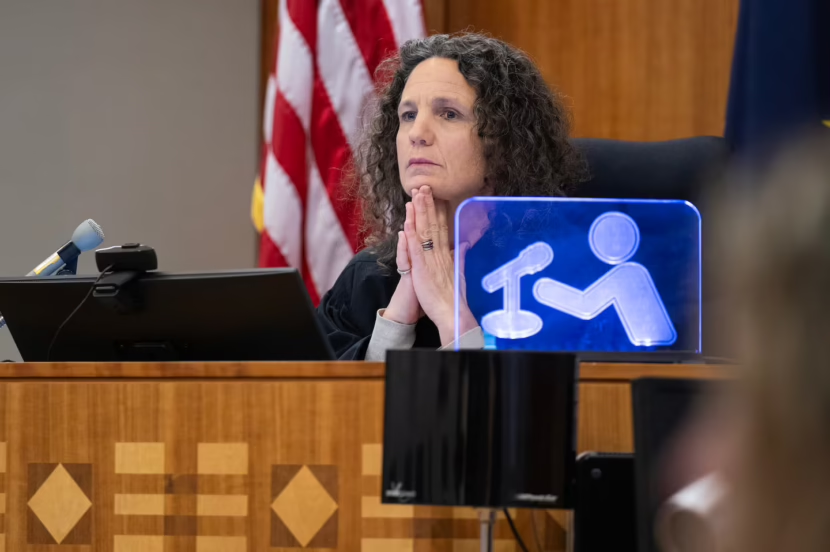
On Monday, Anchorage Superior Court Judge Josie Garton officially arraigned Fenumiai on the charges against him: first- and second-degree murder.
Fenumiai, wearing a hooded puffy coat over light blue hospital pants, attended the hearing, sitting quietly and without expression next to his attorney. A Court Services officer sat nearby.
Attorneys representing both the state and Fenumiai stressed the need for the Department of Corrections to provide safeguards as Fenumiai transitions back to jail.
Their concern is that Fenumiai could “decompensate” — become unstable or experience a sudden worsening of his symptoms — when he’s moved out of the familiar environment of API into the potentially overstimulating atmosphere at the jail.
“The state wants to be notified as soon as possible if there’s decompensation,” prosecutor Ashley McGraw said at a hearing last week, adding that prosecutors want the case to move along as quickly as possible to avoid future competency issues.
Fenumiai was supposed to be released from jail the week the fatal assault occurred in 2024. A judge had dismissed an assault case involving his father after finding Fenumiai incompetent to stand trial.
Instead, the former high school football standout was still in a general population intake unit with another man when Farmer came into their cell. Farmer was given a bed on the floor of the crowded unit in a cell intended for two people.
The incident raised questions as to how the Department of Corrections handles the challenge of housing people with diagnosed mental health disorders, who make up nearly a quarter of the state’s in-custody population.
Those questions are resurfacing now.
State corrections officials have “consistently failed” to keep people safe in custody, Robin Farmer said this week.
“They failed to keep William safe from harm, and failed to keep Mr. Fenumiai safe from causing harm. Why would anyone think they’ll do it now?” she wrote. “My family and I understand the complexities of a loved one living with mental illness, and although deeply saddened by the loss of William, believe the real criminal is the Department of Corrections and hold no personal hatred towards Mr. Fenumiai or his family.”
Fenumiai’s family declined to comment for this story.
The corrections department completed an internal review of the 2024 assault, according to spokesperson Betsy Holley.
“We are aware of comments made by Mr. Farmer’s family and understand their concerns regarding this situation,” Holley said in an email. “The Department of Corrections will not address allegations or ongoing matters in the media.”
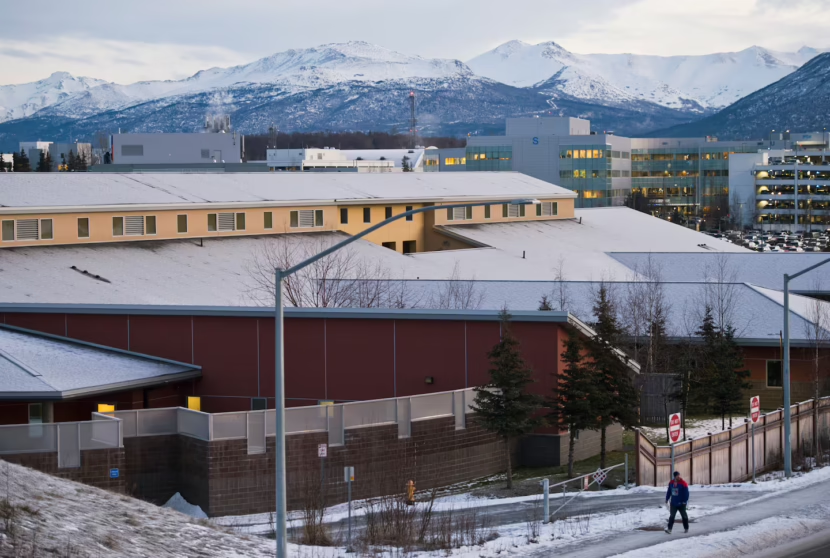
While at API, Fenumiai is voluntarily taking medications prescribed to him, attorneys said during last week’s hearing. He can stay at API through the end of this week.
Medical staff at the Anchorage Correctional Complex will reach out to API staff to coordinate a “warm handoff” when Fenumiai is transferred back to the jail, assistant attorney general Kevin Dilg said during last week’s hearing. That would mean API staff familiar to Fenumiai would be directly involved as jail staff take custody of him.
Fenumiai may be housed in one of the jail’s two designated mental health units, said Dilg, who is representing the corrections department in the case. But that will depend on Fenumiai’s evaluation by staff at the jail, he said.
“I can’t really say a whole lot” until Fenumiai arrives at the jail for intake and assessment, Dilg said.
Fenumiai’s legal team may pursue an insanity defense. Under Alaska law, an arraignment starts a 10-day window for attorneys to file an insanity defense notice.
David Biegel, one of Fenumiai’s attorneys, on Monday asked Garton for a 60-day extension, a request opposed by the state. Biegel said he needs time to not only talk with his client but make sure he understands what they’re discussing.
“Mr. Fenumiai has been charged with first-degree murder. That’s the most serious crime we have in this state,” Biegel said during Monday’s hearing. “I think we all share a concern of decompensation but I don’t think that is any basis to steamroll a decision.”
It’s also possible the case will resolve via plea agreement. McGraw, the prosecutor, said the state has an approved offer.
Garton extended the insanity plea filing deadline to Feb. 17, noting that “there is an interest in this particular case in ensuring that it moves expeditiously toward trial, if it’s not going to resolve in another way, just because of the risk of decompensation.”
This story was published by the Anchorage Daily News and is republished here with permission.