The City and Borough of Juneau is warning residents about urban avalanches a bit differently this year in an effort to help residents in the downtown avalanche zone understand how they should respond to the danger.
The city posted its new avalanche information webpage on Monday, the day before it issued an avalanche advisory for the Behrends neighborhood and Thane Road that remains in effect.
The Alaska Department of Transportation closed Thane Road Tuesday evening and observed several small avalanches in the area overnight. The department plans to fly helicopters over the area to trigger avalanches using explosives or a blast device called a DaisyBell on Thursday starting at 11 a.m.
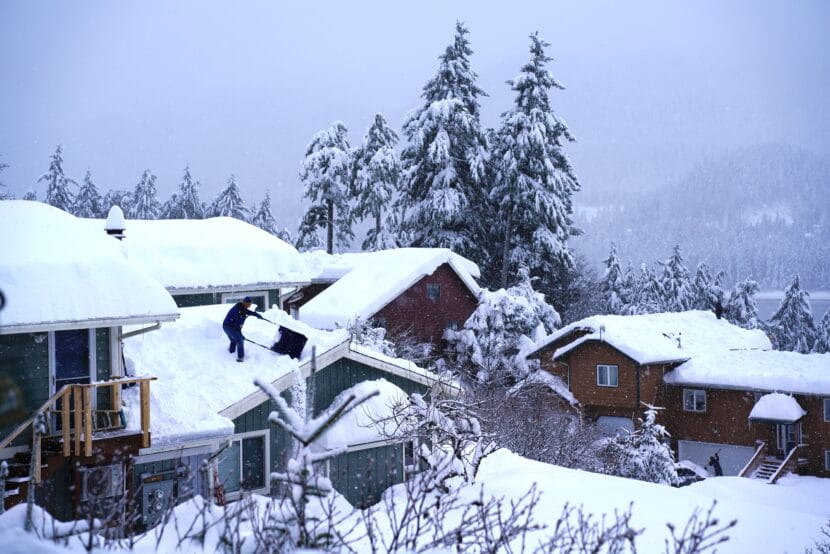
Juneau activated its new avalanche communications strategy as a winter storm dumped around four feet of snow on the capital city over roughly four days.
Nicole Ferrin, a warning coordination meteorologist for the National Weather Service in Juneau, said at a press briefing Wednesday that the winter storm brought new snow records with it.
“The depth was 50 inches of snow on the ground, which is the deepest snow depth ever recorded at the Juneau Airport,” she said, adding that the previous record for accumulated snow was 41 inches in February 1949.
Weather officials say more than 80 inches of snow has fallen at Juneau International Airport this December, making this the city’s second snowiest month ever recorded so far. The month-long record was set in February 1965 at 86.3 inches. For reference, Juneau averages around 88 inches of snow all winter.
City officials say they’ve changed messaging around avalanche danger to help people understand what to do.
The biggest change is that the city is no longer expressing avalanche danger on a scale from one — low — to five — extreme. Now, it’s using a “ready, set, go” system instead.
Ryan O’Shaughnessy is the emergency programs manager for the City and Borough of Juneau. He says the five-point scale was geared towards backcountry recreation like skiing and snowmobiling, and didn’t really tell residents living in an avalanche path how they should respond.
“There is not a recognized urban avalanche hazard scale that’s widely used and accepted by avalanche forecasters, and that’s largely because there are not many places in the United States that have the urban avalanche hazard that Juneau has,” he said.
The five-point scale included both the likelihood and size of an avalanche. Now, O’Shaugnessy says the focus is on the potential downhill impact.
“When we start seeing conditions developing that are trending towards a threat to life, safety or public infrastructure, that’s where we’re at an ‘elevated risk.’”
He says residents in hazard zones should always be ‘ready’ during a winter storm, meaning they should stay up-to-date with weather conditions. When the city issues an advisory saying there’s an elevated avalanche risk, they should get ‘set’ by packing a bag and preparing to stay with friends or family outside of the avalanche zone. An evacuation notice means ‘go’ immediately.
He says it’s too dangerous to trigger avalanches above the Behrends neighborhood, so leaving in the event of an evacuation notice is the best strategy.
The city is sending emergency alerts via cell phone notifications that residents can opt into. O’Shaughnessy urges people to sign up and says roughly 10% of Juneau’s population is on the list.
“That’s absolutely the best way to stay up to date on hazard awareness and any protective actions that may be required,” he said.
O’Shaughnessy said the city won’t rule out going door-to-door to warn residents, as it has in the past, but text alerts reach people faster.
The other change is that city staff are no longer evaluating snowpack in the field to issue an independent avalanche forecast. Instead, O’Shaughnessy said the city is relying on forecasts prepared by professionals at the Alaska Department of Transportation and the Coastal Alaska Avalanche Center.
The National Weather Service’s winter storm warning ended today at noon and snowfall is expected to taper off Thursday, but the avalanche danger remains.