When someone experiences sudden cardiac arrest in Juneau, the average response time for Capital City Fire/Rescue is 9 minutes.
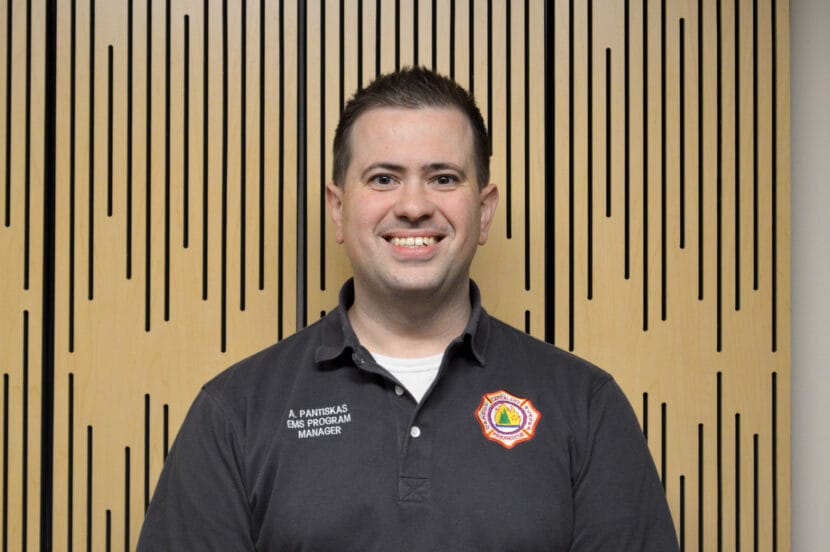
CCFR’s EMS Program Manager Andrew Pantiskas is leading an initiative – involving the help of Juneau community members and an app called PulsePoint – to make the response time faster.
KTOO’s Mike Lane spoke with Pantiskis about this life-saving effort.
Listen:
This interview has been edited for length and clarity.
Mike Lane: There’s an effort that you’ve been helping to lead to collect the contact information from people trained in cardiopulmonary resuscitation, or CPR, and to provide training opportunities. Tell me about that.
Andrew Pantiskas: Yeah, so we’re trying to get our cardiac arrest response to more of a community response. And what I mean by that is our average response time to a cardiac arrest when someone’s heart stops is 9 minutes across the board, and has been for the past over five to 10 years since we’ve been tracking our data. And what we’ve realized, and what most major cities down south have realized, is we need to get the community to the point that they can respond faster, start early compressions. Law enforcement agencies, military organizations, schools – the sooner we can have other trained responders start CPR, the better outcome we’re going to have for that person. Every 1 minute without good quality chest compressions is a 10% decrease in survival. And so you can kind of assume, if no one does chest compressions for about nine to 10 minutes, we’re not going to have a great outcome for that person. Now, that’s not a hard and fast definitive that it will be 100% mortality rate. It just means that the sooner we get compressions on board, the better chances we’re going to have of returning someone home to the community neurologically intact.
Mike Lane: There’s a particular tool out there called Pulse Point, and that’s an app for your phone. Correct?
Andrew Pantiskas: It is, yep.
Mike Lane: So can you tell me about this and why it would be helpful for folks who live here in Juneau?
Andrew Pantiskas: When we identify that someone might be in cardiac arrest, and our dispatchers start telling someone on the phone to start compressions, it basically pings everyone within a certain distance, whatever we set it to, and says, ‘Hey, this person here is in cardiac arrest. We need trained responders to respond. And here is your closest AED so that you can grab it on the way.’
Mike Lane: And that’s going to reduce the response time overall.
Andrew Pantiskas: Exactly.
Mike Lane: Now, PulsePoint is not an active app in Juneau yet, but is going to be in the near future.
Andrew Pantiskas: Yep, I don’t have an exact date. Our hope is that mid- to late-2026, we can do it. So there’s some things administratively we need to do. It’s got to be integrated into our dispatch system. What I can tell you is that CCFR is already adding in AEDs into our registry. If you do have an AED in a public location, your workplace, your religious gathering, your school, wherever it may be, and you don’t know if it’s entered, I would love it if you would send me an email. My email is andrew.pantiskas@juneau.gov. I would love to come out, photograph it and add it to our registry. That way, the day that PulsePoint is ready to go, we’ve already got them all in, and it will speed up the implementation of it.
Mike Lane: Excellent. And now what is the reaction from Juneau residents been towards CCFR’s efforts for this?
Andrew Pantiskas: So far, what I’ve heard is an overwhelming amount of support. This is going to drastically change how we manage our cardiac arrest. And I think that people realize that this is for their family, it’s for our community, it’s for the people who suffer out-of-hospital cardiac arrest, it’s for our friends and family.
Mike Lane: Now, do you have a goal for how many contacts you need or want in order for the app to be effective?
Andrew Pantiskas: To me, as long as we have one person who’s willing that could be their sooner, I see that as a win.
Mike Lane: Tell me about any of the training opportunities in Juneau for CPR.
Andrew Pantiskas: Absolutely. So there’s several agencies, and I apologize, I’m probably not going to list them all, but Tlingit and Haida does CPR classes. Bartlett Regional Hospital does CPR classes. We do CPR classes. While ours are mostly right now, tailored for individuals within or around CCFR, we do them. Southeast Extinguisher does them. And I know that there’s a couple others and I apologize I can’t name them off the top of my head that do them. The first thing I would do is, if anybody has any questions, email me. I can absolutely send you a list.
Mike Lane: Who can be a user of Pulse Point?
Andrew Pantiskas: Yeah, anybody can be a user. There’s differences in the types of responders, and we’ve not internally worked out who’s going to be a verified or unverified responder, and so on and so forth. But anyone can download the application. And so if anybody has questions on that, I would just go download it and start looking into what it does and how it does it. If you are like me or my family and travel down to Seattle or travel down somewhere else, and if you’re walking through Seattle–Tacoma International Airport airport, you might get a ping and say, ‘Oh, there’s someone in C gates who’s in cardiac arrest,’ and you could be the first person there. So if you have questions, just download it and start looking at it.