Listen here:
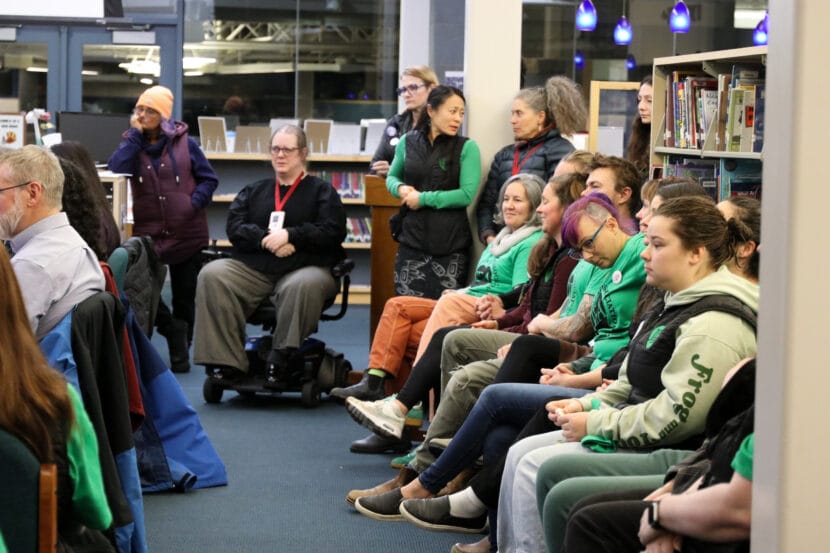
More than 70 educators and community members packed into the Thunder Mountain Middle School library last week during the Juneau School District School Board meeting.
During public testimony, teachers voiced their frustrations about contract negotiations.
“We’re now on the precipice of a true disaster. Dozens of your most experienced educators are waiting to see if they should stay or not,” teacher Amy Lloyd said.
Auke Bay Elementary teacher Kelley Harvey also spoke.
“It is not fair. It is not right, and you all have the power to solve this,” she said. “If you do not choose to respect your educators, this is what will happen.”
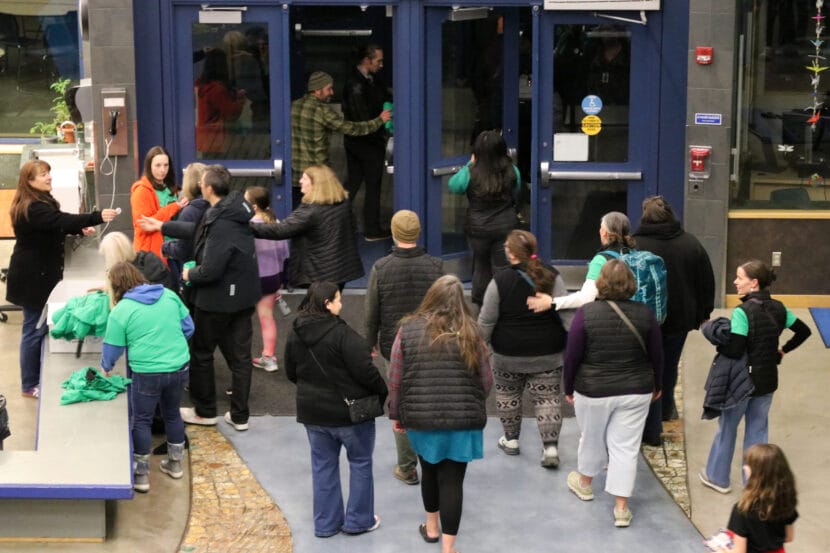
Harvey then stood up and began walking out of the library. A wave of more than 70 teachers silently followed in a mock walkout.
The teachers’ most recent contract ended at the end of June, but teachers are still working under its terms. The union and the district started negotiations for a new contract in February. Both parties declared an impasse in July and entered mediation, a voluntary process where a neutral third party facilitates discussions between both parties.
The parties had three mediation sessions before the mediator, a federal employee, was furloughed.
During the government shutdown, the district escalated the negotiation process and announced on its website earlier this month that it was initiating advisory arbitration with the union. During an advisory arbitration, a neutral third party evaluates both parties’ proposals and issues a recommendation on what to do.
Harvey, who also co-chairs the union’s negotiation support team, said the union was “completely blindsided” by the district’s announcement and that arbitration had not been discussed with the union prior.
“We do not feel that we’re at arbitration. We were still working with our mediator. They were furloughed, so we were forced to kind of stop, but we’ve been working,” she said. “We have a proposal.”
Harvey said in her 27 years with the district, she’s never seen the district move forward with arbitration without discussing it with the union.
In response to the district’s unilateral announcement, the union sent a letter saying it had not yet reached the point of arbitration.
In contract negotiations, the main sticking points for the teachers include salaries, health insurance and preparation time for middle school teachers, Harvey said.
The union’s latest proposal, which is for two years, increases salaries by 8% for the first year and 9% for the second year. It also increases the district’s monthly contribution to health insurance premiums by $25 for the first year and by another $271 for the second year.
In contrast, the district’s 1-year offer increases salaries by 3% and only includes a $10 increase to insurance contributions each month. It also cuts down how much time middle school teachers have to prepare lessons by 200 minutes each week.
The union is insured through the Public Employee Health Trust, and Harvey said insurance premiums have increased a lot for teachers, with some on family plans paying $800 more each month compared to last school year.
“Nationally, right, health insurance has gone up exponentially over the years, and contributions just have not kept up with that,” she said.
The district has increased its monthly contribution toward health insurance by $85 since 2016.
Juneau School District Superintendent Frank Hauser said the union’s latest proposal would cost the district about $12 million over the next two years, rather than the $1.84 million for one year with its previous offer. He said the district felt it has reached the right time to move forward with arbitration.
“We have spent almost 100 hours negotiating, and the time has come to schedule an advisory arbitration as required by Alaska statute and we’re ready to move forward again,” he said.
Hauser said arbitration is not a negative step and can help each side articulate what their position is.
“When negotiations is difficult, and it always is when the resources are limited, it frequently takes some kind of external deadline or external accountability,” Hauser said. “Otherwise we’d be negotiating forever to no effect.”
The district and union aren’t required to take the arbitrator’s recommendation, and Harvey, with the union, said it could open the door for the union to strike if they still can’t settle on a contract. But the union wants to avoid that “at all costs.”
The union and the district are scheduled to meet for another bargaining session Nov. 25.