Listen to this story:
Juneau’s avalanche forecasters are gearing up for winter. The state Department of Transportation and the local electric utility re-installed scientific instruments to help them predict avalanche risk at their largest research site in town.
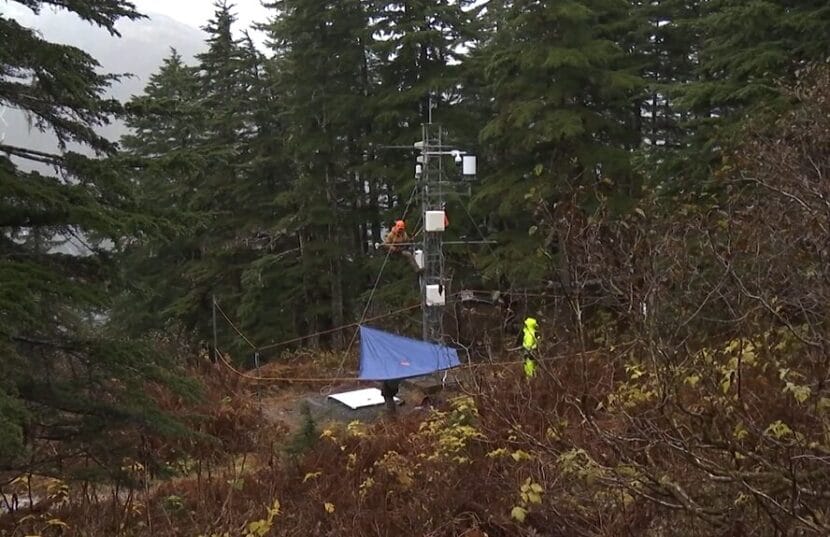
Last month, avalanche forecaster Mike Janes rode the Goldbelt Tram, pulled on a harness and climbed a metal weather tower on the north-facing slope of Mount Roberts in the pouring rain.
“It gives us a baseline,” Janes said about the research site. “Here’s what the snowpack at this elevation in a sheltered area is doing.”
Janes works at Alaska Electric Light & Power. He sets up sensors that will help predict the threat of avalanches once Juneau’s famous rain turns to snow.
Mount Roberts and Mount Juneau loom over downtown. The steep slopes are marked by avalanches and landslides; their history is written in vertical chutes and tree rings. Avalanches are frequent in Juneau, but only a few have been disastrous.
In 1962, an avalanche hit dozens of homes in the Behrends Neighborhood downtown. In 2008, a massive avalanche took out AEL&P’s main power line to Juneau, forcing the city to rely on diesel generators for two months. Since then, the utility has built barriers to protect its energy infrastructure from future slides.
Janes said avalanches occur when a weak, unstable layer of snow forms, causing the layers of snow that accumulate on top to slide off. The instruments he installs on Mount Roberts will help him understand when that weak layer forms and where in the snowpack it is.
Watch a video about avalanche forecasting in Juneau:
First, Janes attached a snow height sensor to a pole about 15 feet up the tower. It sends down sound waves, which bounce off the snow and back to the sensor, measuring the snowpack’s height.
Then, he hung a string vertically from the tower that has nodes spaced 10 centimeters apart. That measures the various temperatures throughout layers of snow.
Next, Janes pointed to an instrument sticking off the side of the weather tower.
“That right up there — probably one of our most important instruments — that white cylinder with the black top,” he said. “That’s a heated tipping bucket, and that measures precipitation.”
It’s heated to melt snow, so forecasters can measure how much water is in the snowpack. Two more are lodged down the slope to measure water that’s melting beneath the snowpack.
Then he pointed to a small double-cylinder sensor called a net radiation meter.
“That particular sensor is important for understanding when we’re getting weak layers forming at the surface that are going to become problems later,” he said.
Earth gives off heat called long-wave radiation, which travels up through the snow and air and gets reflected back down to Earth by clouds that act as a thermal blanket. But on a clear night, that heat escapes into the atmosphere and can cause the top layer of snow to cool quickly, creating a sugar-like surface.
“If that stuff gets buried, then it becomes like a future weak layer that avalanches can run on,” Janes said.
This year, AEL&P, the Alaska Department of Transportation and other agencies will feed all of this data, and more, into a Swiss snowpack model.
Patrick Dryer is an avalanche and geohazard specialist at DOT. He said using the Swiss model could help Alaskans better predict how layers of snow are forming at high elevations.
“That’s especially relevant in Alaska, where we have limited high elevation monitoring sites, but we have miles of roadway that we’re forecasting for,” Dryer said.
He said using the emerging technology can help them make more informed decisions. Those decisions include things like setting off explosives to trigger avalanches before they become destructive, or putting barriers up to protect infrastructure in areas where avalanches happen frequently.
But Dryer said there’s a lot of variability between where they collect data and all of the places where avalanches can occur. Plus, snow dynamics change, so no prediction is perfect.
Learn more about the history of avalanches in Juneau with KTOO’s series, Alaska’s Avalanche Capital.